On November 14, Morgan Stanley's latest research report showed that,$Taiwan Semiconductor Manufacturing (TSM) $It may be planned to increase the production capacity of an additional 20,000 pieces/month of 3nm wafers beyond existing expectations. The bank initially expected TSMC's 3nm production capacity in 2026 to be approximately 140,000-150,000 pieces/month, but the latest information indicates that this figure may be revised up to 160,000-170,000 pieces/month.
This trend follows Nvidia CEO Jensen Huang's recent high-profile visit to the company. During the visit, Jensen Huang publicly stated that Nvidia's business is "very strong" and has requested more chip supplies from TSMC.
If the expansion plan is implemented, it will have a direct impact on TSMC's capital expenditures. It is estimated that the new capacity will require additional capital expenditures of approximately US $5 billion to US $7 billion, which may push TSMC's total capital expenditures in 2026 from the current forecast of approximately US $43 billion to a range of US $48 billion to US $50 billion. This potential spending increase is seen by the market as a positive catalyst for the global semiconductor equipment industry.
This move not only reflects the continued boom in AI demand, but also further confirms that the main contradiction in the current AI supply chain has shifted from back-end packaging to front-end manufacturing. The report clearly points out that CoWoS advanced packaging is no longer the biggest constraint. The real shortage lies in TSMC's front-end wafer production capacity and key materials such as ABF carrier boards.
As customers such as Nvidia, AMD, and Alchip rush to place orders, TSMC's 3nm production capacity is becoming increasingly tight. The report pointed out that the industry generally believed that TSMC hoped to maintain the full utilization rate of its advanced process capacity, so it was cautious about expanding production. However, its 3nm capacity plans may have changed following requests from major AI customers such as Nvidia.
According to TSMC management at the performance meeting, all newly built clean room space in Taiwan will be used for the expansion of the 2nm process. This means that the expansion of 3nm production needs to be carried out within the existing fabs. To solve the space problem, Morgan Stanley's latest survey shows that TSMC may consider moving its 22/28 nanometer equipment located in the Fab15 fab and reserving these equipment for future European factories, thereby providing new 3nm production lines. Free up valuable clean room space.
According to the prediction model of the bank,This adjustment will increase TSMC's total 3nm production capacity in 2026 from the original estimate of 140,000-150,000 pieces/month to 160,000-170,000 pieces/month.
1. Strategy structure
Investors inTaiwan Semiconductor Manufacturing (TSMC)Create aBear Call Spread Bear Call Spread, consisting of two call options with the same expiration date:
Sell Lower Strike Call: K ₁ = 287.5, premium Revenue $0.77
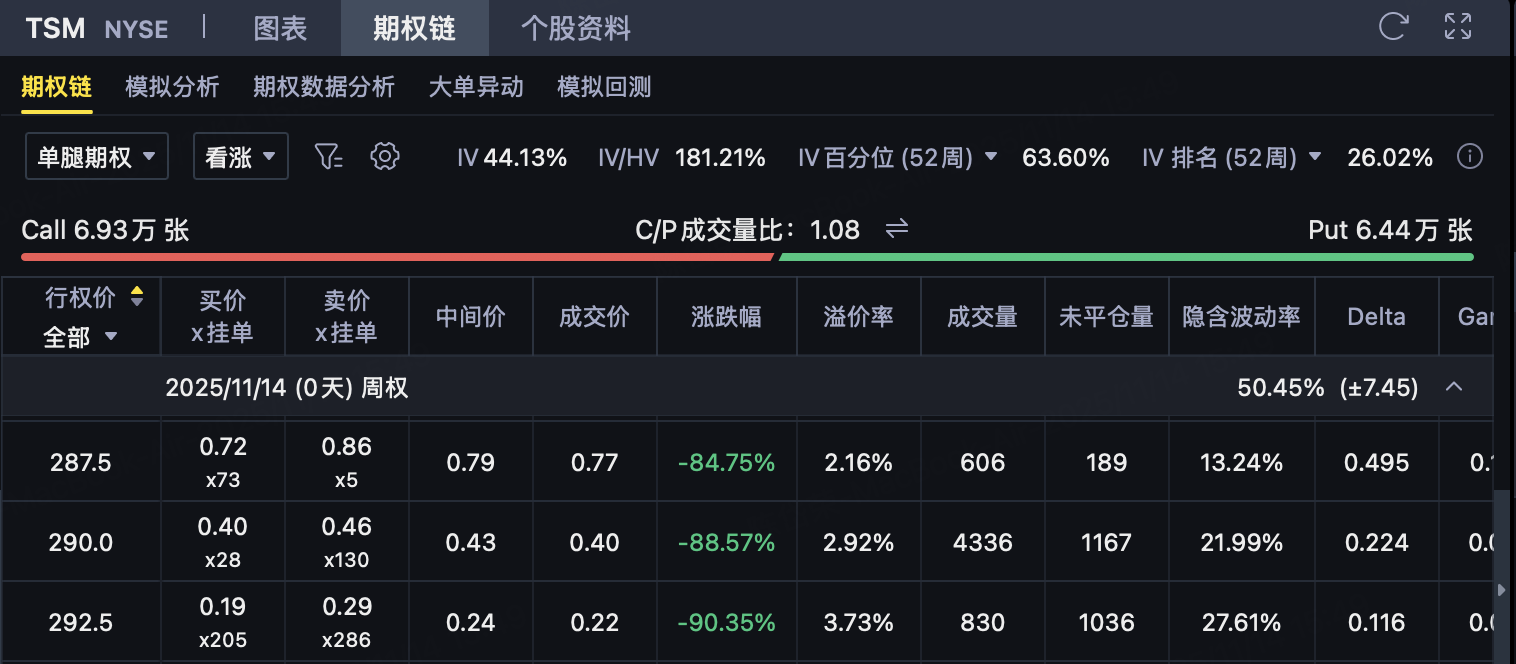
Buy higher strike price Call: K ₂ = 300, premium spends $0.06
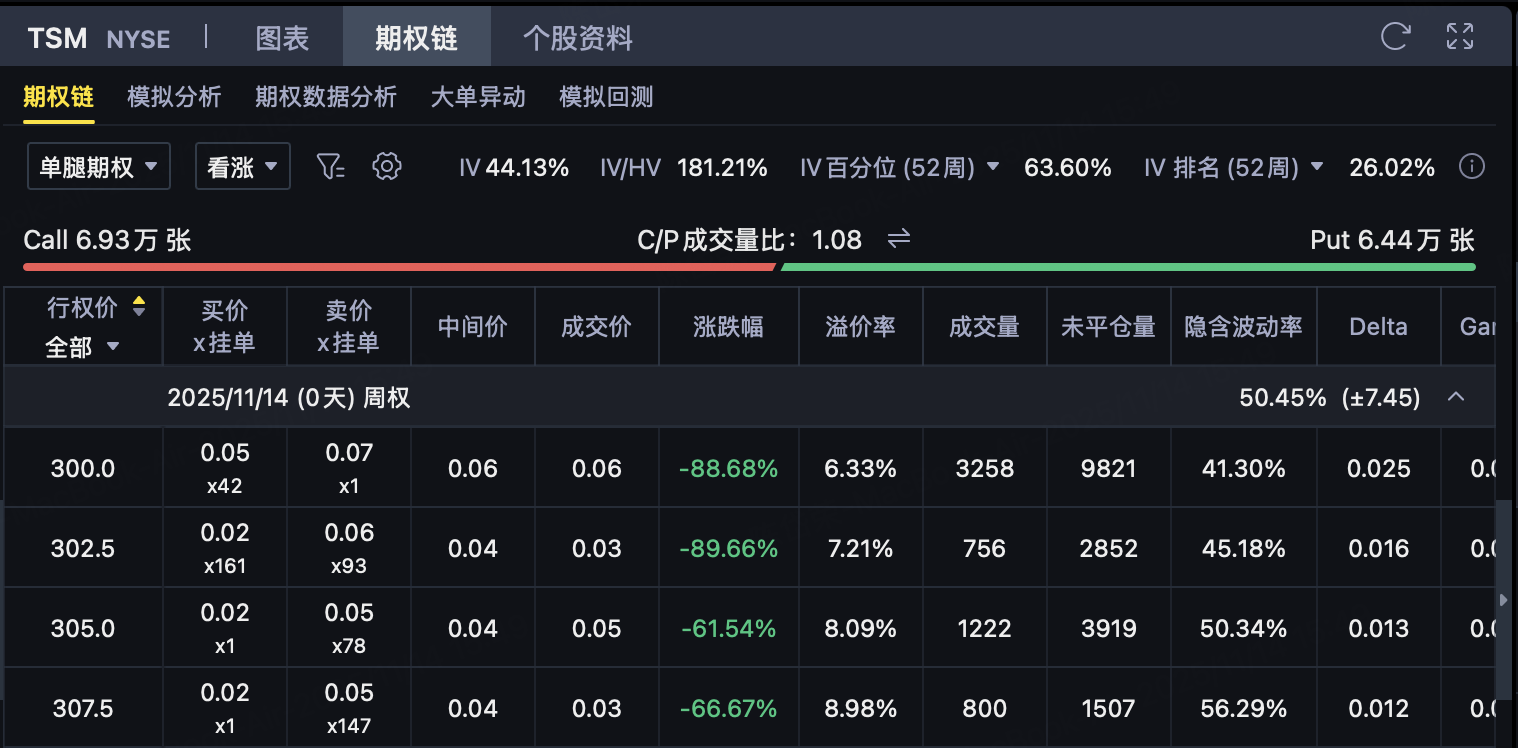
Investors limit risk by selling lower strike price Call and buying higher strike price Call while earning net premium income.
The strategy is inTSMC stock holds at or below $287.5When obtaining maximum benefits, it belongs toBearish bias, limited risk, limited benefitsOf option portfolio.
Initial net income
Net premium revenue = revenue from selling Call − expense from buying Call = 0.77 − 0.06 =$0.71/Share
Corresponding to total revenue:0.71 × 100 = $71/contract
This amount is when the investor opens a positionMaximum potential profit。
3. Maximum profit
If TSMC's stock price expires≤ USD 287.5, neither call option will be exercised, and investors retain all net premium.
Maximum profit =$0.71/Share
Corresponding total profit =$71/contract
4. Maximum loss
If TSMC's stock price expires≥ $300, both Calls were exercised, and investors suffered the maximum spread loss.
Spread width = 300 − 287. 5 =$12.5
Maximum Loss = Spread − Net Income = 12.5 − 0.71 =$11.79/Share
Corresponding to total loss:11.79 × 100 = $1179/contract
5. Break-even point
Breakeven point = lower strike price + net income = 287.5 + 0.71 =USD 288.21
Hence:
When TSMC price≤ US $288.21When investors make a profit;
When TSMC price> $288.21When investors start losing money.
6. Risk and return characteristics
Maximum gain: $71/contract
Maximum loss: $1179/contract
Profit/loss ratio: approximately 1: 16.6
Applicable scenario: Investors expect TSMC prices to fall or remain below $287.5
Strategic Positioning: Bearish Strategy with Limited Risks and Limited Benefits
Engage and Win Options Rewards!
Share your thoughts on options trading or the market in the comments below.
10 lucky participants will each receive a free copy of the Options Handbook!
Already have one, you’ll get a USD 5 Options Voucher instead!
The Options Handbook takes you from the fundamentals to advanced strategies, helping you gradually build your own trading system. You’ll also gain insights from 10 top traders, and learn how to avoid common options trading pitfalls — making your decisions clearer.
💬 Don’t miss out, drop your thoughts and win your reward!
Comments