$Taiwan Semiconductor Manufacturing (TSM) $On November 20, the stock price closed at $282.37, up 1.60% in a single day, and the intraday amplitude was 2.96%. The technical aspect showed a trend of breaking through the previous high.
After the U.S. stock market closed yesterday, NVIDIA reported that its revenue for the third quarter of fiscal year 2025 (usually ending October 26, 2025) was about$57 billion, an increase of about 22% from the previous quarter and an increase of about 62% from the same period last year. Third quarter net profit was approximately$31.91 billion, diluted earnings per share approximately$1.30。 The company has strong guidance for the next quarter, the fourth quarter of the fiscal year: it expects revenue to be about$65 billion(± 2%), gross profit margin of approximately 74.8%-75% (± 0.5 percentage points), etc.
After the financial report was announced, the company's stock price rose in after-hours trading, which the market saw as a signal of "large-scale expansion of AI infrastructure." Many analysts said that this financial report weakened market concerns about an "AI bubble" and believed that NVIDIA is still in the midst of artificial intelligence demandEarly stage。
As a core supplier of AI propellers and many cloud service providers and data center customers, NVIDIA's strong performance is regarded asAI infrastructure wave continues to expandVerification of. This also provides confidence for related industrial chains (including GPU manufacturing, data center hardware, and AI software platforms).
Bull Put Spread
1. Strategy structure
Investors Build A on TSMC StockBull Put Spread Bull Put Spread, consisting of two put options with the same expiration date:
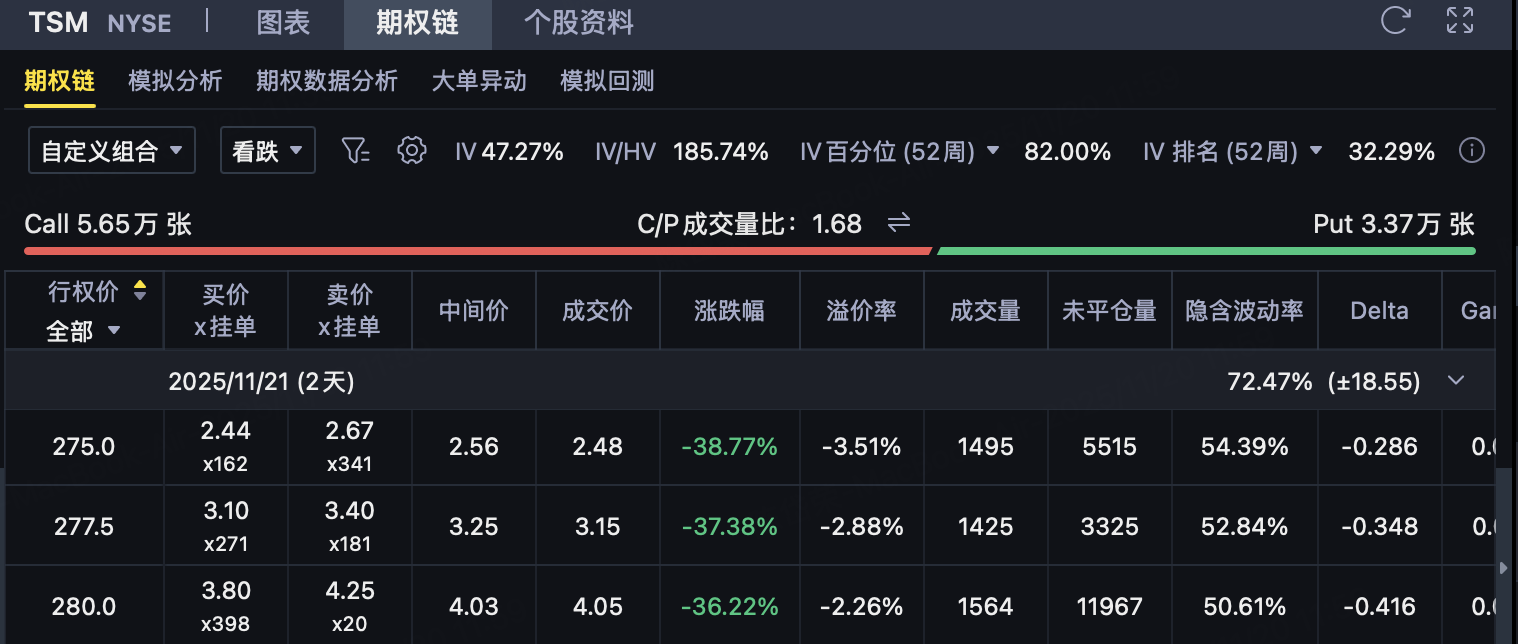
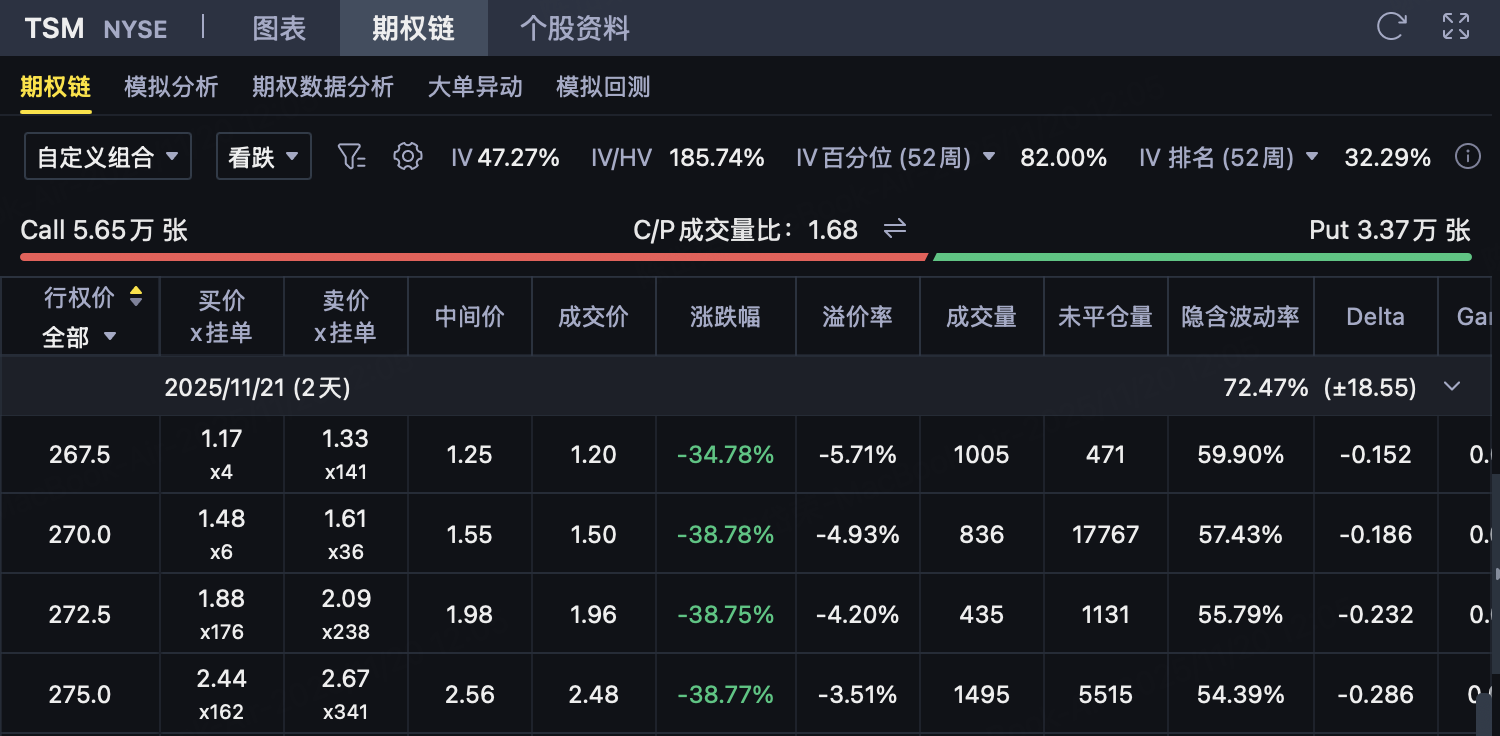
Sell higher strike price Put: K ₂ = 275, collect premium 2.48
Buy Lower Strike Put: K ₁ = 267.5, Pay premium 1.20
The combination belongs toBe bullish (or expect the price to remain above a certain range)The credit strategy has limited maximum returns and limited maximum losses.
When TSMC's stock price is at expirationMaintain at $275 or higher, investors can achieve maximum profits.
Initial net income
The net premium obtained by investors when opening a position is:
Net income = sell 275 P income − buy 267.5 P expense = 2.48 − 1.20 =$1.28/share
If 1 mouth = 100 shares, then:
Total revenue = 1.28 × 100 =$128/contract
This is strategicMaximum potential benefits, is locked when the position is opened.
This is the strategyMaximum potential benefits, is locked when the position is opened.
3. Maximum profit
When TSMC Expires Price≥ $275At that time, both Put options are out-of-the-money options, and the investor retains all net income.
Maximum profit =$1.28/share
Total maximum profit
= $128/contract
4. Maximum loss
If TSMC price expires≤ $267.5, both Put shares are in-the-money, the spread is completely triggered, and investors suffer the biggest loss.
Strike spread = 275 − 267. 5 =$7.5
Maximum Loss = Strike Spread − Net Income = 7.5 − 1.28 =$6.22/share
Total maximum loss = 6.22 × 100 =$622/contract
This situation corresponds to a significant decline in TSMC.
5. Break-even point
The breakeven point formula for the put spread is:
Breakeven = Higher Strike Price − Net Income = 275 − 1.28 =$273.72
Hence:
If due TSMC ≥$273.72→ Investors profit
If due TSMC <$273.72→ The strategy starts to lose money
The break-even point shows that investors have a certain price buffer, and even if TSMC falls to 273.72 yuan, it will still not lose money.
6. Risk and return characteristics
Maximum gain: $128/contract
Maximum loss: $622/contract
Profit/loss ratio approximately: 1: 4.86
Strategy applicable scenario: Investors expect TSMC prices to remain around $275 or higher, or at least not fall below the break-even point
Strategy attributes: long, credit strategy, limited returns, limited risks
Engage and Win Options Rewards!
Share your thoughts on options trading or the market in the comments below.
10 lucky participants will each receive a free copy of the Options Handbook!
Already have one, you’ll get a USD 5 Options Voucher instead!
The Options Handbook takes you from the fundamentals to advanced strategies, helping you gradually build your own trading system. You’ll also gain insights from 10 top traders, and learn how to avoid common options trading pitfalls — making your decisions clearer.
💬 Don’t miss out, drop your thoughts and win your reward!
Comments