On December 1, 2025, BOJ Governor Kazuo Ueda sent the strongest signal to date in a public speech: the central bank will "weigh the pros and cons of rate hike" at its monetary policy meeting on December 18-19, suggesting that it is likely to raise interest rates.
Investors reacted quickly-pricing in rate hike expectations surged. According to market data, the Japanese 2-year Treasury Bond yield climbed rapidly to more than 1%, and the 10-year JGB yield rose to about 1.87%, a new high level since 2008. Meanwhile, the yen strengthened against the dollar-market demand for the yen rose as investors expected Japan to return to higher interest rates.
With the expectation of rate hike landing, the Japanese Treasury Bond market quickly suffered a sell-off. Short-term, medium-and long-term Treasury Bond yields both rose, while bond prices fell-especially short-term bonds with high interest rate sensitivity, which were particularly volatile. On the other hand, the appreciation of the yen has become another core of this round of market drastic changes-exchange rate-sensitive assets, Japanese export companies that rely on yen financing or face foreign exchange risks or global capital flow paths will be reconstructed.
Not limited to Japan-BOJ's hawkish signal quickly triggered a chain reaction in the global bond market. Bond yields in many countries rose simultaneously, including the yield of 10-year Treasury Bond in the United States.
Although the market's expectations for the BOJ rate hike in December are heating up, the actual actions have not yet been fulfilled-the final meeting results will determine the follow-up trend. If the BOJ is delayed or less than expected, the market may "overshoot and rebound".
Bull Put Spread
$20 + + Years US Treasury Bond ETF-iShares (TLT) $By holding U.S. Treasury Bond with a maturity period of more than 20 years, investors can indirectly invest in long-term Treasury Bond. The price of TLT is mainly affected by changes in interest rates. When interest rates fall, the price rises and when interest rates rise, the price falls. Therefore, it is often used as a fixed income investment or interest rate risk hedging tool.
1. Strategy structure
Investors establish a bull Put spread on the target underlying (TLT), which consists of two Put options with the same expiration date:
Sell a higher strike price Put: K ₂ = 88.5, US stock premium revenue is US $0.26
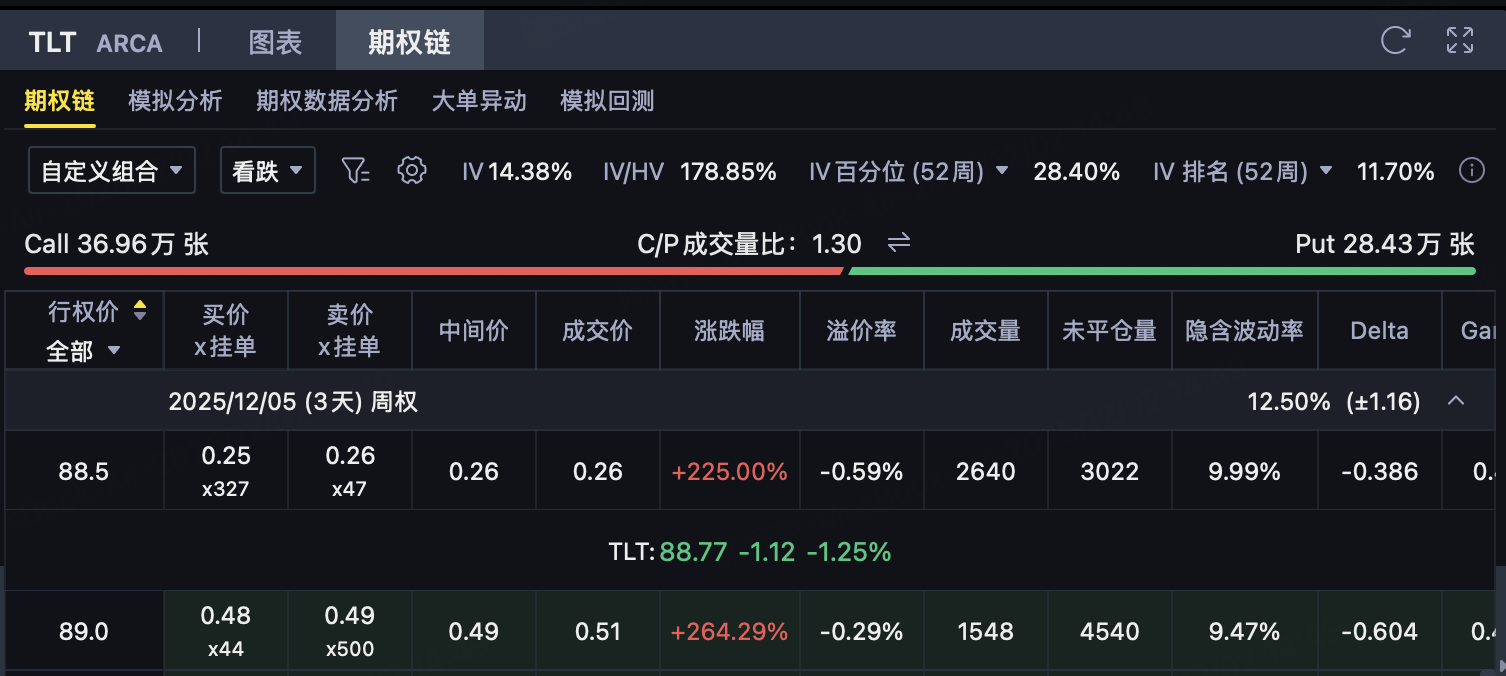
Buy lower strike price Put: K ₁ = 87, US stock premium spend $0.03
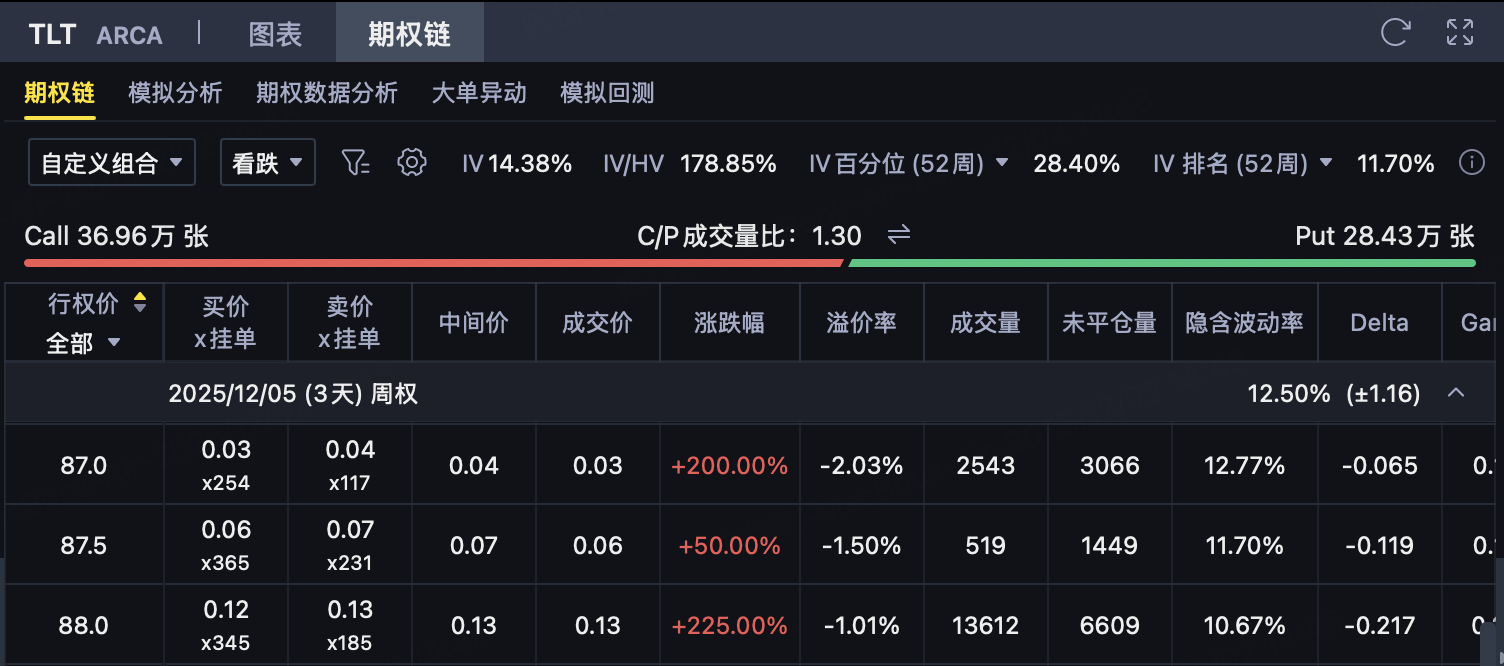
The strategy belongs toCredit type, moreCombination of. Investors expect TLT not to fall below $88.5 at expiration, the higher the better, thereby retaining a net premium.
Initial net income
Net premium (per share)
= 0.26 − 0.03
= $0.23/share
1 mouth = 100 strands, therefore:
Total revenue
= 0.23 × 100
= $23/contract
This is locked when opening a positionMaximum potential profit。
3. Maximum profit
When the TLT maturity price is ≥ $88.5, both Put shares are out-of-the-money, and all premium income is retained by investors.
Maximum profit
= $23/contract
4. Maximum loss
When the TLT expiration price is ≤ $87, both Put shares are in-the-money and the spread is fully triggered, but the investor still retains the net income.
Strike spread
= 88.5 − 87
= $1.5/share
Maximum loss (per share)
= 1.5 − 0.23
= $1.27/share
Total maximum loss
= 1.27 × 100
= $127/contract
5. Break-even point
Break-even point
= K ₂ − Net income
= 88.5 − 0.23
= $88.27
Maturity judgment rules:
≥ $88. 27 → Earnings
≤ US $88.27 → Loss
6. Risk and return characteristics
Maximum gain: $23/contract (limited)
Maximum loss: $127/contract (limited)
Profit-loss ratio: 1: 5.52 (bear 127 losses for 23 gains)
Applicable scenario: Investors expect TLT to trade sideways or rise slightly before expiration, but not to fall below the support range near $88.27
Comments