On Thursday, Eastern Time, the three major U.S. stock indexes closed mixed, with the S&P 500 Index and the Dow Jones Industrial Average hitting record closing highs. The more tech-weighted Nasdaq underperformed as Oracle's earnings report cast doubts on investors' artificial intelligence (AI) investing prospects. As of the close, the Dow rose 646.26 points, or 1.34%, to 48,704.01 points; The Nasdaq fell 60.30 points, or 0.25%, to 23,593.86 points; The S&P 500 rose 14.31 points, or 0.21%, to 6,900.99 points.
Most large technology stocks fell. Google A closed down 2.43%, Nvidia fell 1.55%, Tesla fell 1.01%, Amazon fell 0.65%, Apple fell 0.27%, Meta rose 0.4%, and Microsoft rose 1.03%.
Oracle's stock price plummeted 10.8%. The company's quarterly performance guidance fell short of analysts' expectations, and it warned that annual capital expenditures would be $15 billion higher than previously planned. The market is worried that its heavy bet on the AI cloud business is "burning money" too much, and it is also concerned about AI. Concerns about a possible bubble are heating up again.
Looking ahead to the market outlook, the market focus turns to the upcoming non-farm payrolls report, which will provide more clues for the Federal Reserve's monetary policy. Some analysts pointed out that if the theme of AI investment ebbs, other sectors are expected to take over.
1. Strategy structure
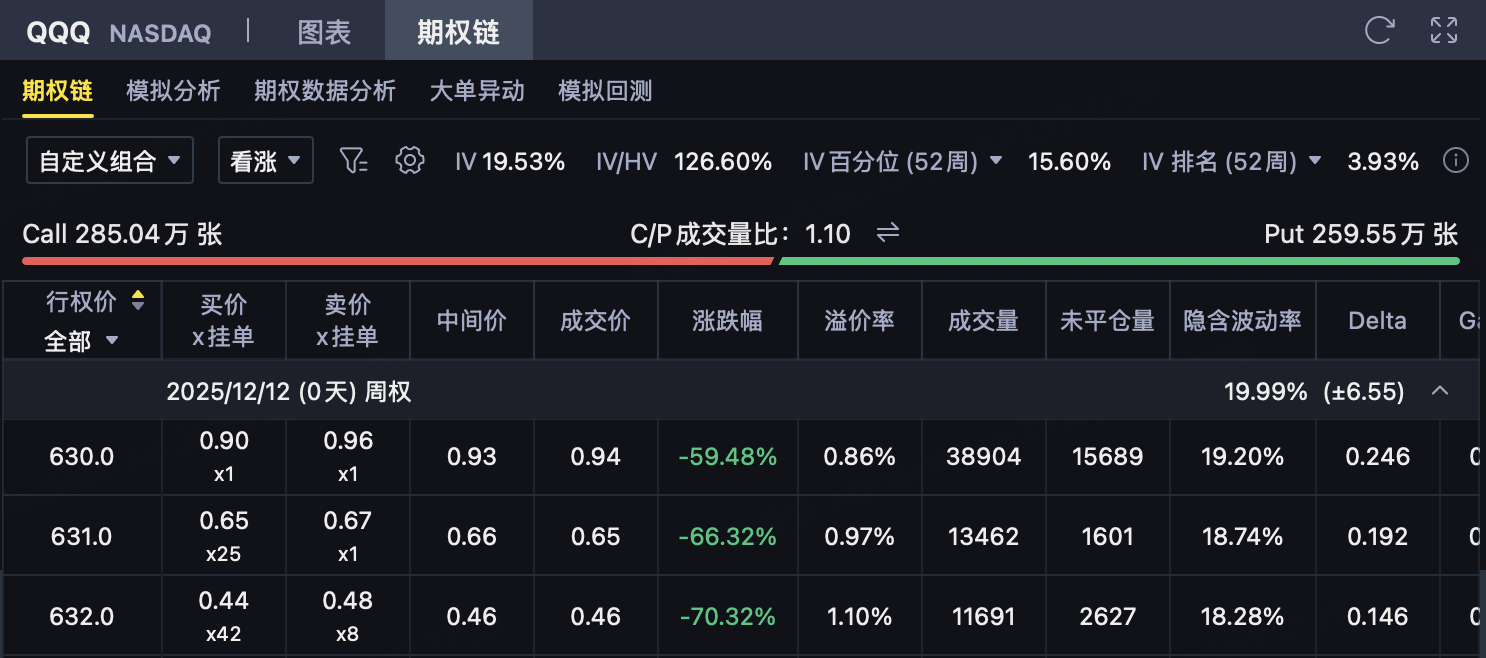
Investors in $Invesco QQQ(QQQ)$ Create aBear Call Spread, consisting of two Call options with the same expiration date:
Sell Lower Strike Call: K ₁ = 630, premium Revenue $0.94
Buy higher strike price Call: K ₂ = 635, premium spends $0.13
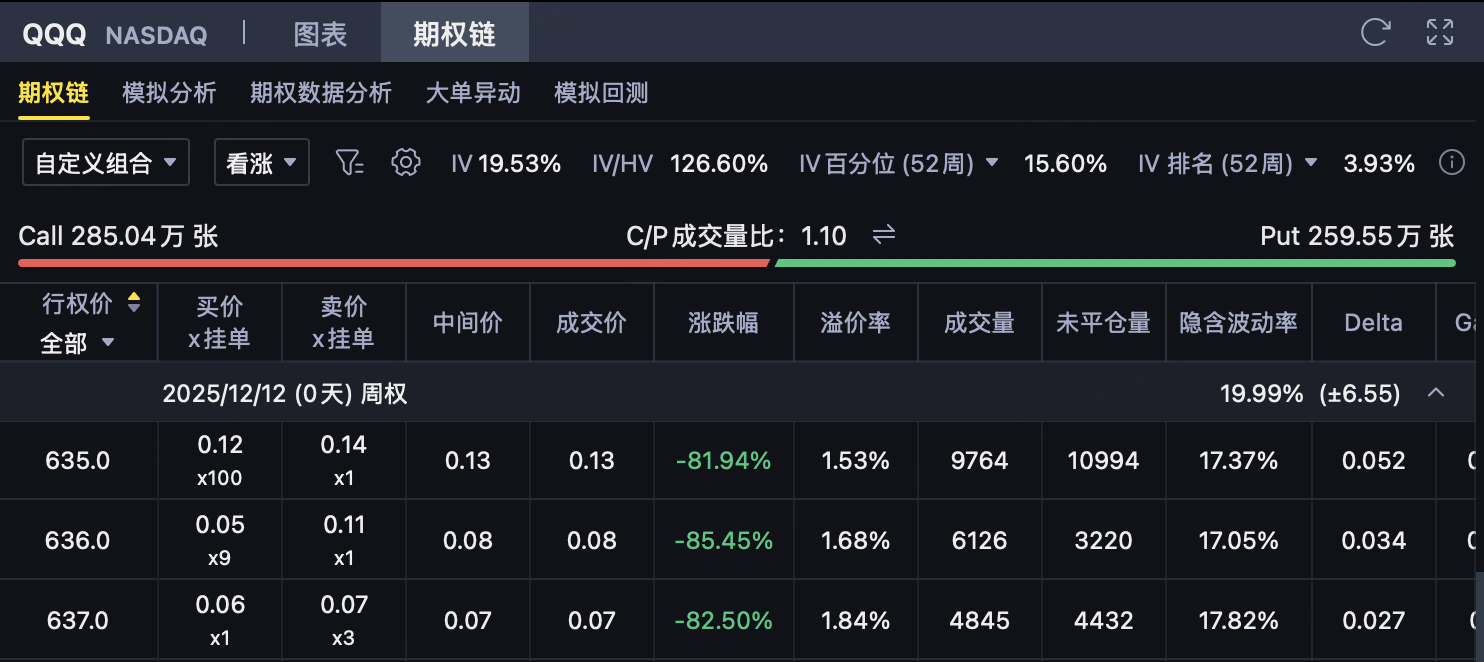
The strategy belongs toCharge premium, bearishThe spread combination. Investors expect QQQ at maturityDown or stay below lower strike price (630); Looking to obtain time value gains in a limited risk manner.
Initial net income
Net premium (per share)
= 0.94 − 0.13
= $0.81/share
1 mouth = 100 strands, therefore:
Total net income
= 0.81 × 100
= $81/contract
This is what investors get when they open positionsMaximum potential profit。
3. Maximum profit
When the QQQ expiration price is ≤ US $630, both Calls are out of the price, and the price difference is all returned to zero:
Strike spread
= 635 − 630
= $5/share
Maximum profit (per share)
= Net premium received
= $0.81/share
Total maximum profit
= 0.81 × 100
= $81/contract
4. Maximum loss
The maximum loss occurs when the spread is fully triggered, that is, when the QQQ expiration price is ≥ $635:
Maximum loss
= Strike spread − Net income
= 5 − 0.81
= $4.19/share
= $419/contract
Happens at:
When the QQQ expiration price is ≥ 635 USD, both Calls are in-the-money, and the full price difference incurs a loss.
5. Break-even point
Break-even point
= K ₁ + Net income
= 630 + 0.81
= $630.81
Maturity judgment rules:
≤ $630.81 → Investor Earnings
= $630.81 → Flat
≥ $630.81 → Investor losses
6. Risk and return characteristics
Maximum gain: $81/contract (limited)
Maximum loss: $419/contract (limited)
Profit-loss ratio: gain: loss = 81: 419 ≈ 1: 5.17
Applicable scenario: Investors expect QQQ before expiration dateStay below 630 or fall slightly, hoping to collect time value by selling Call, while using a higher strike price Call to limit potential risks.
Comments