Shares of $Nvidia(NVDA)$ rose nearly 2% on Wednesday to close at $178.68, as investors continue to focus on supply-demand dynamics for AI accelerators and capital spending guidance from cloud providers. The stock currently trades at a trailing twelve-month P/E of 36.5x and a price-to-sales ratio of 20x, both relatively elevated. Any slowdown in AI-related capex by hyperscalers, intensifying competition from rivals and custom chips, or disruptions in advanced packaging supply could weigh on the shares.
Options Market Analysis
1. Implied Volatility (IV) and Market Sentiment
Nvidia’s options implied volatility stands at 39.46%, with an IV percentile of just 17.93%, indicating a relatively low level by historical standards. This suggests that expectations for future price swings remain subdued, and options are comparatively inexpensive.
Meanwhile, the put/call volume ratio is 1.12, pointing to a slight bias toward bearish positioning in the near term, though sentiment is not at extreme levels.
2. Open Interest (OI) Concentration and Signals
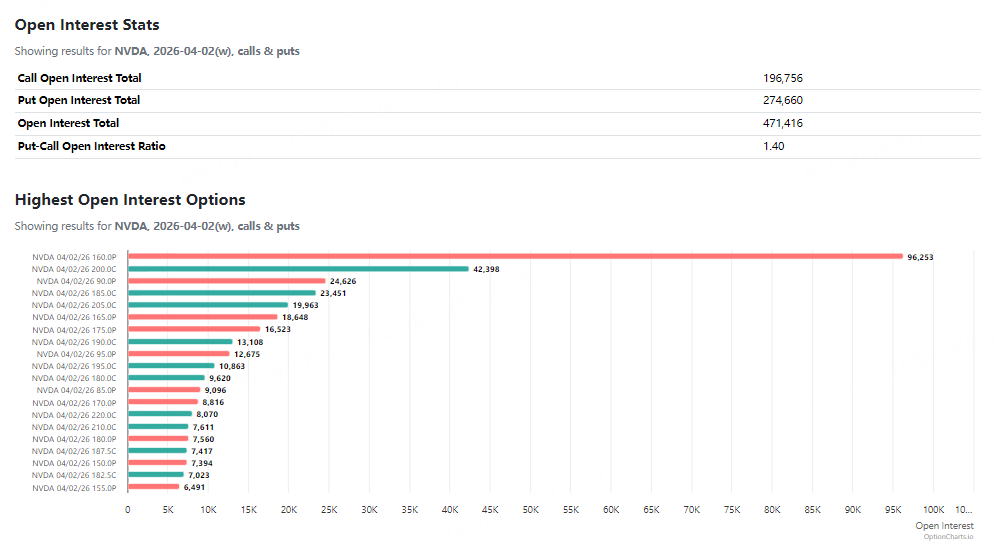
Open interest data highlights a notable concentration: for contracts expiring April 2, put options at the $160 strike have accumulated as many as 96,253 contracts—far exceeding any other single line.
Overall, near-term call open interest totals 196,756 contracts, compared with 274,660 puts, resulting in a put/call OI ratio of 1.4.
3. Institutional Block Trades: Diverging Long-Term Strategies
Recent block trades show institutional activity concentrated in longer-dated contracts spanning several months to two years, with a predominance of put transactions but clear divergence in directional views:
Bear put spread positioning:
One notable trade involved selling 7,000 deep out-of-the-money $150 puts expiring March 2027, while simultaneously buying $230 puts with the same maturity. The strategy has a breakeven around $185, and would profit if Nvidia shares fall below that level by expiration.Source: Tiger Trade App
Selling out-of-the-money calls:
Multiple large trades involved selling calls across both near- and long-dated maturities, including $190 and $185 strikes. These positions target out-of-the-money options and reflect a typical premium-selling strategy, where traders collect time decay while maintaining a margin of safety.Source: Tiger Trade App
Source: Tiger Trade App
Source: Tiger Trade App
Summary and Strategy Takeaways
Overall, Nvidia’s options market reflects a complex setup under a low-volatility regime. Near-term positioning highlights a strong defensive line around the $160 level, while longer-dated trades reveal notable divergence in institutional views on the stock’s trajectory.
For investors favoring premium-selling strategies, out-of-the-money options—such as puts below $160 or calls above $190—may appear to carry a relatively low probability of being breached. However, to better manage margin exposure and cap potential losses, spread strategies (such as bear put spreads or bull call spreads) may be preferable to outright short positions.
Disclaimer: Options trading involves significant risk. The above analysis is for informational purposes only and does not constitute investment advice. Investors should fully understand the characteristics of options and make decisions based on their own risk tolerance.
Comments