


Before United Health's financial report, how to use options to easily make money and control risk
$UnitedHealth (UNH) $Set to announce its third-quarter financial results on Oct. 28, investors are watching closely after a tough year for the health insurance giant.
Wall Street expects UnitedHealth's third-quarter revenue to be about $113.04 billion and earnings per share to be close to $2.82, implying revenue growth of about 12% and earnings per share decline of 61% year-over-year. Analysts will focus on Medicare Advantage margins, medical loss rates, Optum Health results, and any management comments on the DOJ investigation or guidance.
UnitedHealthcare Business: Growth and Cost Pressures Coexist
Membership and revenue are still growing steadily, but Medicare Advantage membership growth has slowed down significantly-the full-year target has been lowered from 800,000 to 650,000. The medical loss rate (MLR) was as high as 89.4% in the second quarter, reflecting the double pressure of the greater than expected medical utilization rate and the reduction of federal subsidies. The market is concerned about whether MLR improves in the third quarter, and whether the effect of AI in claims settlement and cost control can alleviate the decline in profit margins.
Optum Health Medical Services: Profitability Repair Is Key
Profit margins dropped significantly in the second quarter, mainly due to increased medical activities, subsidy reductions and the impact of the transformation of the V28 model. In the third quarter, the company stabilized its business by slowing down expansion and strengthening the integration and standardization of medical facilities. Investors will pay attention to whether Optum Health's revenue stabilizes and losses narrow.
Optum Rx vs. Optum Insight: Stable Earnings Pillar
Optum Rx (Pharmacy Benefits Management) continues to perform strongly and is expected to maintain double-digit revenue growth, which is expected to partially hedge the cost pressure of insurance business. However, the implementation of Trump's "most-favored-nation price" policy and the price reduction agreement of pharmaceutical companies may weaken profit margins. Optum Insight (data and technology) is expected to continue to provide stable revenue.
Management Outlook and Confidence Repair
After the company withdrew its full-year guidance in the second quarter, the market expects the third quarter to provide the prospect of earnings trends in 2025 and a return to growth in 2026. Focus on management's strategies for healthcare cost trends, premium and product adjustments, cost control progress, and regulatory risks such as the Department of Justice investigation.
UnitedHealth's stock price performance over past earnings seasons
UnitedHealth's current implied change is ± 6. 4%, indicating that the options market has bet on its single-day rise and fall of 6.4% after its performance; In comparison, its post-performance stock price change in the first four quarters was about 6.5%.
The options market has overestimated UNH's post-earnings stock price volatility 33% of the time in the last 12 quarters. On average, the market expects the post-earnings stock price change to be ± 3. 9%, while the actual average change (absolute value) is 6.1%. This suggests that UNH's post-earnings stock price volatility tends to be higher than the options market expects.
The post-earnings performance of UnitedHealth in the last six times is +5.2%, +6.5%,-8.1%,-6.0%,-22.4%,-7.5%.
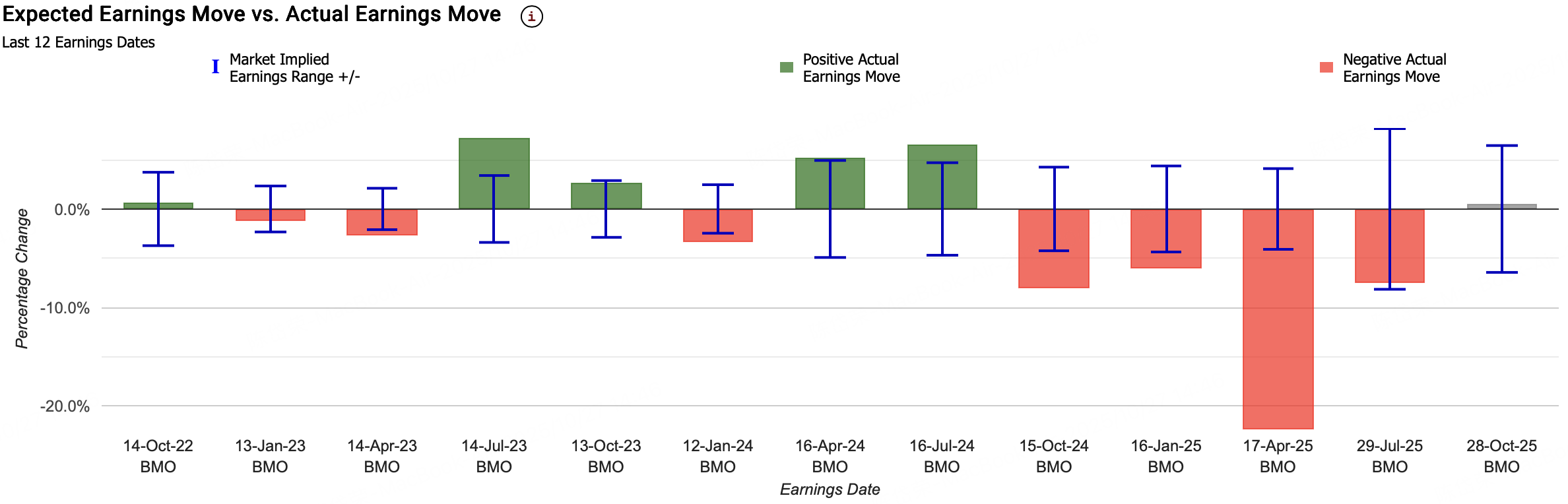
In response to this UnitedHealth performance release event, we can adopt a bull market bearish spread strategy.
Bull Put Spread
The bull put spread is aOptions Strategy, suitable for investors to expect the underlying stock before expirationStay high or rise moderatelyWhen used. The core of the strategy is to passSell High Strike Put, whileBuy Low Strike PutTo achieve return and risk control.
Initial cost vs. net premium
Investors sell 327.5 put options to earn $1.76/share, and buy 317.5 put options to pay $0.91/share.
Cost of selling options: 1.76 × 100 shares = $176
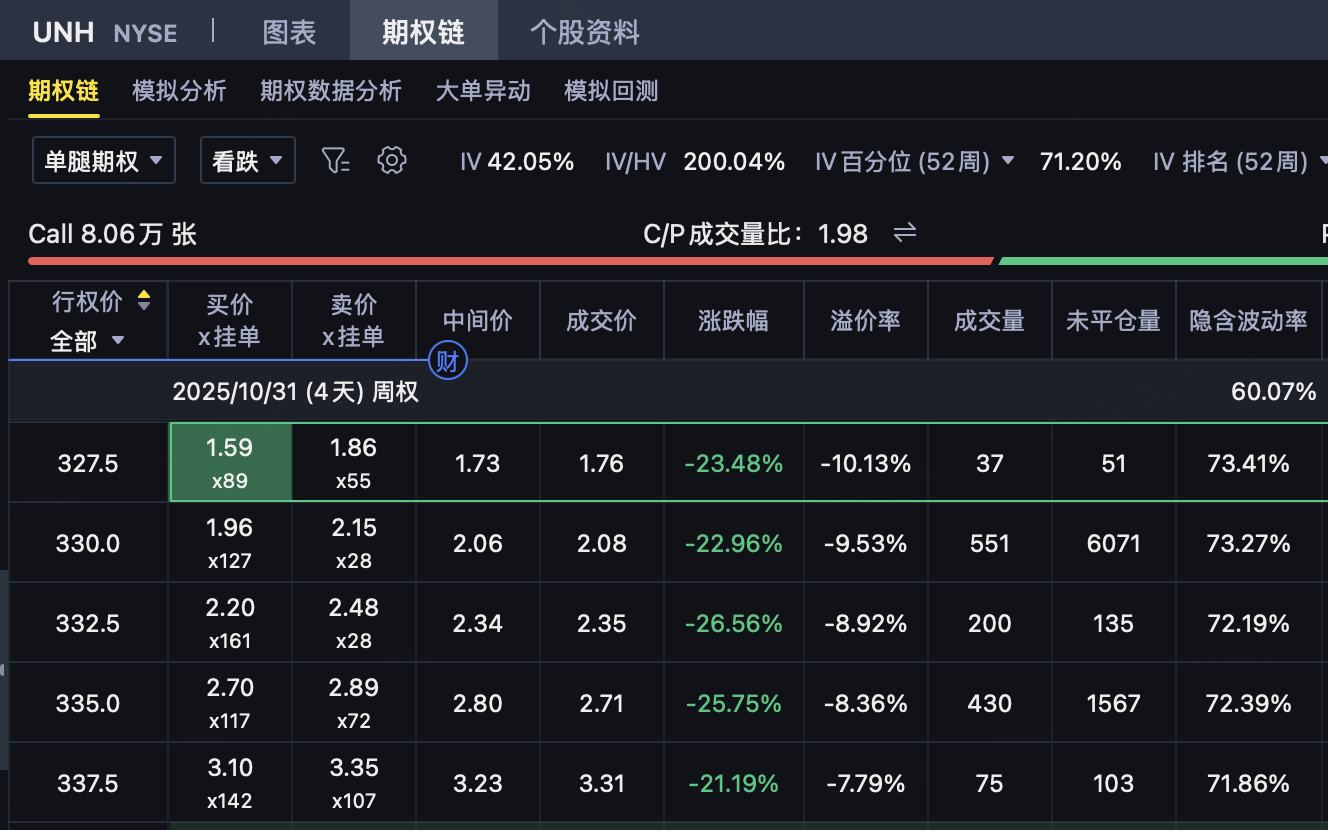
Call option income: 0.91 × 100 shares = $91
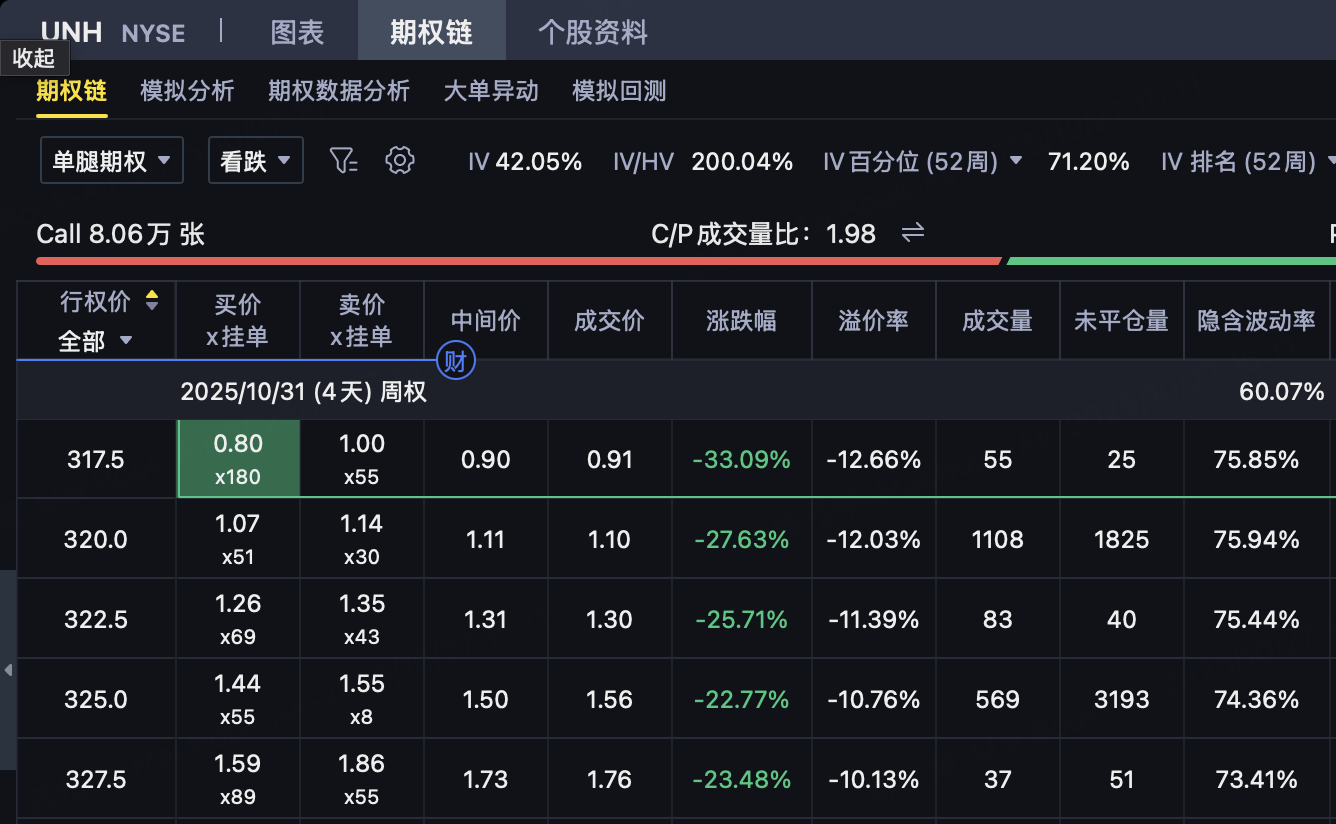
Net income = 176-91 = $85
As a result, the investor has an initial investment income of $85 and a net premium earnings of $0.85 per share.
Maximum potential benefits
The biggest gain occurs when the stock expired above $327.5At this time, both put optionsNot exercisable。
Investor RetentionAll Initial Net premium Income $85, that is, the maximum benefit.
Features: Fixed returns and known risks, suitable for investors who expect the stock price to rise or remain stable.
Maximum potential loss
The biggest loss occurred when the stock price fell below $317.5。
At that time, the high strike price put option is exercised (the seller needs to bear the loss), and the exercise of the low strike price put option can partially offset the loss.
The maximum loss is calculated as follows:
Strike spread = 327.5-317.5 = $10/share
Minus Net premium Income = 10-0.85 = $9.15/share
Total = 9.15 × 100 shares = $915
Investors' losses are strictly limited and risks are controllable.
Break-even point
Breakeven Point Formula: High Strike Price-Net premium Income
327.5-0.85 = $326.65
That is, investors profit when the stock price is higher than $326.65 and start losing money when it is lower than $326.65
Risk Analysis and Strategy Characteristics
Limited but certain income: The maximum gain is an initial net premium of $85, which will not increase no matter how high the stock price is.
Loss controllable: The maximum loss was $915, and the loss no longer increased after the stock price fell below $317.5.
Applicable investor types: Sound investors who expect UnitedHealth's stock price to remain higher or stable after the earnings report, but want to generate additional premium income through options while controlling downside risks.
Disclaimer: Investing carries risk. This is not financial advice. The above content should not be regarded as an offer, recommendation, or solicitation on acquiring or disposing of any financial products, any associated discussions, comments, or posts by author or other users should not be considered as such either. It is solely for general information purpose only, which does not consider your own investment objectives, financial situations or needs. TTM assumes no responsibility or warranty for the accuracy and completeness of the information, investors should do their own research and may seek professional advice before investing.
