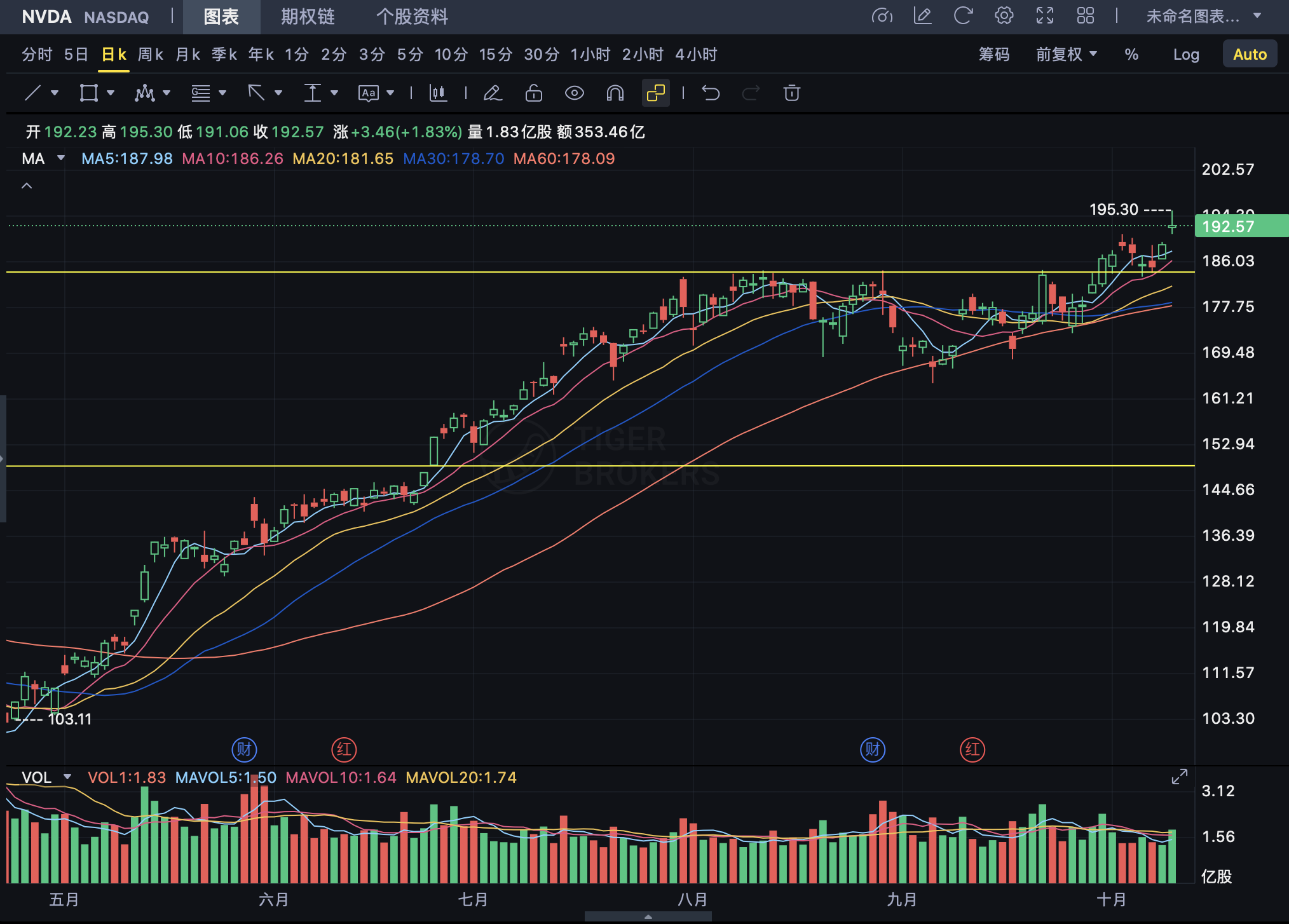
On Thursday, NVIDIA's stock hit an intraday high of $195.3, setting a new record, and closed at $192.57, just a step away from breaking the $200 mark. According to options data, there's a 40% probability that NVIDIA's stock will reach $200 by November.
This article will first examine the fundamental strength behind NVIDIA's potential breakout, then share three options strategies for going long on the stock.
Strong Institutional Bullishness
In a research report dated October 9, 2025, Cantor Fitzgerald gave NVIDIA a strong buy rating and significantly raised its price target from $240 to $300.
The analyst believes the construction of AI infrastructure is still in its early stages, far from forming a bubble. With its technological leadership and full-stack solutions, NVIDIA is poised to continue dominating the AI accelerator market.
NVIDIA has three key growth drivers:
Strong and Accelerating AI Demand:
AI token demand has seen an inflection point over the past 12-16 weeks, primarily driven by "long-horizon reasoning" and multimodal inputs (especially video).
AI platforms like OpenAI achieve high gross margins of 50-70%, leading to all deployed GPU computing capacity being sold out, with clients scrambling for compute resources.
Vast Market Potential:
The AI infrastructure market is projected to reach $3-4 trillion by 2030.
Drivers include massive capital expenditures from hyperscale cloud providers, emerging cloud companies, enterprise applications, and Physical AI.
Competitive Advantages and Strategy:
Technology Moat: A complete full-stack solution (especially the CUDA-X ecosystem) and annual iterations with "extreme co-design" capabilities make it more than a chip supplier – it's an AI platform company.
Market Position: NVIDIA is expected to maintain at least a 75% share of the AI accelerator market long-term.
Product Roadmap: Utilizing a "decoupled yet unified" strategy, software dynamically schedules workloads to the optimal processor, enhancing overall efficiency. The next-generation Rubin platform has already been taped out successfully.
Performance Edge: NVIDIA claims a 3x lead over its closest competitor in the key metric of performance per watt.
The report's price target is significantly above the market consensus because the analyst's EPS estimates are higher:
FY 2026 EPS: $8.00 (Consensus: $6.26)
FY 2027 EPS: $11.00 (Consensus: $7.36)
Based on a P/E ratio of 27x the FY 2027 EPS estimate of $11, the analyst arrived at the $300 price target. Additionally, the analyst believes the company has the potential to achieve an ambitious EPS of $50 by 2030.
Technical Trends
NVIDIA's current stock price is at an all-time high. Short-term technicals show strength, but high valuations and volatility risks following the recent volume-backed rally warrant caution.
Technical indicators suggest the stock continues its ascent after breaking through the previous resistance level of $192.62. However, overbought signals and institutional divergence hint at a potential short-term pullback.
Options Strategies
Based on current options open interest and implied volatility analysis, NVDA's expected trading range for the week of October 17 is between $185 and $195. Assuming market sentiment and volatility levels persist, the stock could fluctuate between $180 and $205 by November.
Combining options pricing and the Greeks, the probability of NVDA reaching $200 before the November expiration is approximately 35%-40%.
Sell Put
Contract: $NVDA 20251219 180.0 PUT$
Current Premium: ~$8.6/share
Potential Profit: The full premium of $8.6/share (if the stock stays above $180 at expiration).
Potential Loss: If the stock price falls below $180 at expiration, the obligation is to buy 100 shares at $180. The effective cost basis would be $180 - $8.6 = $171.4/share.
Rationale: High probability of success, suitable for neutral-to-bullish investors. Approximate annualized return of 24%.
Sell Put + Buy Call (Credit Spread / Risk Reversal)
Sell Contract: $NVDA 20251219 180.0 PUT$
Buy Contract: $NVDA 20251219 200.0 CALL$
Net Credit/Net Cost: $8.6 - $11.75 = -$3.15/share (Net Debit)
Potential Profit: The position becomes profitable if the stock price is above the breakeven point of $180 (Put Strike) + $3.15 (Net Debit) = $183.15 at expiration. Profit increases above this level.
Potential Loss: Maximum loss occurs if the stock is below $180 at expiration, requiring assignment to buy 100 shares at $180, while the call expires worthless. The total cost basis would be $180 + $3.15 = $183.15/share. Losses are incurred between $180 and $183.15.
Rationale: Defines the risk of the short put for a net debit, suitable for bullish investors wanting defined risk on the put side and upside participation.
Bull Call Spread
Buy Contract: $NVDA 20251219 195.0 CALL$
Sell Contract: $NVDA 20251219 215.0 CALL$
Net Debit: ~$14.0 - $6.7 = $7.3/share
Potential Profit: Maximum profit is (215 - 195 - 7.3) = $12.7/share.
Potential Loss: Maximum loss is limited to the net debit of $7.3/share.
Rationale: Defined risk, suitable for investors cautiously optimistic about a breakout but wanting to cap upside potential for lower cost.
Comments