$CoreWeave, Inc.(CRWV)$ s proposed $9 billion acquisition of $Core Scientific, Inc.(CORZ)$ represents the most significant source of valuation divergence currently impacting CRWV's near-term valuation. The core rationale for this acquisition lies in CRWV gaining access to valuable power resources and infrastructure footprint through the acquisition of CORZ to support its rapid expansion in the AI data center sector. Simultaneously, as the target company, the gap between CORZ's current stock price and the implied valuation from the merger presents an arbitrage opportunity for the market, indirectly supporting CRWV's stock performance.
As of October 27, 2025, the transaction remains in the shareholder voting phase (scheduled for October 30). On October 20, proxy advisory firm ISS recommended that CORZ shareholders reject the proposal. However, CRWV countered that the deal lacks competitors and has received unanimous board approval, urging shareholder support. The transaction is expected to close in Q4 2025 (if approved). Recent increased shareholder opposition has driven up CORZ's stock price while causing volatility in CRWV's shares, highlighting market divergence over the deal's prospects.
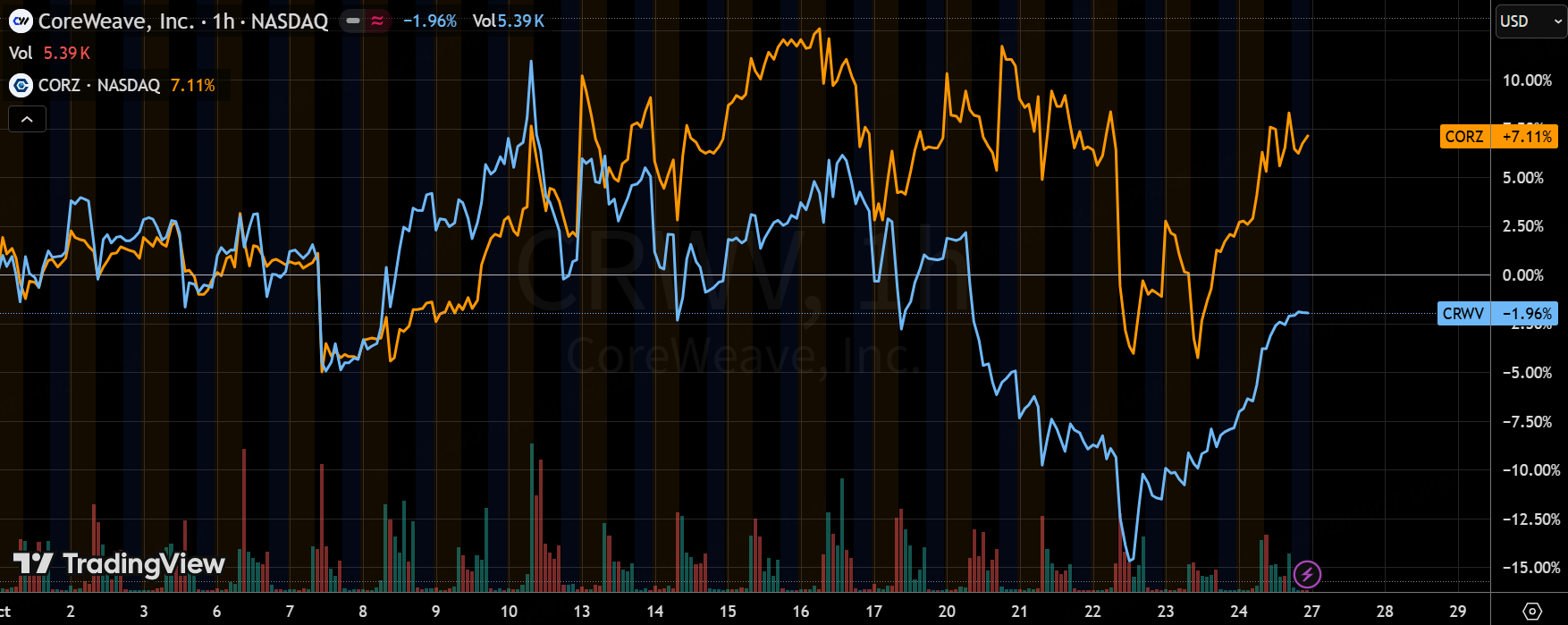
The core view is that the M&A outcome will not undermine CRWV's long-term upward trajectory. Through two scenario analyses, CRWV's potential gains under different outcomes become clear. Although recent opposition from ISS has heightened veto risks, CRWV's organic growth path remains robust. Furthermore, independent valuations of CORZ—such as Roth Capital's upgraded rating—further mitigate potential negative impacts.
Scenario 1: M&A Approval — Short-Term Performance Boost + Long-Term Capacity Assurance
If the transaction proceeds smoothly, CRWV will integrate CORZ's power and infrastructure strengths, delivering quantifiable positive effects:
Core Resource Acquisition: CRWV will secure approximately 1.3GW of power generation capacity (including 1GW expansion potential), effectively alleviating the power bottleneck constraining AI data center expansion. This is critical in the AI infrastructure sector, as power supply directly determines computational capacity.
Significant Financial Performance Enhancement: Based on the latest investment research estimates, the merger will deliver 30-40 cents per share in earnings enhancement for CRWV, primarily driven by cost optimization—annual savings of at least $800 million in leasing expenses and $500 million in operational cost reductions, thereby boosting gross and net profit margins. Combined with CORZ's Q3 2025 earnings report (revenue declining to $81.1 million but shifting toward high-density hosting services), this integration will further strengthen CRWV's cost competitiveness.
2. Scenario Two: M&A Rejection — Organic Growth Intact, Short-Term Incremental Growth Clear
Even if the transaction fails, CRWV's core growth logic remains intact and has clear short-term support:
New Customer Agreements Finalized: CRWV has signed new deployment agreements with clients including Poolside, currently securing 250MW of computing power with 500MW of additional capacity reserved (based on its 2GW campus in West Texas). Additionally, the February 2025 infrastructure agreement with CORZ for an extra 70MW further secures near-term capacity expansion. Even without acquisitions, CRWV's annual recurring revenue (ARR) retains significant upside potential.
Termination Fee Risk is Limited: The agreement stipulates a $27 million termination fee, but it is triggered only under specific conditions (e.g., if CORZ accepts a superior offer during the window period). Given CRWV's assessment of no other potential acquirers and Roth Capital's upgrade of CORZ's rating due to the deal being "unlikely," financial losses for CRWV would be negligible if the deal is rejected. The primary impact would be a slight delay in capacity expansion timing rather than a halt to growth.
Additional Support for M&A Arbitrage Mechanisms: Analysis of CORZ Share Premium Driving CRWV Passive Buying and Arbitrage Opportunities
CORZ's current stock price provides passive support for CRWV with a "neutral outcome," representing a hidden positive factor. Simultaneously, from an arbitrage perspective, the current spread presents investors with a clear trading opportunity:
CORZ Stock Price Exceeds Implied Acquisition Value: As of the morning of October 27, 2025, CORZ stock traded at approximately $19.94 (market cap ~$5.944 billion, with daily trading volume around 16.57 million shares), significantly above the implied acquisition price (calculated based on a stock exchange ratio of 0.1235 shares of CRWV per share of CORZ and CRWV's current share price of $136.29, implying approximately $16.83). The spread is approximately $3.11 (about 18.5%), reflecting the market's heightened expectation of a deal rejection. The market recognizes CORZ's asset value (particularly following its transition to high-density custody) and assigns an independent valuation above current levels. Even if the merger fails, CORZ's share price has support (e.g., the 52-week high of $20.36 reached on October 16), thereby mitigating the drag on CRWV. Recent shareholder opposition news has driven up CORZ's share price, while CRWV's share price has shown minor fluctuations (market cap of approximately $65.626 billion, daily trading volume of about 21.24 million shares), highlighting the divergence.
Arbitrage Position Closing Effects and Trading Opportunities: The market features numerous M&A arbitrage strategies involving "shorting CORZ and hedging with a long position in CRWV" (i.e., selling CORZ short while simultaneously buying a corresponding ratio of CRWV to lock in the spread). This strategy assumes the transaction proceeds: If approved, arbitrageurs stand to profit approximately $3.11 per share (after hedging). The primary risk lies in the probability of rejection (currently elevated due to ISS recommendations and shareholder opposition, widening the spread).
Arbitrage Strategy: From an opportunity perspective, if investors believe the transaction will ultimately pass (CRWV responds positively, no competitors), they can establish a similar position: Sell CORZ short @19.94, buy 0.1235 CRWV @136.29, with a high potential annualized return (assuming swift resolution after the vote). Conversely, if betting on rejection (increasing probability), reverse the arbitrage: go long CORZ (anticipating independent value revaluation upside) and short CRWV (merger failure may trigger short-term pullback). Regardless of outcome, unwinding these arbitrage positions will impact liquidity—a veto would trigger CORZ buying to cover short positions (supporting its price), while CRWV selling to hedge positions could temporarily depress CRWV. If approved, overall market sentiment shifts positive, with CRWV benefiting from integration expectations. Should 20%-30% of CORZ short positions (estimated based on volume) be closed, this would involve 6-9 million shares of CRWV trading volume (approximately 30% of its average daily volume), creating significant liquidity impact and presenting potential volatility opportunities for CRWV's share price.
Long-Term Investment Catalysts for CRWV: Policy Dividends + Major Client Demand, Transcending M&A Framework
On the policy front, the U.S. is accelerating data center construction, with government initiatives such as shortening grid connection approvals to 60 days directly benefiting CRWV as the leading provider of AI data center infrastructure.
Combined with Meta's previous "SPV structure" (off-balance-sheet financing supporting data centers) and "Project Hyperion" (AI infrastructure initiative), CRWV's probability of securing additional orders from $Microsoft (MSFT)$ and $Meta Platforms, Inc. (META)$ increases. The AI expansion of these tech giants will drive sustained demand. This logic, independent of CORZ's M&A activities, forms the foundation of CRWV's long-term valuation.
Given that the CRWV valuation framework is highly event-driven, trading strategies should focus on "risk control" and "technical confirmation," while incorporating an arbitrage perspective:
Current Position Recommendation: Enter with a Small Position: Given the potential upside from M&A, arbitrage support, and the current spread, consider testing the waters with a small position (e.g., establishing a small-scale arbitrage position). However, avoid heavy positions—the voting outcome remains undecided, and event uncertainty persists.
Position Increase Trigger: Technical Breakout: Subsequent position increases require meeting two conditions: the stock price must break above the 10-day/20-day moving average (confirming an upward short-term trend); and must surpass key resistance levels below (reinforcing market consensus). If the arbitrage spread narrows (indicating increased probability of signal trade success), positive arbitrage positions may be scaled up.
Risk Management: Event Uncertainty Despite the overall positive outlook, factors such as ISS recommendations heighten the risk of a negative outcome. Therefore, it is crucial to control exposure through "chart-based stop-loss lines" (e.g., reducing positions upon breaking below support levels) and monitor changes in arbitrage spreads as a key indicator.:
Comments