Today, both A-shares and Hong Kong stocks fell, and the decline of Hong Kong stocks was significantly higher than that of A-shares. The Shanghai Composite Index closed at 3878.0 points, down 0.51%, and the Shenzhen Component Index closed at 12955.25 points, down 0.78%. Transactions in the two cities were active, but lacked upward breakthrough momentum. In terms of sectors, technology and consumer stocks performed weakly, and some heavyweights dragged down the index.
Hong Kong stocks were under even more obvious pressure. The Hang Seng Index fell 1.28% to close at 25,760.73 points, and the Hang Seng China Enterprises Index fell 1.68% to close at 9028.55 points. The 26,000-point integer mark failed to be held, and the short-term technical aspect was under pressure. H50 futures fell by more than 1.5%, indicating that the market is cautious about the follow-up trend of Hong Kong stocks. In terms of funds, Chinese stocks are significantly affected by external market sentiment, with enlarged turnover and heated risk aversion. Some analysts believe that the Bank of Japan may release a rate hike signal, which will trigger an expected rise in global interest rates and increase the cost of yen arbitrage transactions, which will lead to the withdrawal of some international funds from risky assets, including Hong Kong stocks, and aggravate the pressure of market correction.
Overall, A-shares are relatively stable under the support of domestic policy expectations, but they lack breakthrough momentum in the short term; Hong Kong stocks are more sensitive to international capital flows and global economic data, and there is still short-term correction pressure. Investors need to pay attention to overseas interest rate and liquidity trends, as well as the impact of domestic economic policy signals on the market, and pay attention to the potential impact of overseas policy changes such as Japanese rate hike on Hong Kong stocks.
YINN Bear Call Spread
$Triple Long FTSE China ETF-Direxion (YINN) $Is the ticker symbol for Direxion Daily China 3X Financial Stocks ETF, which provides investors with high-risk, high-reward opportunities by using leverage to amplify intraday volatility in China's financial sector. The price of YINN is affected by the overall trend of Chinese financial stocks, and the rise is amplified and the fall is also amplified, so it is suitable for investors who have clear expectations for short-term market volatility.
1. Strategy structure
Investors build a on YINNBear Call Spread(Bear Call Spread), consisting of two Call options with the same expiration date:
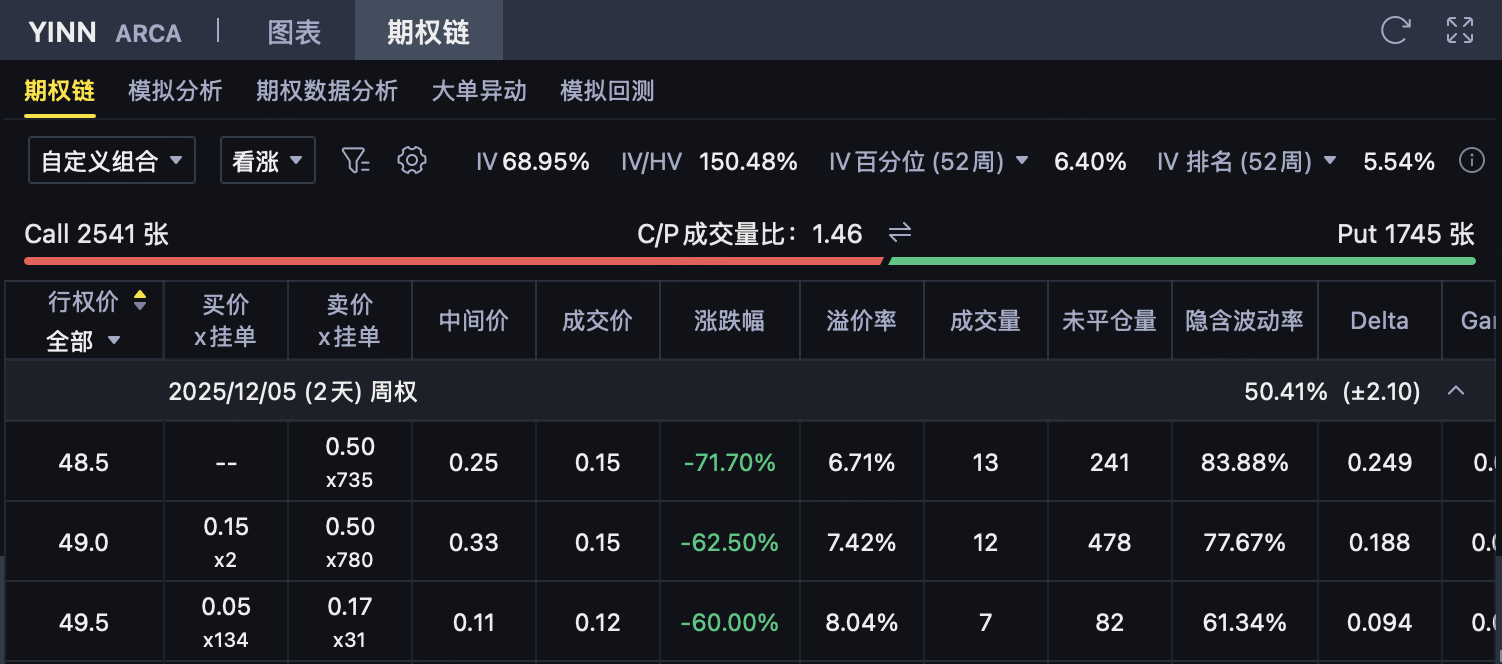
Sell lower strike price Call: K ₁ = $45.5, premium revenue $1.13/share
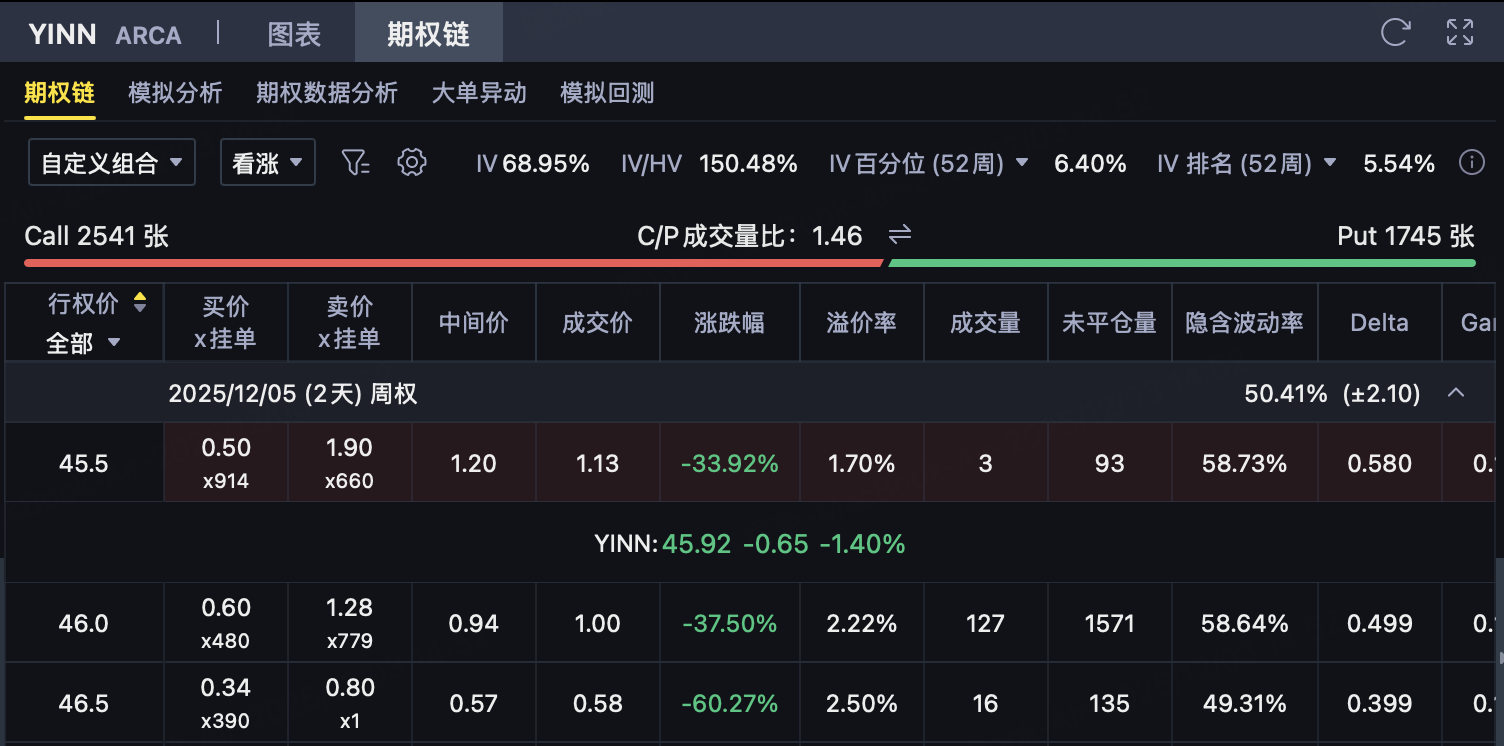
Buy a higher strike price Call: K ₂ = $48.5, premium spends $0.15 per share
The strategy belongs toCredit type, bearishCombination of. Investors expect YINN not to break too much above $45.5 at expiration, the lower the better, thereby retaining net premium income.
Initial net income
Net premium (per share)
= 1.13 − 0.15
= $0.98/share
Each contract is 100 shares, so:
Total revenue
= 0.98 × 100
= $98/contract
This is the maximum potential profit locked in when opening a position.
3. Maximum profit
When the YINN maturity price is ≤ $45.5, both Calls are out-of-the-money, and the investor retains all premium income.
Maximum profit
= $98/contract
4. Maximum loss
When the YINN expiration price is ≥ $48.5, both Calls are in-the-money, the spread is fully triggered, and the investor still retains the net income.
Strike spread
= 48.5 − 45.5
= $3/share
Maximum loss (per share)
= 3 − 0.98
= $2.02/share
Total maximum loss
= 2.02 × 100
= $202/contract
5. Break-even point
Break-even point
= K ₁ + Net income
= 45.5 + 0.98
= $46.48
Maturity judgment rules:
≤ $46.48 → Earnings
≥ $46. 48 → Loss
6. Risk and return characteristics
Maximum gain: $98/contract (limited)
Maximum loss: $202/contract (limited)
Profit-loss ratio: 1: 2.06 (bear 202 losses for 98 gains)
Applicable scenario: Investors expect YINN to trade sideways or fall slightly before expiration, and will not break the pressure range near $46.48
Comments