There is an opportunity to lie flat and make money in 2026: the Warner acquisition. Unlike typical acquisitions, this one appears to be a major consolidation and reshuffle in the media industry on the surface, but it actually involves political maneuvering. For us investors, the logic behind this presents an excellent arbitrage opportunity, and this window of opportunity can last an entire year!
Below is a detailed analysis of the motivations behind the parties involved in this arbitrage case and how to leverage this logic to arbitrage and make money while lying flat in 2026.
Netflix, Warner, and Paramount
On the surface, the acquisition involves three companies: Netflix $NFLX$, Warner $WBD$, and Paramount $PSKY$.
On December 5, Netflix announced its acquisition of Warner Bros. Discovery. The specific plan involves an $82.7 billion purchase of certain assets, including television, film production, and streaming businesses. Warner’s cable TV business will be spun off and listed as an independent entity. The acquisition agreement includes cash and stock swaps, equivalent to $27.75 per share, totaling $72 billion. Netflix will also assume approximately $10.7 billion of Warner Bros. Discovery’s debt.
The day after this selective contract was announced, Paramount made an all-cash offer of $30 per share, seeking to acquire all of Warner’s assets, including cable networks such as CNN and TNT, with a total enterprise value of $108.4 billion.
On the surface, it appears that Paramount is interfering with Netflix’s acquisition, but Paramount was actually the first to express acquisition interest. As early as September, Paramount proposed acquiring Warner through a "cash + stock" hybrid method, with an offer of approximately $19 per share at the time, but it was rejected by Warner due to the low price.
Subsequently, Warner initiated a public bidding process in October, attracting Netflix and Comcast Group to join. During this process, Paramount repeatedly took the initiative to propose acquisitions, all of which were rejected. As of December 4, Paramount had submitted six rounds of offers to Warner, with the final offer raised to $30 per share.
So, rather than Paramount sniping Netflix midway, it’s more accurate to say the opposite: Netflix sniped Paramount.
Powerful Alliance
Why did Warner choose Netflix even though Paramount offered more favorable terms? In one sentence: Netflix, as the world’s largest streaming distribution channel, can generate greater value for Warner’s IP assets.
Warner owns many well-known top-tier IP content and franchises, including but not limited to Harry Potter, The Lord of the Rings, DC Comics, and Game of Thrones. Combining Warner’s content library with Netflix’s global distribution capabilities is highly likely to create value exceeding the acquisition price.
For Warner, this will further expand the influence of its IP content, leveraging Netflix’s over 300 million member base to develop century-old classic IPs like DC Comics, Harry Potter, and The Lord of the Rings. For Netflix, this will further consolidate its leadership in streaming and deepen its competitive moat.
At present, Netflix seems to have a strong advantage in acquiring Warner, given the powerful alliance. So why is Paramount continuing to bid hundreds of billions of dollars under these conditions?
Paramount Skydance and Oracle
In fact, Paramount is no longer the old-school film studio it once was. In August of this year, Paramount was acquired by Skydance Media and renamed Paramount Skydance Corp $PSKY$. Immediately after, in September, Paramount made an acquisition offer for Warner, with Skydance Media being the main force behind the Warner acquisition.
After Paramount’s acquisition was rejected due to financing concerns, on December 22, Oracle founder Larry Ellison provided a $40.4 billion financial guarantee in his personal name, hoping to help defeat Netflix’s competitive bid.
Why is Oracle involved in Skydance’s acquisition? Because Larry Ellison, the founder of Oracle, is the father of Skydance Media CEO David Ellison.
Of course, Oracle’s investment is not due to father-son affection but rather greater ambitions. Oracle is a major shareholder in TikTok’s U.S. joint venture and has also secured licensing for TikTok’s recommendation algorithm.
Thus, it’s no surprise why the son of a cloud services company founder would establish a media company—it’s all part of the plan to manage traffic after taking over TikTok. After all, TikTok has over 2 billion global users, and its channel influence far exceeds that of Netflix.
In other words, Paramount Skydance Corp can monetize IP for 2 billion people, making a $100 billion acquisition fee seem not too expensive. That’s why Larry Ellison dared to provide a personal financial guarantee—he sees this as a very lucrative deal.
Of course, this traffic management isn’t just about profit; it’s also political. The Ellison family has close ties to Trump. Previously, Trump’s son-in-law Jared Kushner was involved in the Warner acquisition but later withdrew. Trump himself publicly questioned whether Netflix’s acquisition plan might have antitrust issues and stated that no matter which company acquires Warner Bros., CNN should change ownership.
Therefore, the capital behind Paramount is highly likely to continue tangle with Netflix and Warner.
The Inevitability of Warner’s Acquisition
This brings us to the lie-flat-and-make-money opportunity mentioned at the beginning.
Netflix’s acquisition of Warner is more defensive than offensive. If Paramount Skydance were to acquire Warner, it would be almost impossible for Netflix to license any IP products. The long-form video sector has been eroded by short-form video, and long-form video IP is a nice addition for TikTok, mostly allowing the Ellison family to make massive profits. For Netflix, however, it is a heavyweight addition, providing more certainty in maintaining user subscriptions and continuing its leadership in long-form video.
Backed by TikTok and Republican support, the Ellison family is determined to consolidate media resources, not only for profit but also for political. Otherwise, they wouldn’t have made an offer for Warner immediately after completing the Paramount acquisition in August and September.
So, no matter who it is, Warner will eventually be acquired.
Warner’s shareholders are very, very aware of this. Warner’s fifth-largest shareholder, Harris Oakmark (holding 96 million shares as of the end of September, about 4% of the total shares), stated that they hope Paramount, controlled by the Ellison family, will offer more favorable terms.
Originally, it was expected that this acquisition would conclude in Q3 2026, but given the current intense situation, it could extend into the following year.
However, the only certainty is that Warner has already become a target, and acquisition by one side or the other is inevitable.
Arbitrage Strategy
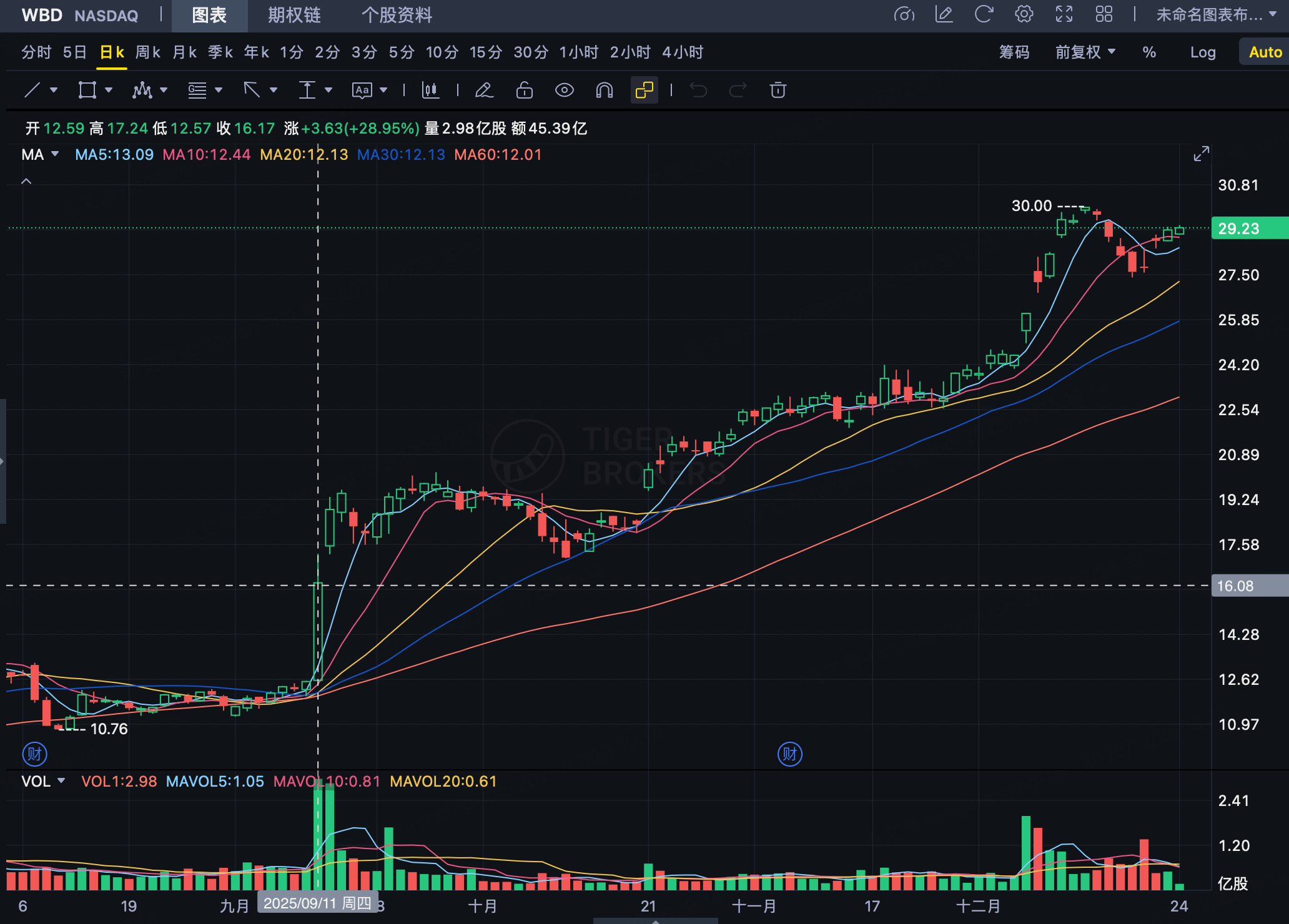
Affected by the acquisition, Warner’s $WBD$ current price fluctuates around $29.
Netflix’s acquisition price is $27.75 per share; Paramount’s acquisition price is $30, and according to media speculation, it may even be raised to $32. If Paramount does not raise the price but uses other means to snipe Netflix, the stock price will continue to fluctuate horizontally around $29.
In another scenario, if Paramount continues to raise the acquisition price, the stock price will rise to the acquisition price and then continue to fluctuate horizontally. However, I believe the probability of another price increase after six rounds is not high.
Horizontal fluctuations with minimal stock price changes, combined with the certainty of the company being acquired, make this be right for arbitrage using short put options.
If Warner is inevitably acquired, then based on the lowest acquisition price (Netflix’s offer of $27.75), the best strategy is to sell puts with strike prices of $27.5 or $27.
At expiration, if the stock price is above $27.5, we collect the premium from selling the options. If the stock price falls below $27.5, we can use covered calls to enhance returns. Since the company’s acquisition is highly likely, there’s no need to worry about holding shares.
For example, you can sell the March expiration $27 put $WBD 20260320 27.0 PUT$ , with an annualized return of 8.88% and a margin requirement of only $618.
Comments