$KWEB 20261106 22.0 PUT$ 🐼 KWEB Cash-Secured Put: Collecting Premium While Waiting for a China ETF Rebound
My trading journal | 31 October 2026 | KWEB $22 Put | Expiry: 6 November 2026
Sometimes, I don’t need to chase a stock when the market is weak. I would rather let the market come to my preferred buying price while collecting some premium along the way.
This is exactly what I am doing with KWEB (KraneShares CSI China Internet ETF).
I sold one KWEB $22 put option expiring on 6 November 2026 and collected a premium of $0.11 per share. Assuming the standard 100-share contract multiplier, that gives me approximately US$11 in premium before transaction fees.
At the time of my trade, KWEB was trading around $22.74. My chosen strike price of $22 is below the current market price, giving me a buffer of approximately 3.25%.
My thinking is straightforward: I am willing to own KWEB at $22, but I don’t want to rush into buying it at the current market price. If the ETF stays above $22, I keep the premium. If it falls below $22 and I am assigned, I will own the ETF at an effective cost of $21.89 per share, before fees.
For me, this is a small, controlled way of expressing a cautiously bullish view on Chinese internet companies.
1️⃣ Why am I making this trade now?
📉 Technical analysis: Why $22.54 matters to me
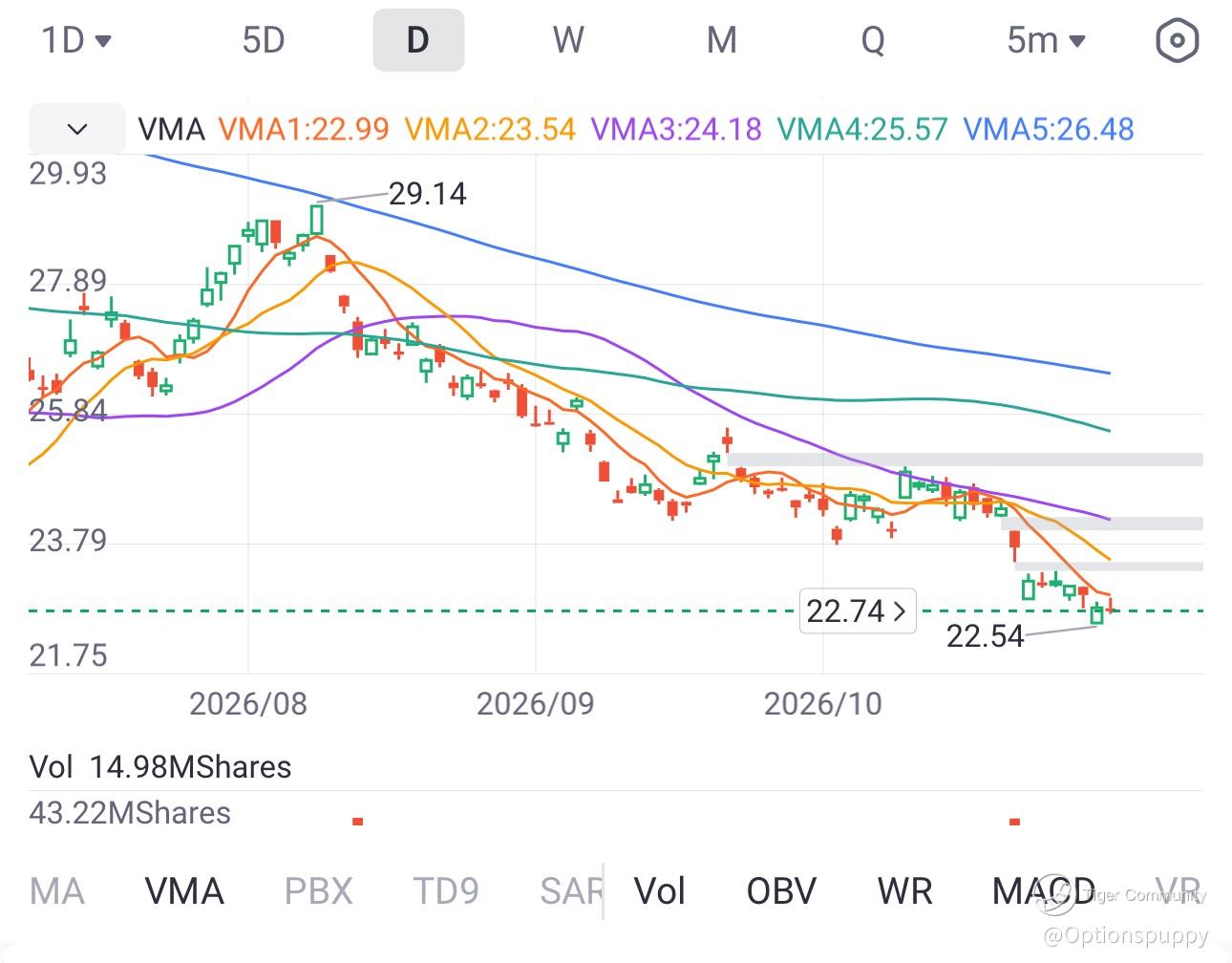
Looking at my KWEB daily chart, I notice that the ETF has been in a declining trend for several months.
Earlier in the chart, KWEB traded above $30. It subsequently experienced a series of lower highs and lower lows, eventually declining towards the $22–$23 region.
What interests me now is the price action around $22.54.
This is the recent low marked on my chart. KWEB has approached this level and is showing signs of trying to stabilise. I see $22.54 as an important potential support area because buyers have previously stepped in around this price.
My reasoning is simple: if sellers have already pushed the ETF down significantly, I want to see whether buying interest starts appearing near this level.
However, I don’t want to confuse support with a guaranteed floor. Support can break, particularly when the broader Chinese market experiences negative news.
📊 Understanding my moving averages
My chart also displays several volume moving averages (VMA) and price levels.
The current price of $22.74 is below the displayed moving-average readings:
* VMA1: 22.99
* VMA2: 23.54
* VMA3: 24.18
* VMA4: 25.57
* VMA5: 26.48
This tells me that the overall trend is still weak. There is no convincing technical confirmation of a bullish reversal yet.
I would like to see KWEB reclaim $22.99 first, followed by $23.54. A stronger recovery above $24.18 would give me more confidence that the selling pressure is easing.
For now, I am not trying to predict an immediate rally. I am simply positioning myself at a lower entry price.
🐼 What exactly am I buying through KWEB?
One reason I am interested in KWEB is that I am not buying just one Chinese technology company.
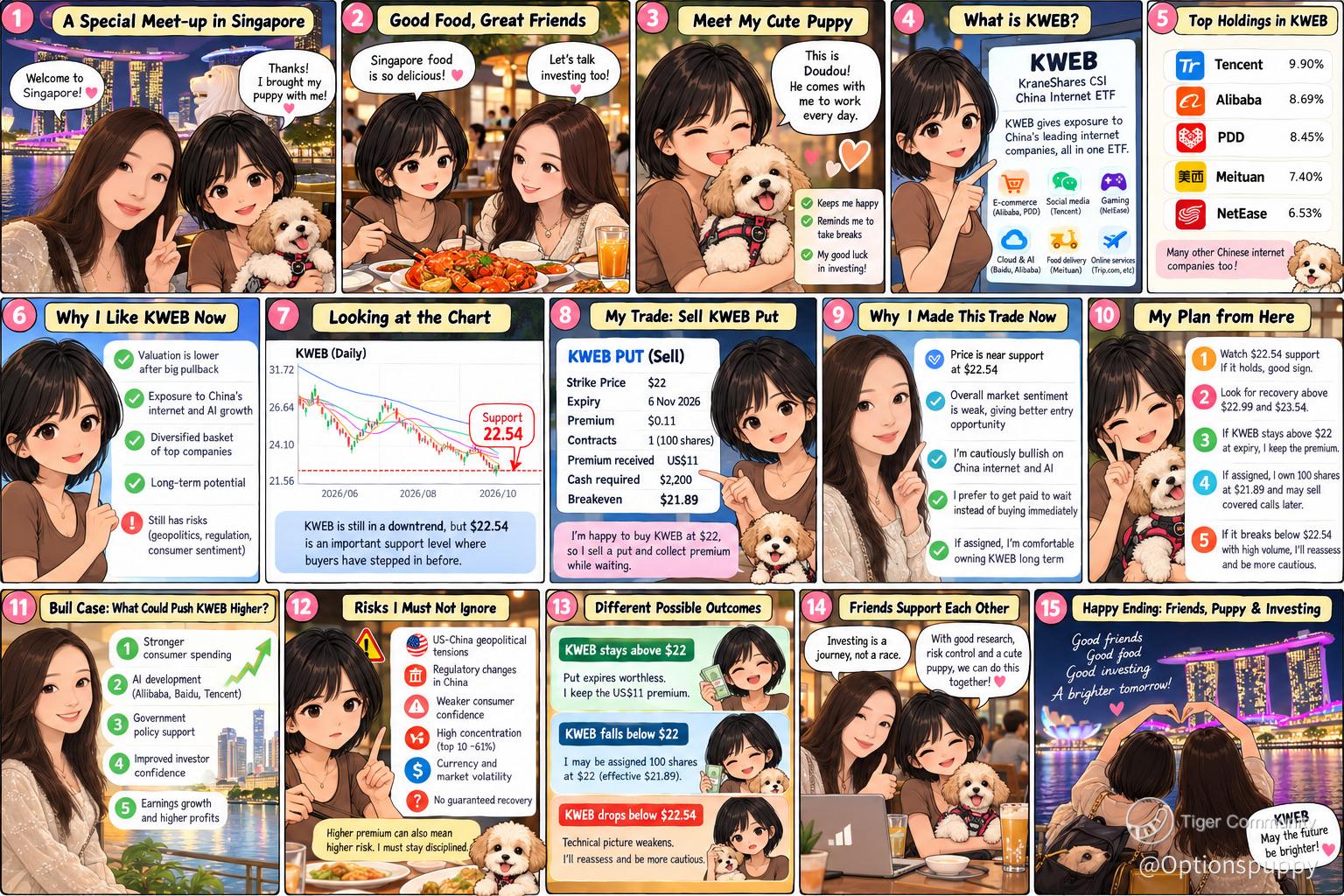
KWEB is the KraneShares CSI China Internet ETF. It tracks the CSI Overseas China Internet Index and provides exposure to Chinese companies whose businesses are primarily focused on internet and internet-related technology.
Think of KWEB as a basket of some of China’s biggest internet businesses.
Its portfolio includes companies involved in:
* Online shopping and e-commerce.
* Social media and digital entertainment.
* Online gaming.
* Search engines and artificial intelligence.
* Food delivery and online services.
* Travel booking and digital platforms.
* Cloud computing and internet infrastructure.
Instead of trying to decide whether Alibaba, Tencent or Baidu will outperform, I can gain exposure to a basket of these businesses through one ETF.
🏢 What are the major companies inside KWEB?
The following are the major holdings based on the reported 30 October 2026 portfolio data. Holdings and weights change over time. Schwab Wall Street +1
1. Tencent — approximately 9.90%
Tencent is one of China’s largest technology companies. Its businesses include WeChat, online gaming, digital advertising, cloud services and financial technology. WeChat is particularly important because it connects communication, payments, shopping and everyday digital services.
2. Alibaba — approximately 8.69%
Alibaba operates major e-commerce platforms, including Taobao and Tmall. It also has cloud computing and artificial intelligence businesses. I see Alibaba as an important holding because it provides exposure to Chinese consumer spending as well as the development of AI infrastructure.
3. PDD Holdings — approximately 8.45%
PDD operates Pinduoduo in China and Temu internationally. Its business focuses on value-driven e-commerce and connecting consumers with merchants. It benefits from online shopping demand, although competition and consumer spending remain important risks.
4. Meituan — approximately 7.40%
Meituan is a major Chinese food delivery and local services platform. It connects restaurants, delivery riders and consumers. Its business is closely linked to domestic consumption and everyday spending.
5. NetEase — approximately 6.53%
NetEase is well known for online gaming, digital entertainment and related services. Gaming is an important source of revenue, and successful game releases can provide earnings growth.
Other significant holdings include Lenovo, KE Holdings, JD.com, Trip.com, Baidu, Full Truck Alliance and Kuaishou.
What I find interesting is the diversity within this ETF. It is not simply a technology ETF holding semiconductor manufacturers. It gives me exposure to the companies that operate China’s digital economy.
🤖 Why I am interested in China’s AI opportunity
One of the reasons I don’t want to completely ignore Chinese technology stocks is the development of artificial intelligence.
When investors discuss AI, the conversation often revolves around Nvidia, Microsoft, Google and other American technology giants.
But China is also developing its own AI ecosystem.
Companies such as Alibaba and Baidu are investing in AI models, cloud computing and digital services. Tencent also has substantial data, applications and consumer platforms that could benefit from AI adoption.
There are several ways these companies could benefit:
* AI-powered search and digital advertising.
* More efficient e-commerce recommendations.
* AI-assisted customer service.
* Cloud computing demand.
* Gaming and entertainment improvements.
* Business automation and enterprise software.
I don’t need every company inside KWEB to become an AI winner. I only need the overall basket to benefit from improvements in China’s digital economy over time.
Of course, AI investment does not automatically translate into profits. I will still need to watch revenue growth, margins, capital expenditure and competition.
🇨🇳 Why Chinese internet companies deserve attention
Another reason I am interested is valuation.
Chinese technology companies have experienced significant volatility over the years because of regulatory concerns, geopolitical tensions, economic uncertainty and changing investor sentiment.
Sometimes, the market prices these risks very aggressively.
This creates an interesting situation: businesses may continue operating, generating revenue and developing new products even when their share prices are weak.
I am not suggesting that every Chinese technology company is cheap or that prices must recover. Instead, I want to take a measured position when valuations and market sentiment appear depressed.
KWEB gives me a diversified way to participate without having to select one individual winner.
There are also important risks. Government policies, competition, weaker consumer confidence, US-China relations, accounting and listing arrangements can all affect the ETF.
That is why I prefer starting with a relatively low strike price rather than buying aggressively.
2️⃣ What’s my plan from here?
🎯 My $22 cash-secured put strategy
My trade is straightforward.
US$11
Gross premium collected, assuming 100 shares per contract
Trade detail My position
ETF KWEB
Current price at trade $22.74
Put strike $22
Expiry 6 Nov 2026
Contracts sold 1
Premium received $0.11
Gross premium $11
Cash required $2,200
Breakeven $21.89
Downside buffer 3.74% to breakeven
I am essentially agreeing to buy 100 shares of KWEB at $22 if I am assigned.
My effective purchase price becomes:
22.00-0.11=\boxed{\$21.89}
This is the important number I want to remember.
If KWEB stays above $22 at expiry, the put will generally expire worthless and I keep my premium.
If KWEB falls below $22, I may be assigned 100 shares at $22, with the premium reducing my effective cost to $21.89 per share.
The maximum obligation is US$2,200, not just the US$11 premium. I must be comfortable owning the ETF even if its market price falls substantially below my strike.
📍 My three important price levels
I will be watching three areas on the chart.
1. $22.54 — Immediate support
This is the recent low shown on my chart. I want to see buyers defend this area.
If KWEB holds above $22.54, I will become more comfortable with my short-term view.
However, I will not assume that support must hold. A decisive breakdown could signal that sellers remain in control.
2. $22.99–$23.54 — First recovery zone
These are important moving-average reference levels on my chart.
If KWEB can recover above $22.99 and subsequently $23.54, it would suggest that the ETF is beginning to regain momentum.
I would prefer to see improving trading volume alongside the recovery rather than a temporary price bounce.
3. $24.18–$25.57 — Stronger resistance zone
A recovery towards these levels would be more encouraging.
I would watch whether KWEB can break above resistance and establish higher lows. That would give me a stronger technical reason to consider holding shares for a longer period.
💰 Why I prefer selling puts instead of buying immediately
There are three possible outcomes from this trade.
Scenario A: KWEB stays above $22
If KWEB remains above my strike price at expiry, I keep the US$11 premium.
I can then decide whether to sell another put, wait for a better opportunity or simply keep my cash in reserve.
Scenario B: KWEB falls below $22
I may be assigned 100 shares at $22.
My effective cost is $21.89. If I am comfortable holding KWEB for the longer term, I can treat the assignment as my initial entry into the Chinese internet sector.
I don’t need to panic simply because the ETF moves below my strike. What matters is whether the underlying investment thesis remains intact.
Scenario C: KWEB breaks below $22.54 support
This is where I need to become more cautious.
If KWEB breaks through $22.54 with strong selling volume, the technical picture becomes weaker. I would reassess whether the market is simply testing support or entering another downward leg.
I would not automatically sell another put just because the premium becomes more attractive.
A higher premium can sometimes be the market’s way of telling me that the underlying risk has increased.
📊 What could make KWEB recover?
I will be monitoring five potential catalysts.
1. Chinese consumer spending
Alibaba, PDD and Meituan are connected to consumer activity. If domestic consumption improves, these companies could benefit through higher transactions and stronger revenue.
2. Artificial intelligence development
Alibaba, Baidu and Tencent are investing in AI. If they successfully monetise AI through cloud services, advertising, subscriptions and enterprise applications, their earnings could improve.
3. Government policy support
China’s technology self-sufficiency and domestic innovation ambitions could support the long-term development of local technology businesses. However, policy support does not guarantee higher share prices.
4. Improved investor confidence
Chinese stocks have historically been sensitive to international investor sentiment. Better confidence towards China, improved economic data and reduced geopolitical uncertainty could encourage capital to return.
5. Earnings growth
Ultimately, I want to see companies translating technology investment into sustainable revenue, operating profits and cash flow.
A good story alone is not enough. I want to see actual financial performance.
⚠️ What are the risks I must not ignore?
I like the idea of buying KWEB at a lower price, but I must remember that this is not a low-risk investment.
* Concentration risk: The top 10 holdings account for approximately 61.47% of the portfolio. A poor performance from major constituents can affect the entire ETF. Schwab Wall Street +1
* Geopolitical risk: US-China tensions can cause sudden changes in investor sentiment.
* Regulatory risk: Changes in Chinese regulations can affect internet platforms and their profitability.
* Consumer weakness: If Chinese households remain cautious about spending, e-commerce and local service businesses may struggle.
* Currency risk: The underlying businesses operate in different currencies, while KWEB is traded in US dollars.
* Market risk: KWEB can continue falling even when individual companies report reasonable earnings.
The ETF also charges an annual operating expense of approximately 0.69%. This is deducted within the fund rather than charged separately every time I buy shares. KraneShares CSI China Internet ETF +1
I also need to remember that KWEB is an equity ETF, not a bond fund or capital-protected product. There is no guaranteed dividend or guaranteed recovery.
🧮 My longer-term strategy if I get assigned
If I eventually own 100 shares at an effective cost of $21.89, I can consider a covered-call strategy.
For example, I could look at selling an out-of-the-money call with a strike above my purchase price, provided the premium compensates me for the risk of giving up the upside.
I would not rush to sell calls immediately after assignment.
If KWEB is recovering strongly, I might prefer to keep my shares and allow the recovery to develop.
If the ETF trades sideways, covered calls could potentially generate additional income.
However, I must be careful not to sell calls too close to the market price. I don’t want to cap my upside unnecessarily, especially if Chinese technology stocks begin a strong recovery.
My objective is to combine three possible sources of return:
* Premium collected from selling puts.
* Potential capital appreciation if KWEB recovers.
* Additional call premiums if I eventually own the ETF.
There is no guarantee that these strategies will produce a profit, and covered calls do not protect me from substantial losses in the underlying shares.
🐼 My final thoughts: I am willing to buy, but I don’t need to rush
What I like about this particular KWEB trade is that I have a clear entry price and a defined amount of capital I am prepared to commit.
At $22.74, I don’t see a convincing technical reversal yet. The ETF remains below its moving-average reference levels, and the overall trend is still weak.
However, the recent $22.54 low gives me an important level to watch.
I am not betting that KWEB will suddenly jump to $30 next week. I am taking a smaller position because I believe China’s internet economy still has long-term opportunities through e-commerce, gaming, cloud computing and artificial intelligence.
My $22 put gives me the opportunity to collect premium while waiting for a lower entry price.
If I am not assigned, I keep my premium and retain flexibility.
If I am assigned, I am prepared to own 100 shares at an effective cost of $21.89, provided my investment thesis remains valid.
My personal trading philosophy is simple: I don’t have to buy every dip, and I don’t have to chase every rally. I would rather decide my entry price first, get paid for waiting, and make sure I have enough cash to honour my commitment.
That is how I approach KWEB this week: cautiously bullish, patient with my entry and disciplined with my risk.
Disclaimer: This is my personal trading journal and educational discussion, not financial advice. Options can result in substantial losses. The support levels are technical observations, not guarantees.
Useful reference: KraneShares official KWEB fund page — for updated holdings, performance and fund information.
@AI_FocusedTrader @Shernice軒嬣 2000 @TigerStars @MillionaireTiger 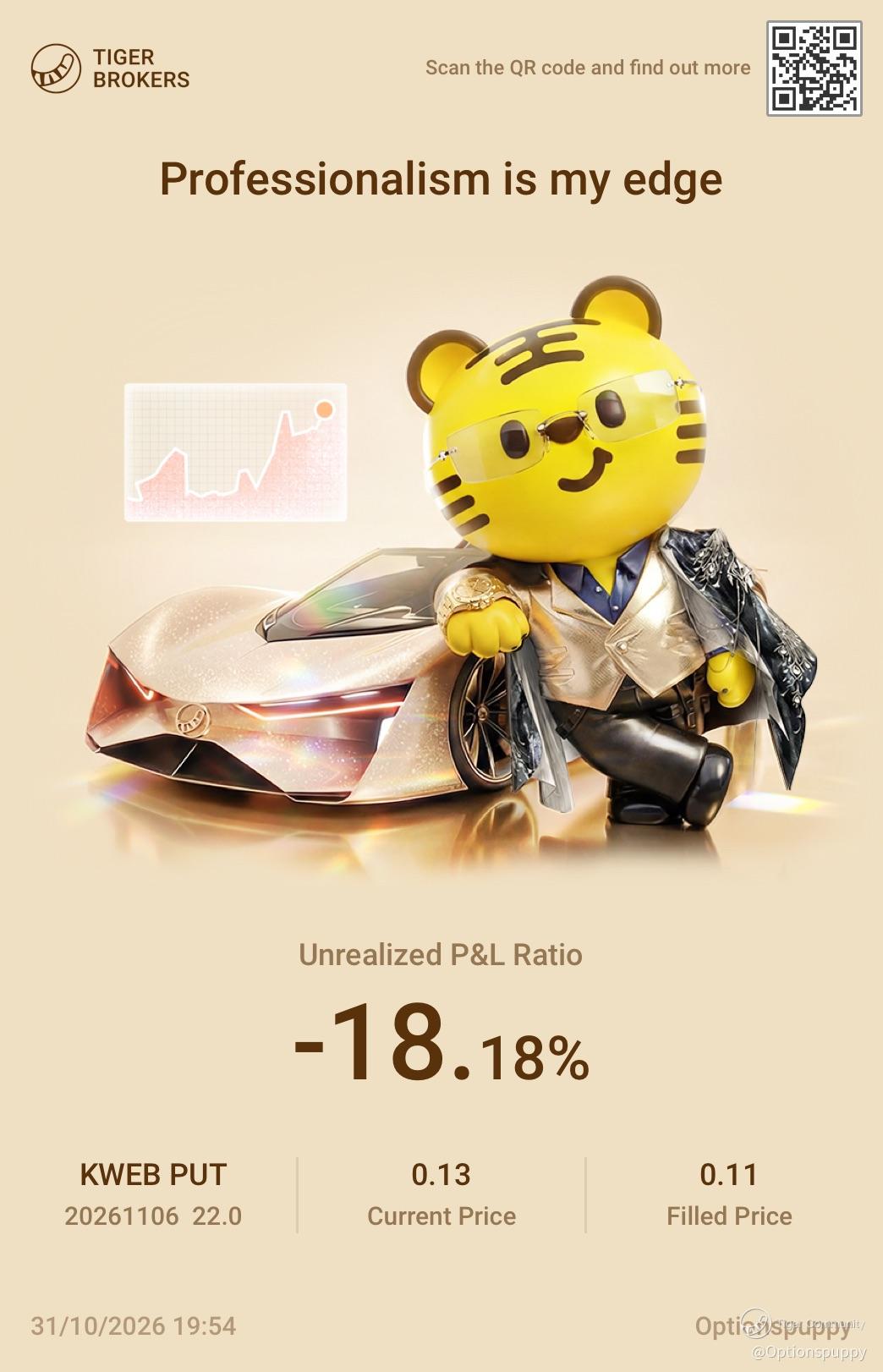
KWEB PUT
10-31 01:56
US20261106 22.0
| Side | Price | Realized P&L |
|---|---|---|
| Sell Open | 0.11 | -18.18% Holding |
Trade Feed: Who is your favorite trader?
Come to the Trade Feed Topic to find more trading opportunities! Also, please feel free to recommend and introduce fellow Tigers to the "hidden gem traders" that you've discovered!
Disclaimer: Investing carries risk. This is not financial advice. The above content should not be regarded as an offer, recommendation, or solicitation on acquiring or disposing of any financial products, any associated discussions, comments, or posts by author or other users should not be considered as such either. It is solely for general information purpose only, which does not consider your own investment objectives, financial situations or needs. TTM assumes no responsibility or warranty for the accuracy and completeness of the information, investors should do their own research and may seek professional advice before investing.
Comments
That is how I approach KWEB this week: cautiously bullish, patient with my entry and disciplined with my risk.
My latest options trade: Selling the NVDA US$215 Call
I decided to sell one NVDA call option with a strike price of US$215 and an expiration date of 20 December 2026.
I like Citigroup because it is more than just a traditional American bank. Citi has a strong international presence, serving corporations, governments, institutional investors and wealthy clients across more than 180 countries and jurisdictions.
Sometimes, the best investment opportunities are not necessarily the hottest technology stocks or the companies making headlines every day. I also like looking at established financial companies that have solid businesses, global operations and the p