


U.S. stocks ended with modest gains on Tuesday as investors parsed conflicting remarks from Federal Reserve officials, with upbeat consumer data providing some lift. All three major U.S. stock indexes lost momentum as the session progressed, but ended the range-bound session in the green.
Market Snapshot
The Dow Jones Industrial Average (.DJI) rose 83.51 points, or 0.24%, to 35,416.98, the S&P 500 (.SPX) gained 4.46 points, or 0.10%, at 4,554.89 and the Nasdaq Composite (.IXIC) added 40.73 points, or 0.29%, at 14,281.76.

Market Movers
Micron Technology raised its outlook for fiscal first-quarter earnings and revenue but the stock dropped 1.8% after the memory chip maker forecast higher operating expenses. The stock has risen 52% this year.
Boeing was upgraded to Outperform from Sector Perform at RBC Capital and the price target on shares of the airplane maker were raised to $275 from $200. “After another year of supply-chain disruptions and lowered expectations, we believe the set-up into 2024 is favorable,” the analysts said in a research note. The stock rose 1.4% to $222.37.
Zscaler reported fiscal first-quarter adjusted earnings, revenue, and calculated billings that beat analysts’ expectations and the cybersecurity company issued a forecast for the second quarter that also topped estimates. Zscaler shares rose 1% after falling earlier as the company maintained its fiscal-year forecast for calculated billings at $2.52 billion to $2.56 billion versus estimates of $2.54 billion. Shares of competitor CrowdStrike Holdings, which is scheduled to report earnings after the closing bell Tuesday, were up 1.1%.
Acelyrin disclosed there was a programming error in a drug trial of izokibep, a treatment for psoriatic arthritis. Acelyrin said the protocol was programmed incorrectly by a vendor, “resulting in a sequencing error that went further unidentified through the providers’ testing processes.” The company said it has addressed the programming error. Shares of the biopharmaceutical company sank 32%.
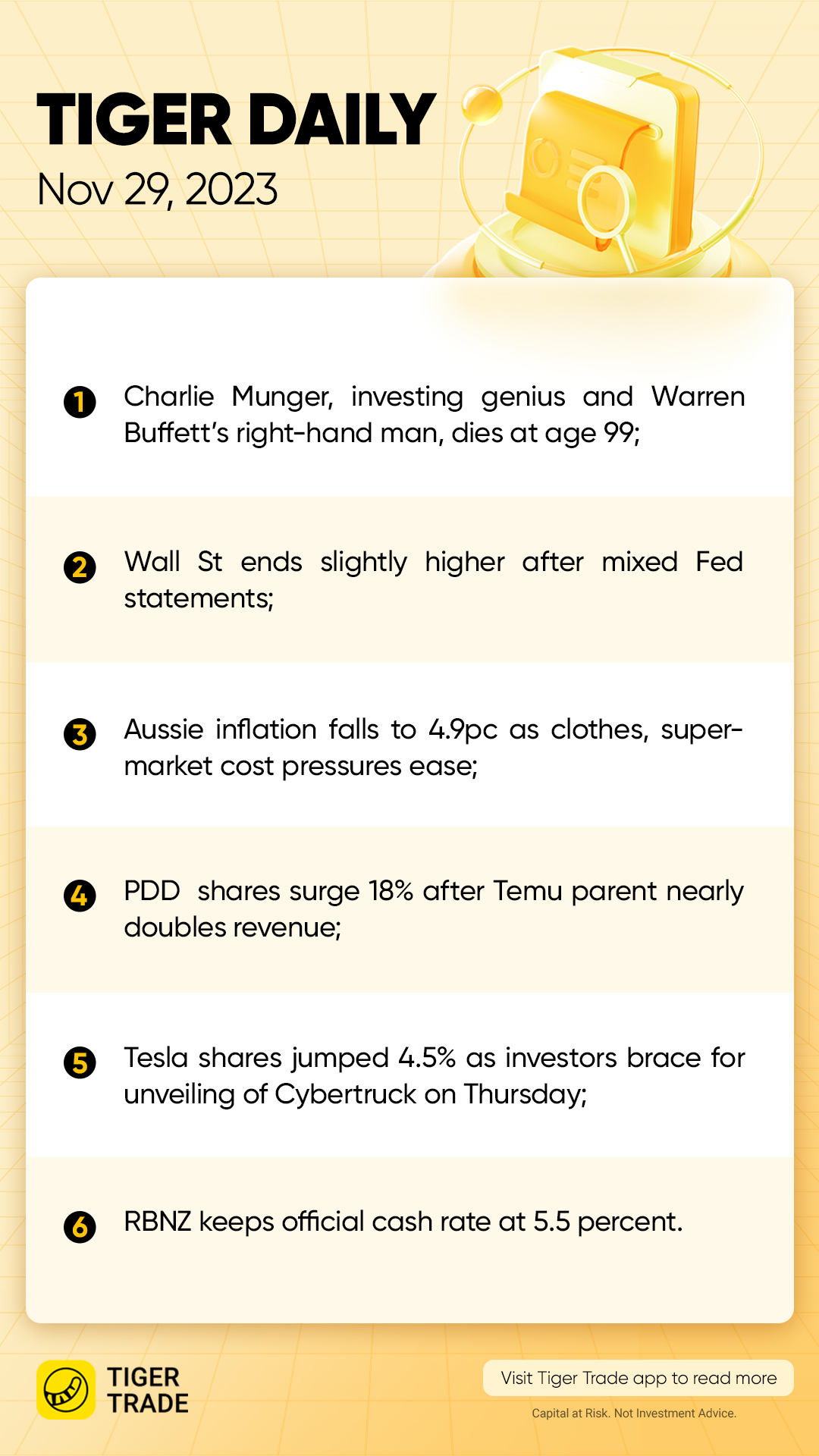
U.S.-listed shares of PDD Holdings surged 18% after the online retailer reported third-quarter earnings and revenue that smashed analysts’ estimates.
ChargePoint Holdings fell 3% to $1.93 after shares of the maker of equipment for electric-vehicle charging were downgraded to Neutral from Buy at UBS and the price target was cut to $2.25 from $9.
Avidity Biosciences rose 15% to $7.08 after the biopharmaceutical company announced a licensing and research deal with Bristol Myers Squibb. As a part of the collaboration focused on the development and commercialization of multiple cardiovascular drugs, Bristol Myers will pay Avidity $60 million in cash and will purchase about $40 million of Avidity common stock at $7.88 a share.
Affirm jumped 11.5% to $32.75 after Jefferies analysts highlighted the growing adoption of the “buy now pay later” service. The analysts upgraded their recommendation on Affirm to Hold from Underperform.
Carlyle Group rose 4.9% as shares of the buyout group were set to join the S&P MidCap 400 index beginning Thursday, according to S&P Dow Jones Indices.
Market News
Charlie Munger, investing genius and Warren Buffett’s right-hand man, dies at age 99
Billionaire Charlie Munger, the investing sage who made a fortune even before he became Warren Buffett’s right-hand man at Berkshire Hathaway, has died at age 99.
Munger died Tuesday, according to a press release from Berkshire Hathaway. The conglomerate said it was advised by members of Munger’s family that he peacefully died this morning at a California hospital. He would have turned 100 on New Year’s Day.
“Berkshire Hathaway could not have been built to its present status without Charlie’s inspiration, wisdom and participation,” Buffett said in a statement.
Apple Pulls Plug on Goldman Credit-Card Partnership
Apple is pulling the plug on its credit-card partnership with Goldman Sachs, the final nail in the coffin of the Wall Street bank’s bid to expand into consumer lending.
The tech giant recently sent a proposal to Goldman to exit from the contract in the next roughly 12-to-15 months, according to people briefed on the matter. The exit would cover their entire consumer partnership, including the credit card the companies launched in 2019 and the savings account rolled out this year.