


John Flood, a senior executive at Wall Street giant Goldman Sachs, stated that as positioning across U.S. and global equity markets grows increasingly crowded, and the strong buying power of CTAs — one of the core institutional capital forces — is about to shift to selling, equity investors should prepare for a notable correction in the short term.
Therefore, ahead of the back-to-back quarterly earnings releases from five mega tech giants including Google, Microsoft and Apple this week, multiple Goldman Sachs strategists led by Flood warned that fading marginal buying from CTAs, selling pressure from pension fund rebalancing, hedge fund deleveraging and continuous deterioration in market breadth may jointly trigger a near-term market pullback. Nevertheless, the Goldman Sachs strategy team stressed that the medium and long-term bullish outlook for equities remains intact, and the correction will serve as a major opportunity to purchase and allocate stocks on dips.
As a Goldman Sachs Partner and Head of Americas Equities Execution Services, Flood projected in his latest research report that the S&P 500 will keep surging sharply through the end of this year. Meanwhile, he warned of potential sharp sell-off risks for the benchmark index in the near term. In his report dated Sunday, he also pointed out that such a pullback should be regarded as a significant buying opportunity on dips.
From the AI boom to overheated positioning, Goldman Sachs warns of a market correction, yet emphasizes dips as ideal entry points.
The latest market judgment from Goldman Sachs strategists does not signal the end of the bull market. Instead, the short-term rally driven by the AI frenzy has become overly fierce, positioning excessively crowded and marginal buying momentum depleted, leaving U.S. and global risk assets vulnerable to a near-term correction. This pullback, however, is more likely a rebalancing within the bull market rather than a secular bear reversal. Strategists including John Flood clearly noted that CTAs have ceased to be marginal buyers after purchasing approximately $530 billion in assets over the past month. Month-end pension fund rebalancing may bring over $250 billion in U.S. equity selling pressure, while hedge funds have also reduced leverage amid the market rebound. Even so, they expect the S&P 500 to trade “materially higher” by year-end and define the potential correction as a buying opportunity.
CTAs, namely Commodity Trading Advisors known as “fast money” capital, are likely to become a key catalyst for market sell-offs. The Goldman Sachs strategy team led by Flood indicated that after accumulating around $530 billion in equity assets in the past month, CTAs currently hold roughly $320 billion in long positions on the S&P 500 and will no longer act as major buyers of the index in the short run. Based on Goldman Sachs trading desk models, CTAs may turn net sellers if stocks move sideways temporarily, and selling will intensify amid market declines.
Large-scale month-end pension fund rebalancing is also set to weigh on U.S. and global stock markets. Goldman Sachs strategists forecast that pension funds may sell more than $250 billion worth of U.S. equities, ranking this projected sell-off among the top 15 since 2000 for the bank.
“Excluding quarter-end settlement dates that combine monthly and quarterly rebalancing, this will be the largest monthly selling estimate on record,” Flood and his team added.
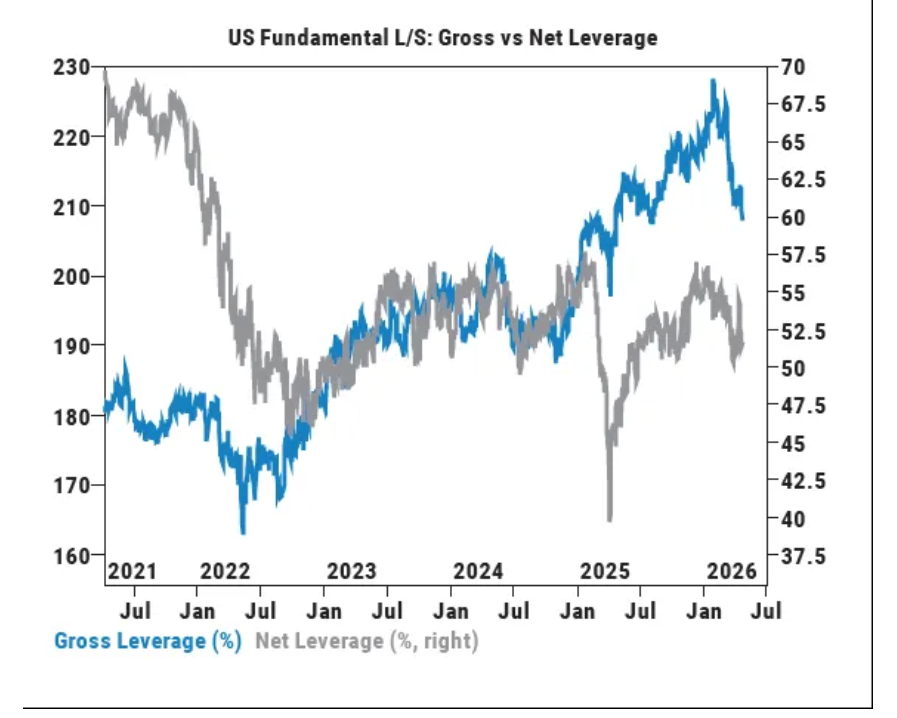
Meanwhile, hedge funds have seen a sharp decline in overall leverage, as managers actively covered short hedging positions during the recent market rebound. Goldman Sachs Prime Brokerage data showed that overall trading activity dropped for the first time in 13 weeks last week, leaving leveraged hedge funds with limited room for additional equity purchases in the near term.
According to the firm’s statistics, hedge funds cut their overall long and short equity exposure at the steepest pace since last September to reduce market risks amid the U.S. stock rally.
U.S. stocks retreated modestly on Tuesday. Following a steep April rally, the S&P 500 and Nasdaq 100 eased notably from record highs. Supported by resilient corporate earnings and easing U.S.-Iran geopolitical tensions, the two key benchmarks are on track for one of their strongest monthly performances in years. The rapid rally has pushed major indices into overbought territory and lifted investor exposure substantially, with Goldman Sachs’ U.S. Equity Sentiment Index signaling crowded positioning.
In addition, market breadth has deteriorated markedly. The Philadelphia Semiconductor Index, a key semiconductor sector bellwether, posted a record 18 consecutive daily gains. The gap between the 52-week highs of the S&P 500 and its median constituent stock has widened to one of the largest levels since 2020, reflecting that the current rally is highly concentrated on leading AI computing chain players such as Intel, AMD, Broadcom and Micron. Such extreme concentration has made equities highly sensitive to downside reversals, as five global tech heavyweights — Google (GOOGL.US), Microsoft (MSFT.US), Amazon (AMZN.US), Meta (META.US) and Apple (AAPL.US) — are scheduled to release quarterly earnings in the coming days.
Avoid chasing highs at crowded and overheated levels; investors may seize short-term entry opportunities amid the upcoming correction.
Specifically, Goldman Sachs worries that multiple negative factors will jointly trigger a brief technical and position-driven pullback: sharp volatility triggered by big tech earnings, massive selling from CTAs and pension funds, overvalued semiconductor stocks linked to AI computing infrastructure, and sustained oil price and interest rate pressure amid prolonged U.S.-Iran geopolitical tensions. In the medium term, as long as AI capital expenditure, corporate earnings, share buybacks and robust cash flow of tech giants continue to shore up fundamentals, Goldman Sachs maintains that the overall market trend remains bullish.
Tony Pasquariello, Global Head of Hedge Fund Coverage at Goldman Sachs, holds a view consistent with John Flood: the bull market is far from over, making both bullish chasing and blind shorting irrational. Investors are advised to maintain core long exposure and wait for dips to increase allocations. In short, Goldman Sachs is not calling for a market retreat, but reminding investors to avoid chasing highs at the most crowded and overheated levels, with reasonable allocation opportunities only emerging in the upcoming short-term correction.
Tony Pasquariello warned of localized topping risks in the technology and semiconductor sectors. The explosive monthly surge of the Philadelphia Semiconductor Index, elevated RSI readings and extreme deviations from the 200-day moving average indicate that the bullish narrative of the AI computing chain has been rapidly and excessively priced, even with short-squeezing characteristics. The core issue is not weak AI demand, but overcrowded market bets on perpetual upward revisions of AI capital spending and unlimited profit growth for semiconductor firms. Goldman Sachs’ U.S. Equity Sentiment Index has climbed to historically stretched levels, which typically lead to subdued stock returns in the subsequent weeks. Coupled with concentrated tech earnings releases and worsening market breadth, the market’s heavy reliance on a small number of large-cap AI stocks has greatly reduced short-term risk tolerance.
Rich Privorotsky, Head of Delta One at Goldman Sachs, issued macro warnings stemming from combined oil price and interest rate pressures. If Iran’s geopolitical situation fails to normalize quickly, oil price shocks will evolve from one-off spikes into lasting pressure transmitted through gasoline costs, shipping fees, inflation expectations, corporate operating expenses and nominal interest rates. Goldman Sachs has raised its fourth-quarter average Brent crude price forecast to $90–100 per barrel, with upside oil risks still lingering under extreme scenarios, suggesting energy markets are repricing prolonged geopolitical conflict risks. Persistently high oil prices will constrain the Federal Reserve’s monetary easing pivot and keep long-term Treasury yields under pressure, directly challenging the discount rate assumptions for high-valued tech stocks.
In terms of investment strategy, the bullish narrative of the AI computing sector remains intact, yet this earnings season serves as a critical ROI verification period rather than a market celebration. The overall AI investment theme stays bullish, with capital set to rotate from general AI concept stocks to sectors with solid cloud computing order visibility, tight supply and clear commercialization logic. The sustainability of the global stock bull market hinges on whether the five major tech giants can deliver clear growth paths in three core dimensions: sustained robust AI capital expenditure, tangible AI revenue monetization, and controllable profit margin and cash flow risks.
Morgan Stanley and Citi share the same analytical logic: the core indicator to measure AI investment returns is accelerated revenue growth from AI-related businesses, rather than mere AI CapEx scale. Trillion-dollar tech leaders need to maintain aggressive investment cycles in AI computing infrastructure amid clearer AI monetization paths. Google needs to prove cloud and AI-driven revenue can offset depreciation costs; Microsoft must ensure Azure computing demand continues to outpace supply; Meta needs to verify that AI-powered advertising cash flow can cover infrastructure expansion; Amazon has to deliver credible long-term AWS AI capacity plans for 2027–2028. Meanwhile, JPMorgan has lifted its year-end S&P 500 target to 7,600, citing AI-driven earnings upgrades and strong tech momentum, further proving that mainstream Wall Street institutions remain confident in the durability of the AI rally.
