


TradingKey - Brent crude (UKOIL) prices briefly touched $107 per barrel. Last Saturday, Houthi militants attacked King Khalid International Airport in Riyadh, the capital of Saudi Arabia, rapidly escalating market fears over Middle East supply disruptions.
According to Saudi state media Saudi Gazette, the General Authority of Civil Aviation of Saudi Arabia stated that the attack on Riyadh's King Khalid International Airport left 13 people dead and 309 injured. Earlier on Thursday, a Houthi attack on the airport killed three Saudi citizens, including a pilot.
Diplomatic channels also remain in a stalemate. Iran's "seven conditions" and the U.S. response delivered via Qatari intermediaries have yet to produce substantive progress in negotiations. The White House said U.S. officials are engaging in active and constructive dialogue with mediators regarding Iran, but the blockade and military pressure persist.
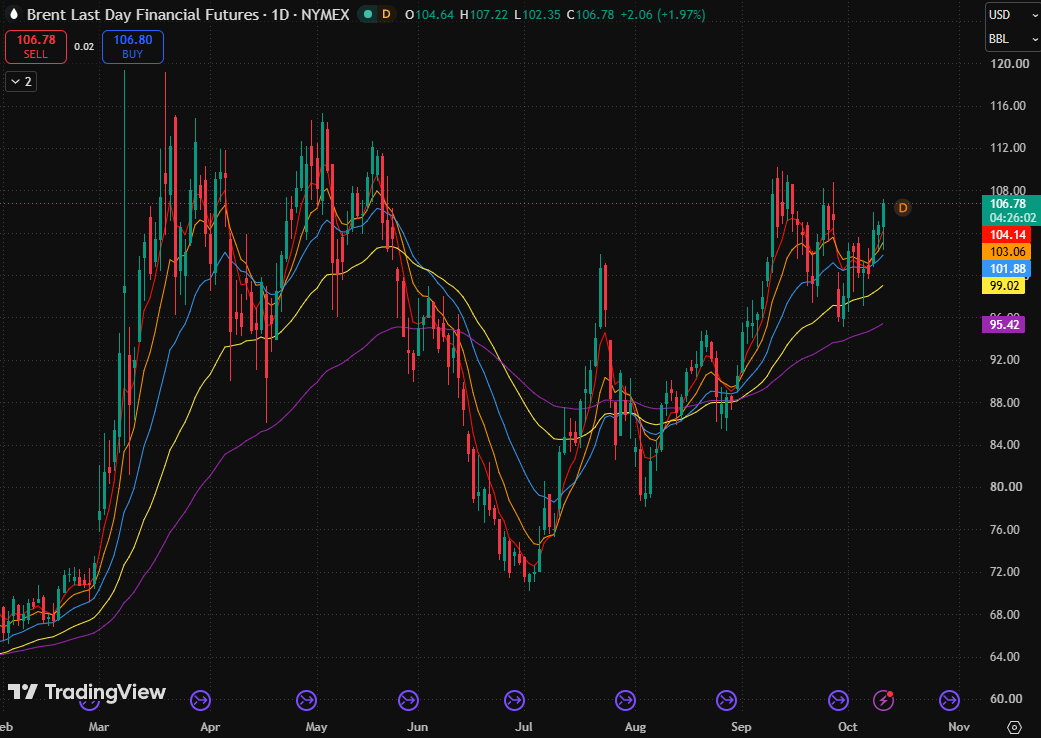
Brent crude daily chart, Source: TradingView
The Strait of Hormuz is a vital global energy transit corridor. Iran's blockade of the strait has become its primary lever of pressure, with impacts spreading from the Middle East to international energy markets. As the U.S. Congressional midterm elections in November approach, rising oil prices and potential fuel cost pressures present new political challenges for the Trump administration and the Republican Party.
Against the backdrop of already elevated oil prices, Goldman Sachs further raised its short-term crude price forecast. The bank raised its December Brent crude forecast by $5 to $90 per barrel, citing ongoing risks to Middle East supply.
Goldman Sachs analysts including Daan Struyven stated that while an eventual recovery and adjustment of Middle East supply could exert downward pressure on oil prices, further regional escalation still poses significant upside risks. Downside risks to supply, inadequate inventories, and high sensitivity of oil prices to interest rates are keeping demand for physical replenishment and financial hedging strong.
Goldman Sachs maintained its forecast for an average Brent crude price of $80 per barrel in 2027. The bank believes supply in the Gulf region could recover faster than expected, and risk premiums may gradually recede; however, short-term supply risks remain sufficient to support oil prices at high levels. Meanwhile, Goldman's commodities team acknowledged that its long-standing Brent crude pricing model "has broken down" this year. The model previously tracked commercial inventories in OECD countries, but nearly 60% of the inventory drawdowns in this cycle have occurred in non-OECD countries. Relying solely on OECD inventory data is no longer capable of accurately reflecting true changes in the global supply buffer.
This means the market is paying near-record "fear premiums" for a global oil supply system with virtually no inventory buffer. Even if actual supplies have not yet been fully disrupted, as long as shipping risks continue to accumulate, oil prices could price in potential losses in advance.
In addition, Vitol CEO Russell Hardy stated at the Energy Intelligence Forum in London that Western nations "have no more inventory left to draw down." He warned that in an extreme scenario, if shipping in the Strait of Hormuz is disrupted, oil prices could surge toward $200 per barrel.
The future trajectory of oil prices remains contingent on three key variables: whether shipping through the Strait of Hormuz remains disrupted, the scale of actual supply losses in Iran and the Gulf region, and whether diplomatic channels can be restarted.
Find out more
