


"The first stablecoin stock" Circle exploded! Short time?
At the beginning of the U.S. stock market on Monday, Circle, the first stablecoin stock, rose to more than 24%. In just a few weeks, the stock price soared from US $31 to approaching the US $300 mark. Since its listing, it has risen by more than 860%, and its total market value once reached US $65 billion.
The data shows,$Circle Internet Corp. (CRCL) $Is a leading global fintech company whose core business is issuing and managing compliant stablecoins USDC and EURC. As a digital asset anchored to legal currency, stablecoins are widely used in cross-border payments, on-chain transactions, DeFi ecosystem and other scenarios.
Circle is widely trusted by institutions for its regulatory compliance, transparent reserves, and sound audits. It is currently the most recognized "regular army" stablecoin issuer. Its main source of income is the interest on U.S. debt corresponding to USDC, which is about US $1.5 billion per year, 50% of which is allocated to partner Coinbase.
In terms of financial data, the company's fundamentals have performed well, with both revenue and profit showing strong growth momentum.
In the first quarter of this year, the company's revenue reached US $578 million, a year-on-year increase of 58.5%, and its net profit was US $64.8 million, compared with US $48.6 million in the previous year, an increase of 33.2%. Circle's USDC (U.S. dollar stablecoin) saw a surge in trading volume, with roughly $6 trillion processed in the first quarter and more than $25 trillion since its launch.
With the advancement of the "GENIUS Act", USDC issuer Circle may become the biggest winner.Because it has actively embraced supervision for a long time-it continues to promote the transparency of asset audits, and cooperates with the guidance and recommendations of U.S. regulatory agencies. The reserve assets are mainly cash and short-term U.S. debt. After the bill is passed,USDC relies on its unique attributes of "registered in the United States, clearly audited, and friendly supervision",The penetration rate in payment networks such as Visa, Mastercard, PayPal, etc. is expected to jump further.
And USDT faces survival mode challenges.Tether, the issuer of USDT, is headquartered in the British Virgin Islands. It has long used "offshore opacity" as its moat, and the composition of asset reserves has been repeatedly questioned. With the implementation of the "GENIUS Act", the circulation of USDT in the United States will undoubtedly be significantly affected. Although Tether is not helpless, its options are not easy:
Proactively apply for a U.S. license in accordance with regulatory requirements;
Abandon the US market and move to Asia, the Middle East and other places;
Establish a cooperation mechanism with the compliance platform, and access the compliance network in disguised form through "hierarchical distribution" or "transfer bridge".
Overall, although USDT still has advantages due to its liquidity, network effects, and global adoption, the complexity and time cost of its compliance transformation provide a valuable window period for USDC.USDC is expected to take advantage of the "GENIUS Act" to accelerate its penetration into global payment networks and institutional scenarios, and its market share may increase significantly.
For investors who want to hedge after a big rise, you can consider shorting Circle with a bear market spread strategy.
Options Strategy: Use the Bear Spread Strategy to Short Circle
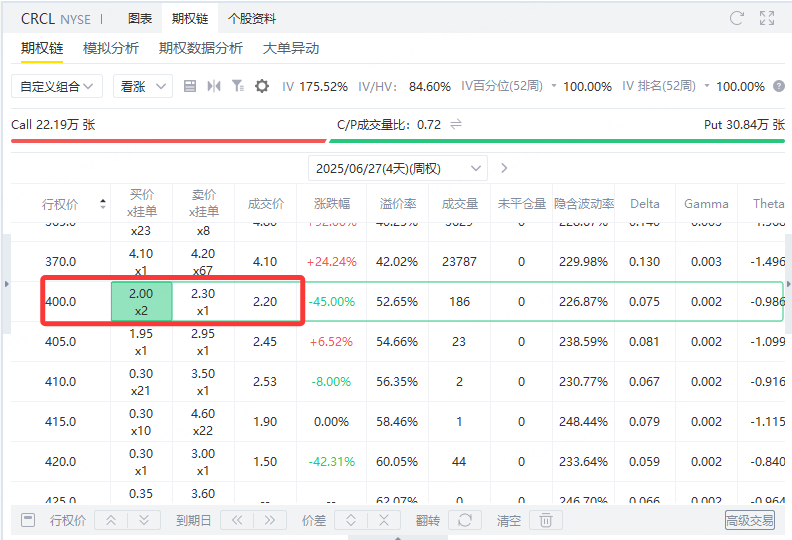
The current price of Circle is $270, and we can short Circle by selling a call option expiring on June 27, 2025, with an exercise price of 400 and a premium of $220.
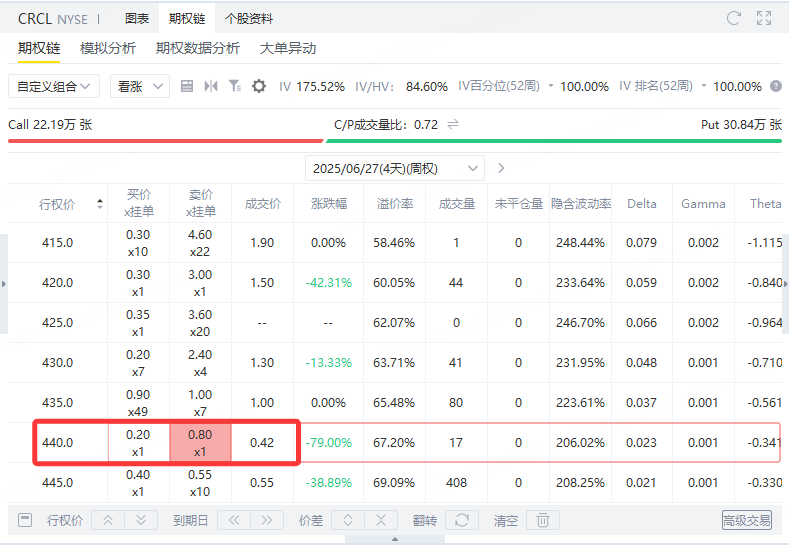
Because we are worried that the newly listed stock will skyrocket and cause huge losses to investors, we can also buy a call option with an exercise price of 440 and spend $42 to limit the maximum loss.
Sella sheet ofDue June 27, 2025、Exercise price $400OfCall Options Call Option, obtained premium rights$220/sheet;
BUYa sheet ofSame due date、Strike price $440OfCall Options, pay premium42 USD/sheet;
Net income was:(220-42) × 1 sheet = US $178。
Profit and loss analysis:
Maximum benefit(when stock price ≤ 400):
Neither option is exercised;
Revenue = Net premium Revenue =$178
Maximum loss(when stock price ≥ 440):
Call 400 is executed (you need to sell the stock for $400), and Call 440 is also executed (you buy it for $440);
Loss per share = 440-400 = $40;
Total loss = 40 × 100 = $4000;
After deducting premium income:Maximum loss = 4000-178 = $3822
Break-even point(just neither profit nor loss):
Total Net Income = $178 ⇒ Per Share = 178/100 =$1.78
Break-even point = sell Call exercise price + net income per share =400 + 1.78 = $401.78
Strategy Conclusion:
This strategy is suitable for you to judge that Circle will not rise above $400, and you want to earn time value by selling out-of-the-money Calls, while buying Calls with higher strike prices to limit potential loss risks.
Disclaimer: Investing carries risk. This is not financial advice. The above content should not be regarded as an offer, recommendation, or solicitation on acquiring or disposing of any financial products, any associated discussions, comments, or posts by author or other users should not be considered as such either. It is solely for general information purpose only, which does not consider your own investment objectives, financial situations or needs. TTM assumes no responsibility or warranty for the accuracy and completeness of the information, investors should do their own research and may seek professional advice before investing.
