


The "tariff deadline" is approaching, how to use SPY options to lock in risks?
On July 9th, the "tariff deadline" is approaching. May Trump personally end the negotiation window? On Sunday local time, Trump said in an interview with the media,There is no need to extend the expiring tariff period. Letters will be sent to hundreds of countries, including Japan, in the next few days to unilaterally inform them of the tariff rates of exports to the United States, instead of continuing trade negotiations.
Trump took the letter beginning with "Dear Mr. Japan" as an example to illustrate how the United States will inform trading partners of the new tariff arrangement, sayingThe United States will impose a 25% tariff on Japanese cars.
He stressed that the letter will be sent out soon, saying that "we don't need a meeting, we know the situation and we have all the data".
Previously,Trump made similar promises on May 16th and June 11th, saying that he would send unilateral tariff letters within 2-3 weeks, but none of them were fulfilled.
Meanwhile, this week's US-Japan trade talks have stalled。Japan's chief tariff negotiator, Yoshio Akazawa, failed to achieve a breakthrough in the seventh round of ministerial negotiations in Washington this week, and even failed to meet with U.S. Treasury Secretary Bescent.
Trump's statement means that the U.S. government is preparing to abandon the practice of resolving trade disputes through negotiations.
Trump said in the interview:
"I'd rather just send them a letter, a very fair letter, saying 'Congratulations, we're going to allow you to trade in the United States of America and you're going to pay 25% tariffs, or 20%, or 40% or 50%'".
This position is in contrast to previous statements made by US officials.
U.S. Commerce Secretary Lutnick and National Economic Council Director Hassett had previously promised that a large number of agreements would be reached this week. Wall Street News also mentioned that Treasury Secretary Bescent also said last Friday that the trade agreement might be completed before September 1st.
For investors who are worried that the market will fluctuate sharply again due to trade issues, they can consider using broad-cap index options as a hedge.
Large Cap Options Index Hedging Strategy
If investors currently hold value$1,000,000 US technology stocks, hoping to hedge the downside risk through options. Let's take buying the Put option (Put) of the SPY index as an example to explain in detail:
Basic assumptions:
Current SPY price is $617
The selection option is: Put with an exercise price of $614 expiring on July 31, 2025
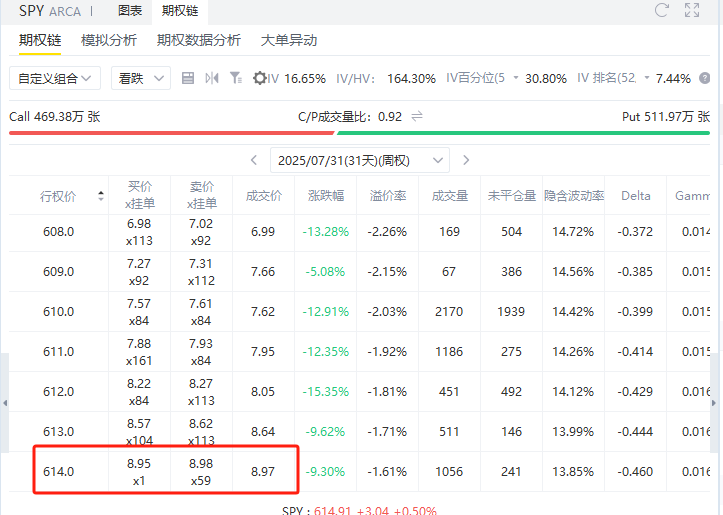
Current price per option is $897
Each SPY option represents 100 shares, which corresponds to a position of approximately $61,700 market capitalization
To hedge a technology stock portfolio with a market capitalization of $1,000,000, you need to buy roughly 16 SPY Put (1,000,000 ÷ 61,700 ≈ 16)
The total cost is: 16 × $897 =$14,352, approximately 1.44% of investor assets
Scenario analysis:
SPY unchanged at $617
The investor's stock portfolio is not losing money
SPY Put expires and invalidates, losing all premium $14,352
Net loss: $14,352 (i.e. "premiums")
SPY fell to $580 (down 6%)
Stock portfolio estimated loss of approximately $60,000
The intrinsic value of SPY Put is ($614-$580) = $34 and the total return of 16 options is $54,400
Net loss is:-60,000 + 54,400 =-$5,600(loss of only 0.56%)
SPY fell to $550 (down about 10.9%)
Stock portfolio estimated loss of approximately $109,000
SPY Put Value is ($614-$550) × 100 × 16 = $102,400
Net loss is:-109,000 + 102,400 =-$6,600
SPY fell to $500 (down about 18.9%)
Stock portfolio estimated loss of approximately $189,000
SPY Put Value is ($614-$500) × 100 × 16 = $182,400
Net loss is:-189,000 + 182,400 =-$6,600(almost locked in the maximum loss)
SPY rises to $650 (up ~ 5.3%)
Stock portfolio estimated profit of approximately $53,000
Put expired and void, loss of $14,352
Net income is: $53,000-$14,352 =$38,648
Summary:
By buying SPY Put, you can effectively hedge your risk when the broader market falls sharply, so that the maximum loss of the portfolio is controlled at about $6,600.
If the market does not fall, the loss of premium is $14,352, which is equivalent to paying 1.44% of the "insurance premium".
If the market rises, investors still have most of the gains in their portfolios, but only slightly less.
Disclaimer: Investing carries risk. This is not financial advice. The above content should not be regarded as an offer, recommendation, or solicitation on acquiring or disposing of any financial products, any associated discussions, comments, or posts by author or other users should not be considered as such either. It is solely for general information purpose only, which does not consider your own investment objectives, financial situations or needs. TTM assumes no responsibility or warranty for the accuracy and completeness of the information, investors should do their own research and may seek professional advice before investing.
