


Non-agricultural data will be released tonight! How to trade U.S. bonds with diagonal spreads?
At 8:30 p.m. Beijing time on Thursday, the U.S. Bureau of Labor Statistics will release the June non-farm payrolls report.Economists expect non-farm payrolls to increase by 110,000 in June, a slowdown from 139,000 last month, the unemployment rate to rise slightly from 4.2% to 4.3%, and the year-on-year hourly wage growth rate to remain unchanged at 3.9%, with the month-on-month growth rate slowing to 0.3% from 0.4% in May.
Morgan Stanley chief U.S. economist Michael Gapen wrote in a note to clients, "We think labor demand is slowing, but so far,The magnitude of the slowdown is modest.”
If the non-agricultural data is in line with expectations, this will keep the Fed on track to cut interest rates in September, which is also in line with investors' current expectations through the futures market. However,Any signs of faster deterioration will increase bets on the Fed's early action at the upcoming July 29-30 policy meeting.
Nancy Vanden Houten, chief U.S. economist at Oxford Economics, said in a note, "The weak job market in June is a signal of future trends, and we expect the rest of the year to weaken due to tariffs and high policy uncertainty." The employment growth trend will weaken. "
Will unemployment rise?
With major changes in the field of federal trade and immigration policy,Economists are divided on whether and how much unemployment will rise in June--And this is perhaps the most influential indicator of Fed policy in the report.
Most leading indicators point to a rise in unemployment. In the week in which the monthly report data is collected,Continuing jobless claims rise to nearly two million, which is the highest level since November 2021.
Recent data has also continued to show signs of cooling the job market. On Wednesday,Private-sector employers unexpectedly cut 33,000 jobs in June, ADP data showed.This marks the first monthly loss of jobs in the private sector since March 2023. Continuing jobless claims, meanwhile, recently reached their highest level in nearly four years.
The report also indicates that,The summer hiring season for American college graduates is off to a rough start, and economists at Citigroup, who expect the unemployment rate to jump to 4.4%, believe that this is a potential factor.
Andrew Hollenhorst, chief U.S. economist at Citigroup, said in a note, "The number of people applying for unemployment benefits continues to rise, and this may underestimate the unemployment situation, because new entrants to the labor market will show up as unemployed, but they are not eligible for unemployment benefits."
On the other hand,Trump administration efforts to halt immigration and step up deportations could help curb unemployment, becauseSlowing hiring is matched by slowing workforce expansion-while pushing down the numerator and denominator of the formula.
That appears to be the case in the May report, when the unemployment rate remained at 4.2% while the labor force participation rate fell to 62.4%. Economists at Morgan Stanley believe that this dynamic will keep the unemployment rate unchanged again in June data. The Morgan Stanley team, led by the bank's chief U.S. economist Michael Gapen, said in a note that "unauthorized immigrants and their families may choose to reduce labor participation to reduce their chances of deportation.If last month's decline in labor force participation persists in June, that would further support this view, "they said, adding,The unemployment rate would have been 4.7% if it weren't for the massive drop in participation.
But Stuart Kaiser, head of U.S. equity trading at Citigroup, wrote in a note to clients that if Thursday's jobs report shows signs of a clear slowdown in the U.S. economy, that, while further increasing bets on interest rate cuts, could also be a downside catalyst for stocks. Kaiser wrote, "We believe a non-farm payrolls reading below 100k or an unemployment rate of 4.4% would send stocks down at least 1%,”
If the non-agricultural data falls short of expectations, it may usher in a good time to go long on U.S. debt.
What is a diagonal spread?
diagonal spread refers to the spread established using options with different strike prices and different expiration dates. Generally, the duration of the long leg in the spread is longer than that of the short leg. Diagonal spreads include diagonal bull spreads versus diagonal bear spreads.
The diagonal bull spread is basically similar to the bull subscription spread strategy, except that it has been upgraded and improved again.The difference is that the two options for the diagonal spread have different expirations, the trader buys a longer-term call option with a lower strike price and sells a shorter-term call option with a higher strike price. The number of call options bought and sold is still the same.
TLT Diagonal Spread Case
Assuming investors are bullish for the next year$20 + + Years US Treasury Bond ETF-iShares (TLT) $, you can directly buy the call option with an exercise price of 88 and an expiration date of March 31, 2026. This option becomes our long leg, which costs $425 at the latest transaction price.
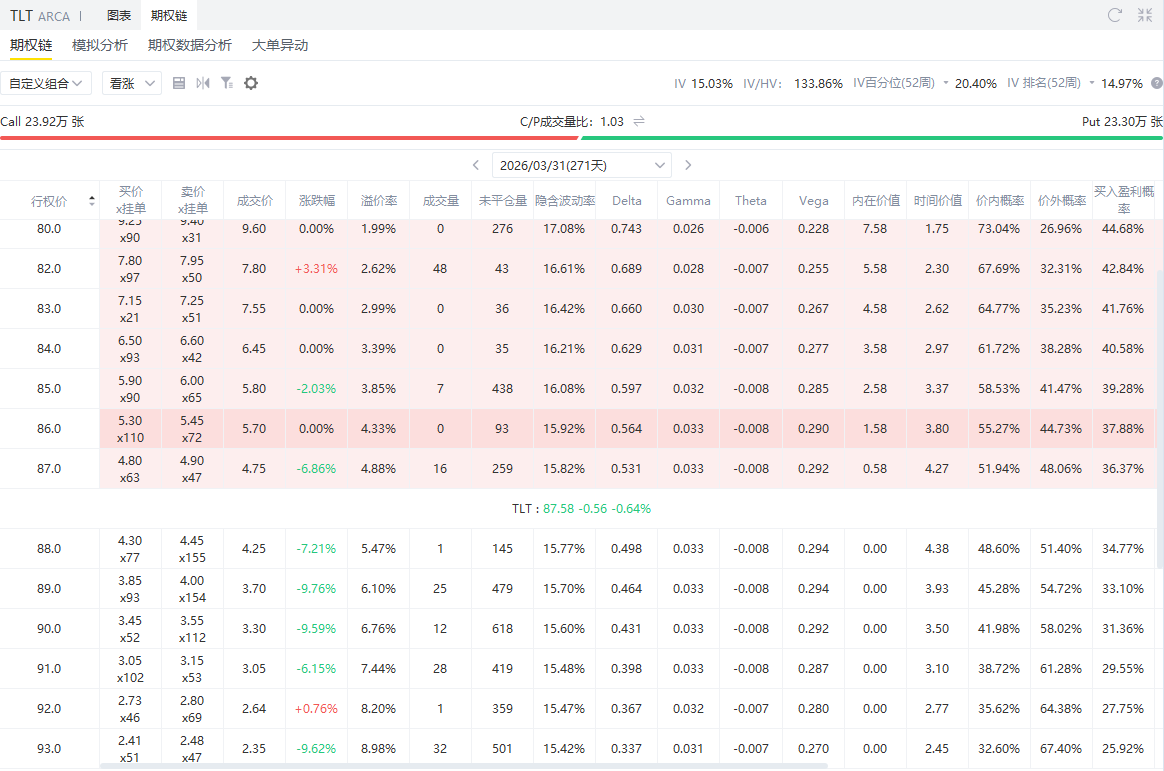
After the long leg is established, we can establish the short leg according to a shorter cycle than the long leg. Here, we can choose to establish it on a weekly basis. Choose to sell a call option with a strike price of $90 and an expiration date of July 11 and get $10 from premium.
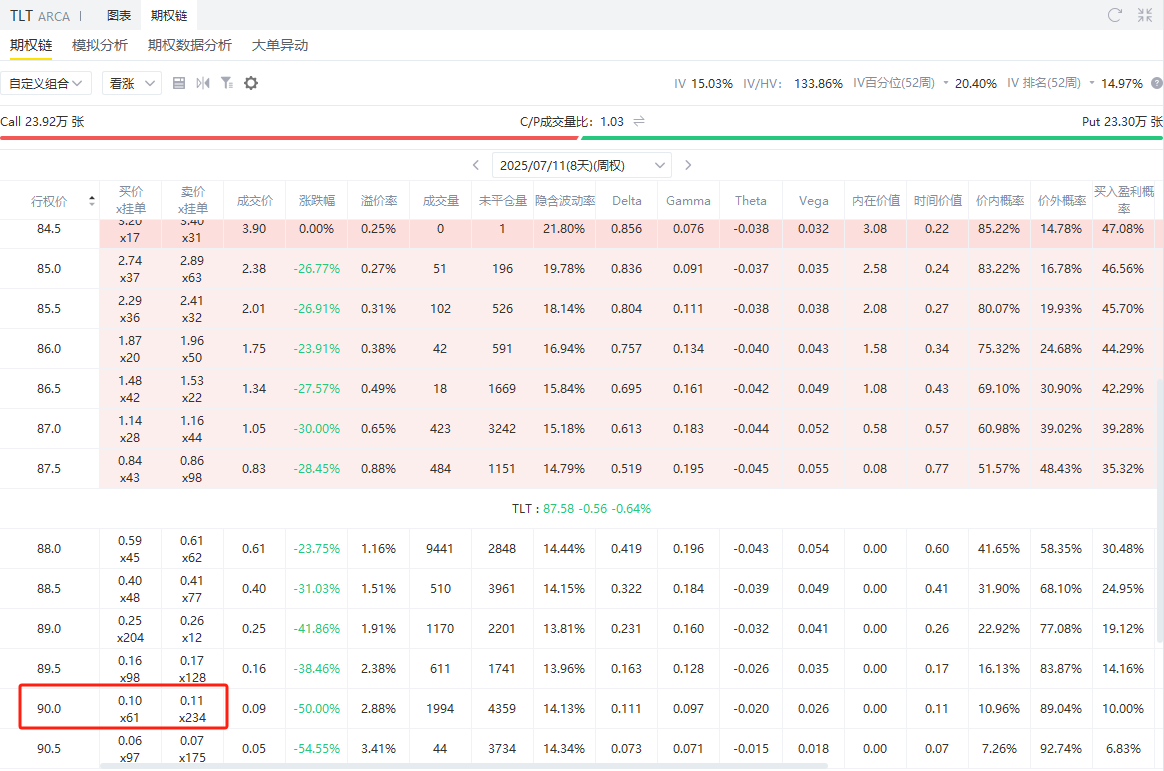
Here, if the call option sold is not exercised, it will generate a profit of $10, which is about 2.3% relative to the cost of $425 on the long side. However, the short leg can be executed once a week. With the remaining date of the long leg of 271 days, investors can sell call options many times. If some sold call options can successfully obtain premium, the cost of buying call options will be greatly reduced. The cost of the option itself, and even get call options for free.
Compared with buying bulls alone, the diagonal spread obtains an additional premium income, which reduces the overall net premium expenditure of the strategy, and the break-even point of the strategy is also shifted to the left, and the winning rate is also increased accordingly. AdditionallyThe selling point of the diagonal spread can be controlled by investors themselves, so different short-selling efforts can be selected in different cycles to facilitate investors to control risks. Diagonal spreadEssentially, it is a low-cost call option strategy that is worth investors studying.
Disclaimer: Investing carries risk. This is not financial advice. The above content should not be regarded as an offer, recommendation, or solicitation on acquiring or disposing of any financial products, any associated discussions, comments, or posts by author or other users should not be considered as such either. It is solely for general information purpose only, which does not consider your own investment objectives, financial situations or needs. TTM assumes no responsibility or warranty for the accuracy and completeness of the information, investors should do their own research and may seek professional advice before investing.
