


Long-term U.S. bond yields are approaching the 5% mark. Is the opportunity for U.S. bonds coming?
Treasury Bond in the United States fell for the fifth consecutive trading day, as the global demand for long-term government bonds was weak, and US President Trump announced more tariffs, which once again caused panic in the financial market. In addition, the U.S. Treasury Department will auction 10-year and 30-year Treasury Bond today and tomorrow, and many futures and options traders have been closing some large bullish bets on U.S. Treasury Bond recently.
Market data showed that U.S. bond yields fell across the board again on Tuesday, with the 30-year U.S. bond yield further approaching the 5% mark, the highest level since mid-June. Although the benchmark 10-year Treasury Bond yield fell slightly in the afternoon of New York session, it still rose by about two basis points from the previous trading day.
The auction of 3-year U.S. Treasury bonds conducted by the U.S. Treasury Department on Tuesday marked the beginning of this week's Treasury Bond coupon issuance plan totaling $119 billion. However, the demand for the $58 billion three-year Treasury Bond auction was weak, and the winning bid rate was 3.891%, which was about 0.5 basis points higher than the pre-auction secondary market yield. The bid multiple is 2.51 and demand is also below average.
According to the schedule, the U.S. Treasury Department will auction $39 billion in 10-year Treasury Bond on Wednesday and $22 billion in 30-year U.S. bonds on Thursday, which may become the two highlights of the U.S. bond market this week.
U.S. bond yields have continued to rise since last week, initially as investors cut bets on the Federal Reserve to cut interest rates before the end of the year, after non-farm payrolls data released last Friday showed an unexpectedly strong U.S. labor market. Interest rate swaps show that traders have now completely withdrawn their bets on a July rate cut. The Fed is expected to cut interest rates this year starting in September, and another 25 basis points are expected before the end of the year.
Earlier on Tuesday, the sell-off of long-term Japanese Treasury Bond further triggered a new round of panic in global bond markets and pushed up German Treasury Bond yields.
The long-term Treasury Bond is suffering worldwide, as many traditional buyers withdraw from the market while supply expands. Such securities tend to attract a smaller group of investors because of their higher interest rate risk, and declining liquidity often exacerbates price volatility.
In the United States, U.S. debt is also facing contradictory risk factors around President Trump's tariff policy, U.S. fiscal policy and the prospect of the Federal Reserve's interest rate cut.
The U.S. Congress also last week passed the "Big and American Act" backed by Trump, which will increase U.S. public debt by trillions of dollars and raise the debt ceiling by $5 trillion over the next 10 years.
For investors who want to go long on U.S. bonds on dips, they can use the put option strategy to go long on U.S. bonds.
Options strategy: Use put options to go long on U.S. bonds
Faced with the trend of U.S. debt, we can use options strategies to conduct efficient long trading.
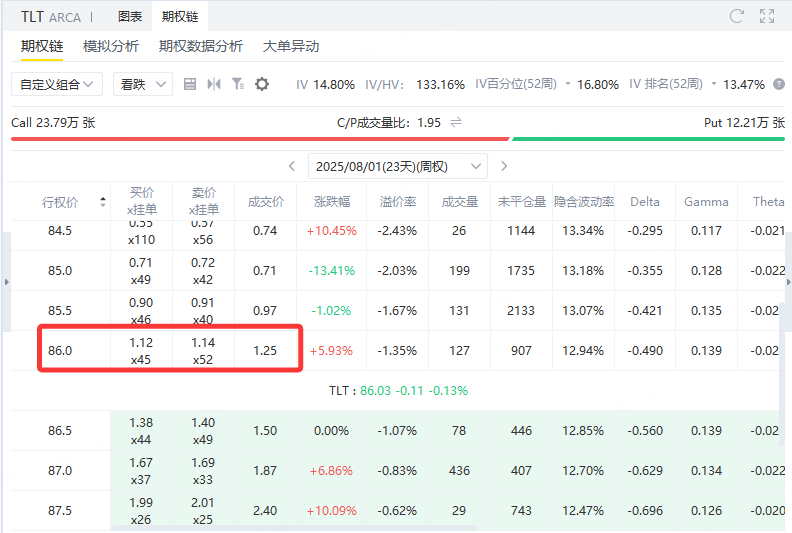
Current$20 + + Years US Treasury Bond ETF-iShares (TLT) $Current price is $86.03. We can do this bySell a Put Option with an exercise price of $86 and a premium of $125 expiring on August 1, 2025, to realize the strategy of being bullish on U.S. debt. This way belongs toCash-secured put options, with the characteristics of participating in the rise of U.S. bonds at a lower cost. This strategy can not only make profits when U.S. bonds rise, but even if gold prices trade sideways or fall slightly, you can still rely on premium to earn profits.
Profit and loss analysis:
Maximum benefit:If the price of the U.S. bond is higher than $86 at maturity, the option will not be exercised and investors will retain all premium gains. Maximum benefit =Premium revenue $125
Maximum loss:If the price of U.S. bonds falls to 0, investors still need to buy it at $86, and the net loss is the price paid minus premium. Maximum loss =$86-$1.25 = $84.75× 100 =$8,475
Break-even point:At maturity, as long as the price of U.S. bonds is higher than this price, positive returns can be achieved. Breakeven point =Strike price $86-premium $1.25 = $84.75
Investors' interest in U.S. debtModestly Bullish Ahead;
I hope to gain income through premium, even if U.S. debt does not rise;
Willing to buy U.S. bonds at a lower price during a correction.
sum up
In the face of Trump's aggressive policies, the unstable global situation and the central bank's increase in holdings, U.S. debt has become a real safe haven tool. Using the options market, we can efficiently go long U.S. bonds while controlling risks through the strategy of selling put options. This is not only a smart way of trading, but also a sound investment choice that conforms to market trends.
Disclaimer: Investing carries risk. This is not financial advice. The above content should not be regarded as an offer, recommendation, or solicitation on acquiring or disposing of any financial products, any associated discussions, comments, or posts by author or other users should not be considered as such either. It is solely for general information purpose only, which does not consider your own investment objectives, financial situations or needs. TTM assumes no responsibility or warranty for the accuracy and completeness of the information, investors should do their own research and may seek professional advice before investing.
