


AMD Gets Export License, Time To Go Long?
The White House confirmed on the 12th that two American chip manufacturers, Nvidia and AMD, have agreed to a special agreement to hand over 15% of their chip sales revenue in China to the U.S. government in exchange for export licenses for related products. The White House said the agreement could be expanded to more companies in the future. On August 12th, local time, White House spokesman Karoline Leavitt said at a press conference that at present, such agreements only involve these two companies, "but they may be extended to other companies in the future". She also said that the U.S. Department of Commerce is still studying the relevant legal basis and specific operation methods, and the details will be further explained by the Ministry of Commerce.
Bank of America (BofA) analysts revealed reports that Nvidia (NASDAQ: NVDA) and Super Micro$Advanced Micro Corporation (AMD) $After turning over 15% of AI chip sales from China to the U.S. government in exchange for export licenses, it maintained its "buy" rating on the two companies. Analyst Vivek Arya said the U.S. government agreed to allow the two companies to export specific AI chips (H20/MI308) to China at a 15% fee.
BofA believes that the agreement is a marginal benefit due to the following reasons: Nvidia and AMD have sufficient pricing power to offset some expenses; You can make use of the previously impaired inventory, and even if you pay a 15% fee, you can still recover part of the gross profit; Resuming sales to China will help maintain interaction with China's AI ecosystem and curb competitors to a certain extent (* *). Analysts also pointed out that it is difficult for the Chinese market to become a source of sustainable growth in the short term, due to the following reasons: uncertainty about future export license approval; It will take 8-9 months to restart the AI chip supply chain, which may lead to a sales gap in China in the first half of 2026; The AI industry is changing rapidly, which may compress the demand of some Chinese customers. BofA keeps its earnings forecasts for NVDA and AMD unchanged, but expects the two companies to try to recover recent impairments (NVDA $4.5 billion, AMD $800 million) even if they pay a 15% fee.
Go Long AMD With Put Options
The current AMD price is $184.42, and we can sell itExpires September 12, 2025, exercise price 182.5, premium $800Put Option to go longAMD。
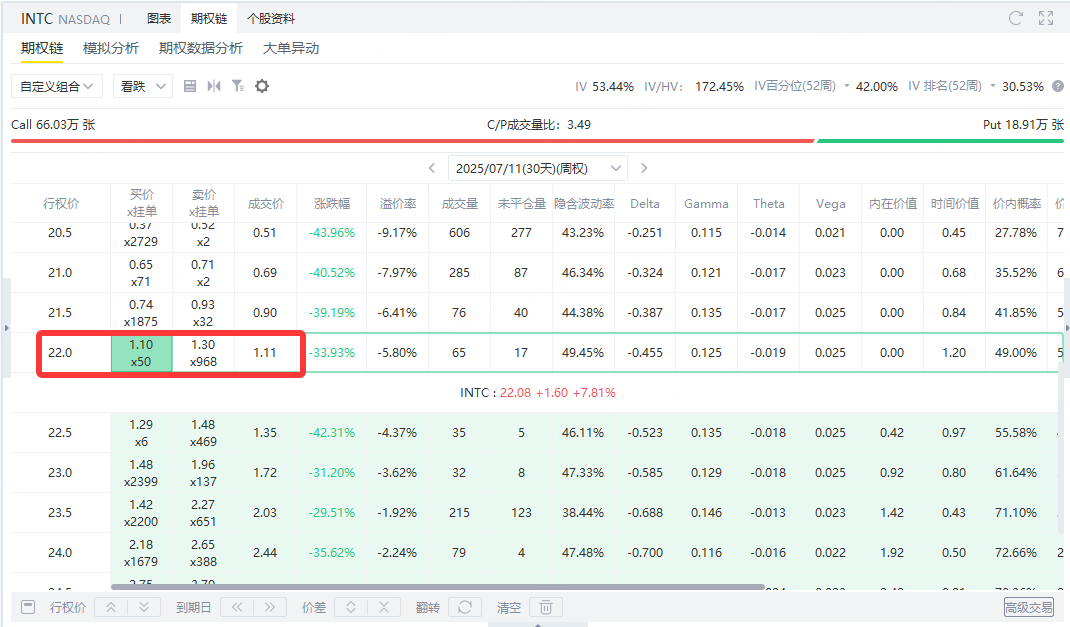
Not only can this strategy profit when AMD rises, even if AMD goes sideways or falls slightly, you can still rely on premium to earn earnings.
Maximum benefit: If AMD's stock price is higher than or equal to $182.5 at expiration, the option will not be exercised and you retain all premium. The maximum gain is $800.
Maximum loss: If AMD stock price drops to $0, you need to buy 100 shares at $182.5, with a total cost of $18,250. Subtracting premium received of $800, the maximum loss was $17,450.
Break-even point: The breakeven point is $174.50 (i.e. the exercise price of $182.5 minus $8.00 per premium). As long as the AMD stock price is above $174.50 at expiration, you are a net profit.
advantage:
The limited gain ($800) is locked in at the outset;
The winning rate is high, and you can make a profit as long as the stock price does not fall sharply;
If you want to buy AMD stock in the first place, this way can reduce the cost of buying.
Risk warning:
Profit and loss are asymmetric, the maximum income is limited, but the potential loss is large;
Requires a margin account to support selling naked Put;
Closing positions before expiration or rolling operations can be considered to dynamically manage risk.
Disclaimer: Investing carries risk. This is not financial advice. The above content should not be regarded as an offer, recommendation, or solicitation on acquiring or disposing of any financial products, any associated discussions, comments, or posts by author or other users should not be considered as such either. It is solely for general information purpose only, which does not consider your own investment objectives, financial situations or needs. TTM assumes no responsibility or warranty for the accuracy and completeness of the information, investors should do their own research and may seek professional advice before investing.
