


Netflix's financial report is released tonight! How to play options?
$Netflix (NFLX) $The financial report will be released after the market closes on October 21, Eastern Time. The agency expects revenue of US $11.514 billion in 2025Q3, a year-on-year increase of 17.19%; Earnings per share are expected to be $6.940, a year-on-year increase of 28.53%.
Looking back at the last quarter, Netflix's Q2 performance in 2025 was strong. The main points include a 16% year-on-year increase in revenue to US $11.08 billion, exceeding analysts' expectations of US $11.04 billion; Earnings per share of $7.19 also topped estimates of $7.07. The company's operating profit margin for the quarter is expected to reach 30%, and it raised its full-year revenue guidance to US $44.8 billion to US $45.2 billion, exceeding previous expectations.
The consensus estimate is that the operating margin will increase to 31.5% in the third quarter and 30.3% for the full year of 2025 (previously 29.6%). The company expects to achieve revenue growth by improving user engagement trends, reducing user churn rates, and providing a richer entertainment product portfolio. Gaming business and advertising growth could be key drivers in 2025.
In the spring, management pointed to advertising packages that allowed the company to offer lower-priced subscriptions. The company said on its earnings call that it expects ad revenue to double year-over-year again in 2025. Since the beginning of 2025, ad-supported revenue expectations have continued to rise ahead of the third-quarter earnings report. While still below the initial estimate of $1.6 billion in early 2024, current trends are improving and are now at $1.1 billion.
Looking back at 2025, Netflix's revenue can maintain a mid-double-digit growth rate, mainly due to two major factors:
First, the substantial growth of subscribers in the fourth quarter of last year laid the base;
The second is the increase brought about by price adjustments and exchange rate fluctuations in the US market this year. However, if you want to drive growth through price increases next year, you need to be wary of potential bottlenecks-the United States and some major markets have completed substantial price adjustments, but after excluding the impact of exchange rates, the overall average revenue per user (ARPU) growth rate is still slowing down. Even if the current overall ARPU maintains a growth rate of 3%-4%, part of the increase comes from the passive price adjustment of the Latin American market in response to inflation; If we focus on the normalized ARPU trend in other regions outside the United States, the ARPU growth in these regions is likely to only maintain low single-digit levels.
The future guidance reflected in this financial report is quite important.
How has Netflix performed in the past few performance days?
Netflix's current implied change is ± 7. 2%, indicating that the options market has bet on its single-day rise and fall of 7.2% after its performance; In comparison, its post-performance stock price change in the first four quarters was approximately 6.9%.
In the past 12 results days, the options market overestimated Netflix's stock price volatility after its earnings report was announced 50% of the time. After the financial report was released, the average market expected stock price fluctuation range was ± 8. 6%, while the actual stock price fluctuation (calculated in absolute terms) averaged only 8.2%.
The performance after Netflix's past six financial reports is-9.1%,-1.5%, 11.1%, 9.7%, 1.5%,-5.1%.
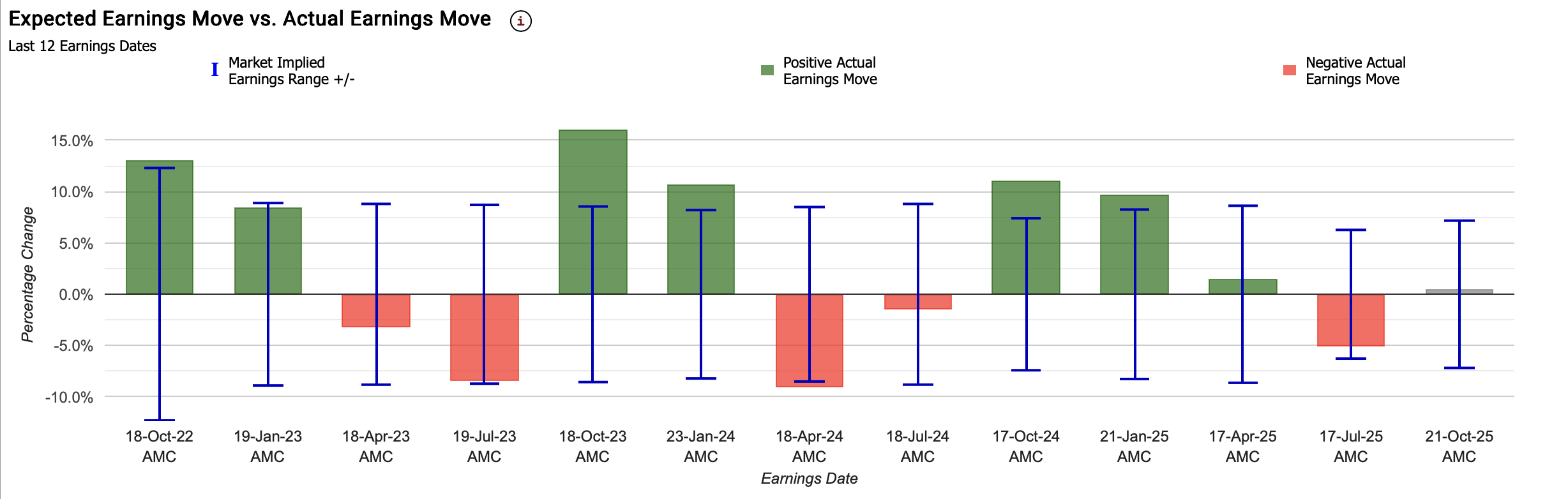
In view of the current Netflix financial report market, we believe that Netflix's stock price is expected to rise moderately or slightly, and we can adopt a bull market bearish spread strategy.
Bull Put Spread
The bull put spread is an options strategy used when investors are gently bullish on the market. It is constructed by selling a put option with a higher strike price while buying a put option with a lower strike price, both options having the same expiration date. The net income is the price difference between selling premium and buying premium (initial net income of premium)。
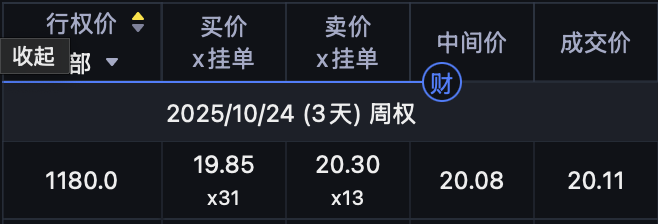
In the first step, investors can sell a put option with a strike price of 1180 and collect the 2011 premium.
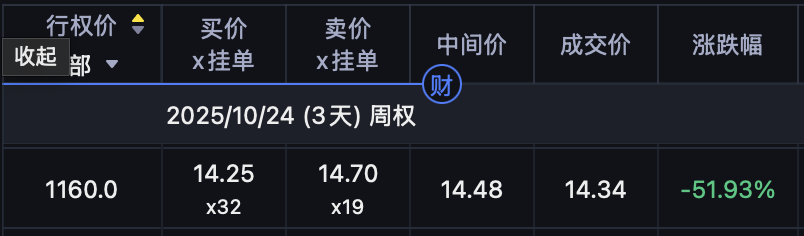
The second step is to buy a put option with a strike price of 1160 and pay 1434 premium to limit the downside risk.
Revenue Analysis
The maximum benefit that this strategy can bring to investors is fixed, and its amount is the net income of two premium.
That is, US $2011-US $1434 =$577。
Conditions for achieving this maximum profit: Netflix's stock price is higher than $1,180 at the time of option expiration. In this case, neither put option sold nor the two put options bought by the investor will be exercised, so the initial net premium of $577 gained will become the final profit.
Risk Analysis
The advantage of this strategy is that its maximum loss is known and capped. The worst-case scenario happens when the options expire and Netflix shares fall to $1,160 or below.
At this point, the investor's loss will reach its maximum, which is calculated by the formula: the difference between the two strike prices minus the net premium gained, that is, [($1180-$1160)-$5.77] * 100 = $1423.
This $20 strike spread is the theoretical loss that investors need to bear, and the previously obtained net premium of $577 acted as a buffer, ultimately locking the net loss at $1,423.
Break-even point
The break-even point is the key stock price to judge the ultimate profit or loss of this deal. It is obtained by subtracting the net premium obtained by investors from the higher strike price, which is specifically $1,180-$5.77 = $1,174.23.
When the expiration stock price is higher than $1174.23, investors will earn a profit.
When the expiration stock price falls below $1174.23, investors will start to make losses.
The more the stock price falls, the loss will gradually increase until the stock price falls to $1,160, triggering the maximum loss of $1,423 mentioned above.
Disclaimer: Investing carries risk. This is not financial advice. The above content should not be regarded as an offer, recommendation, or solicitation on acquiring or disposing of any financial products, any associated discussions, comments, or posts by author or other users should not be considered as such either. It is solely for general information purpose only, which does not consider your own investment objectives, financial situations or needs. TTM assumes no responsibility or warranty for the accuracy and completeness of the information, investors should do their own research and may seek professional advice before investing.
