


After Apple's earnings report, how to make money from the short-term rally?
$Apple (AAPL) $Last week announced its financial results for the fourth quarter of fiscal 2025, which ended September 27, 2025. Revenue for the quarter was $102.5 billion (up 8% year-over-year), product revenue was $73.7 billion and service revenue was $28.8 billion. Earnings per share reached $1.85. This data is slightly better than market expectations for revenue of about 102.2 billion US dollars and EPS of about 1.77 US dollars. Gross margin was 47.2%, net income was $27.5 billion, and operating cash flow was $29.7 billion.
iPhone revenue was $49 billion, up 6% year-over-year. Mac revenue was $8.7 billion, up 13%. iPad revenue of $7 billion. Wearables, Home and Accessories revenue was $9 billion. Service revenue reached approximately US $2.88 billion, which continues to be an important driving force for revenue and profit growth.
Apple said it hit record highs in multiple product categories and geographical markets this quarter, including iPhone revenue, service revenue, and local revenue. In the fourth quarter, iPhone sales increased by 6% to US $49.03 billion, contributing most of Apple's product revenue, and achieving the highest quarterly revenue in many countries or regions (such as India, Europe, the United States, Asia-Pacific except China).
The iPhone, while generating more than $49 billion in revenue, grew only 6%. The iPhone 17 series and iPhone Air were announced on Sept. 19, eight days before the end of the fourth quarter. Based on the momentum in the quarter and high demand for the iPhone 17, Apple expects Q1 2026 to be another record-breaking quarter, with total revenue expected to grow between 10% and 12% year-over-year. As each segment continues to grow, a series of historical and quarterly records could be broken in time for the January earnings call.
On the risk front, management highlighted tariff-related costs of $1.4 billion in the next quarter; Ongoing iPhone 17 Supply Constraints Could Limit Upside;
Significant increases in R&D spending and opex from AI investments could impact margins if they don't match revenue growth.
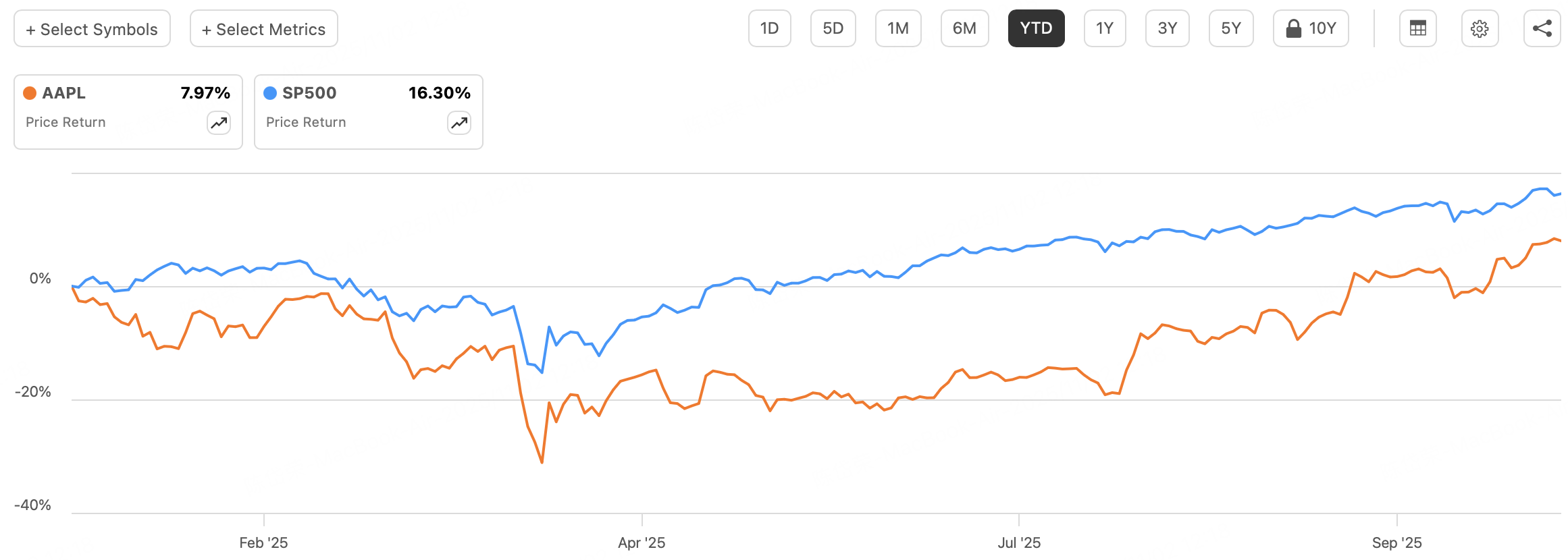
Apple shares are up about 8% so far this year, while the broader S&P 500 index is up more than 16%. The main reason is that the company has entered a mature stage, its valuation is high, and its growth expectations have slowed down. A large part of Apple's revenue depends on the iPhone. In mature markets such as China, North America, and Europe, the smartphone market is already relatively saturated, with fierce competition and slow shipment growth. In addition, external pressures such as politics, tariffs, supply chain adjustments, and Apple's AI layout continues to lag behind its peers (such as Google and Microsoft) have also increased uncertainty, thus affecting investor sentiment.
However, from the steady growth signal released this quarter, as well as the popularity of the iPhone 17 series, which has brought about a high increase in volume expectations in the next quarter, and the stable environment brought about by the implementation of US tariffs, we expect that Apple's stock price will rise moderately in the short term in the future, and we can adopt a bull market. Put spread strategy.
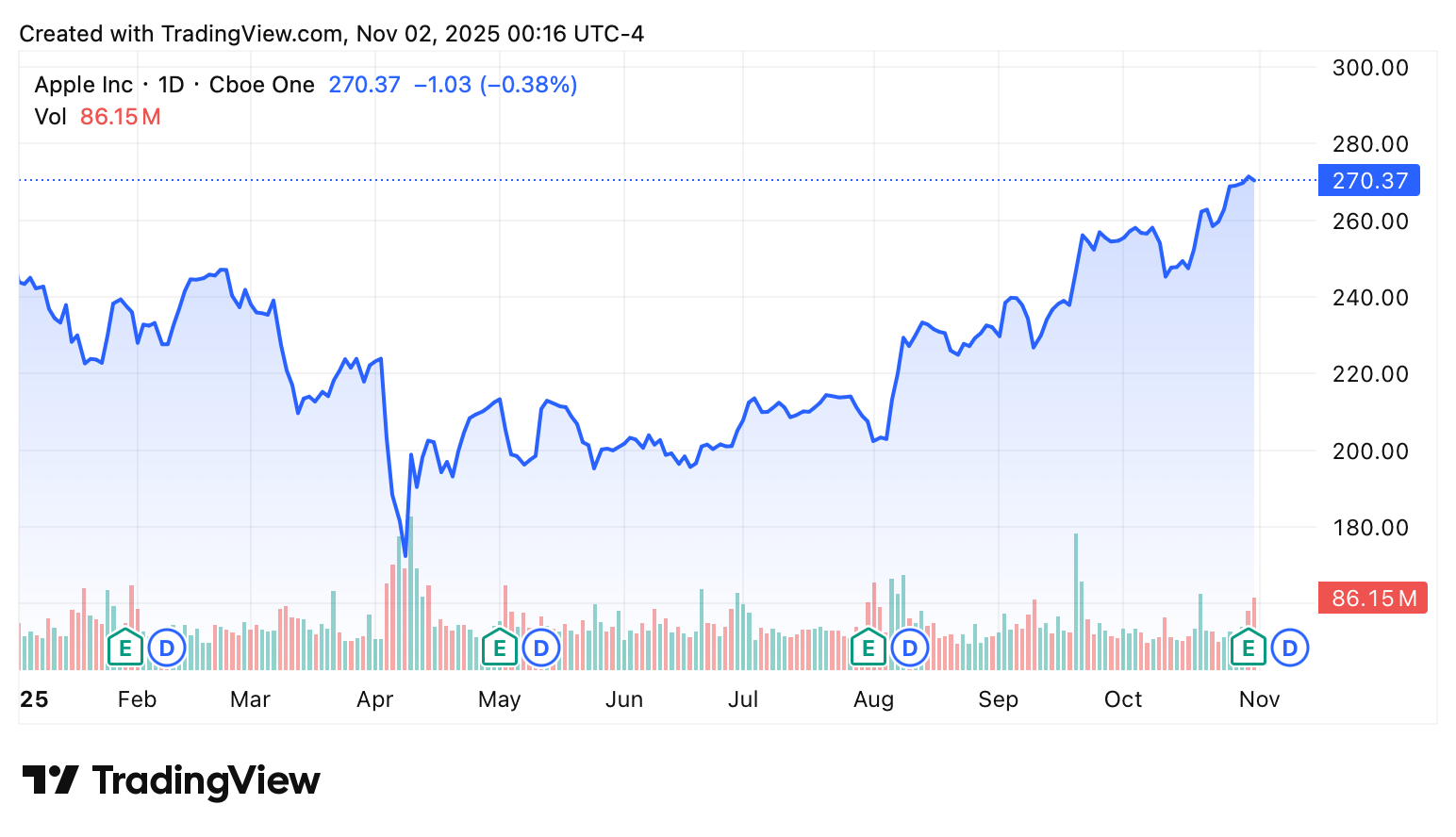
Bull Put Spread Strategy
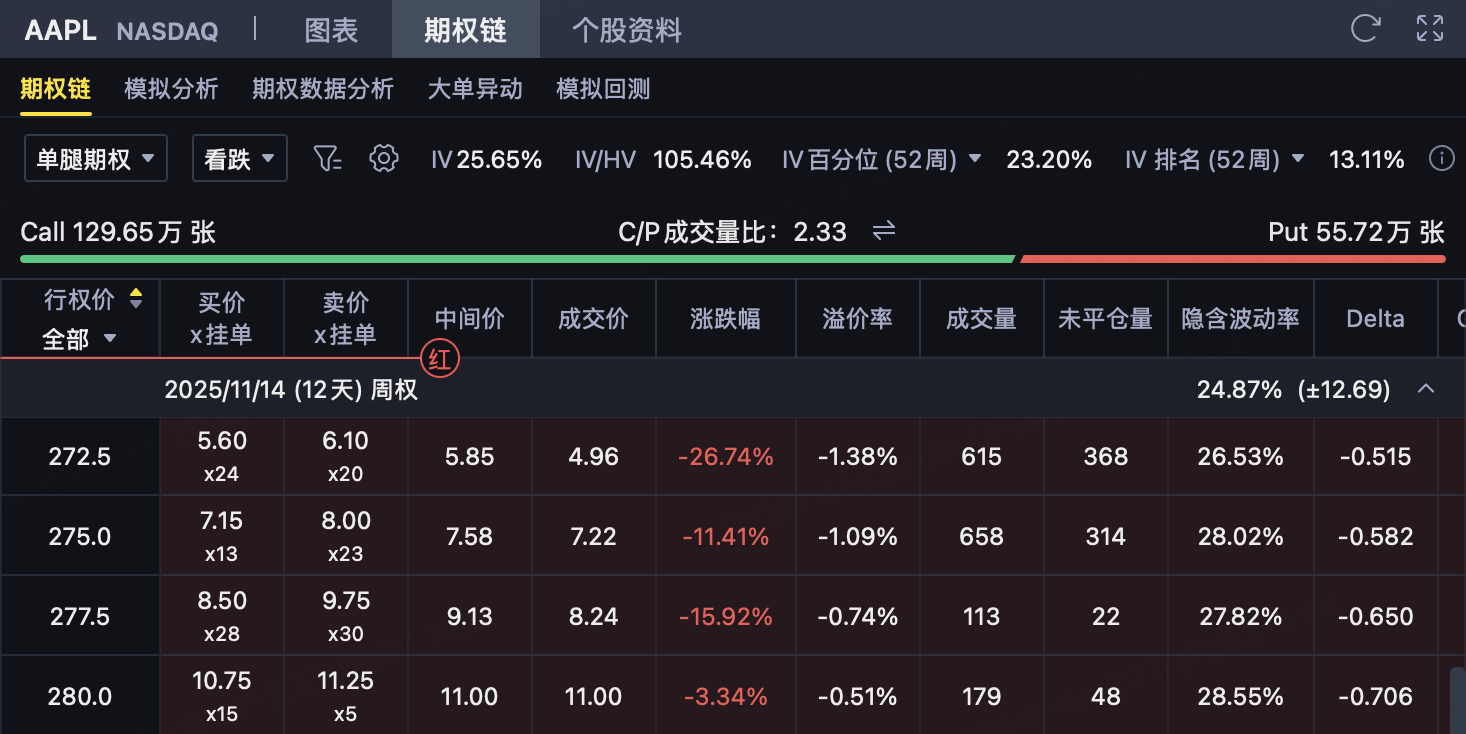
Considering that Apple will pay dividends this weekend, we choose a 12-day two-week weekly right to trade.
First,Sell AAPL 272.5 Put(Charge premium $4.96)
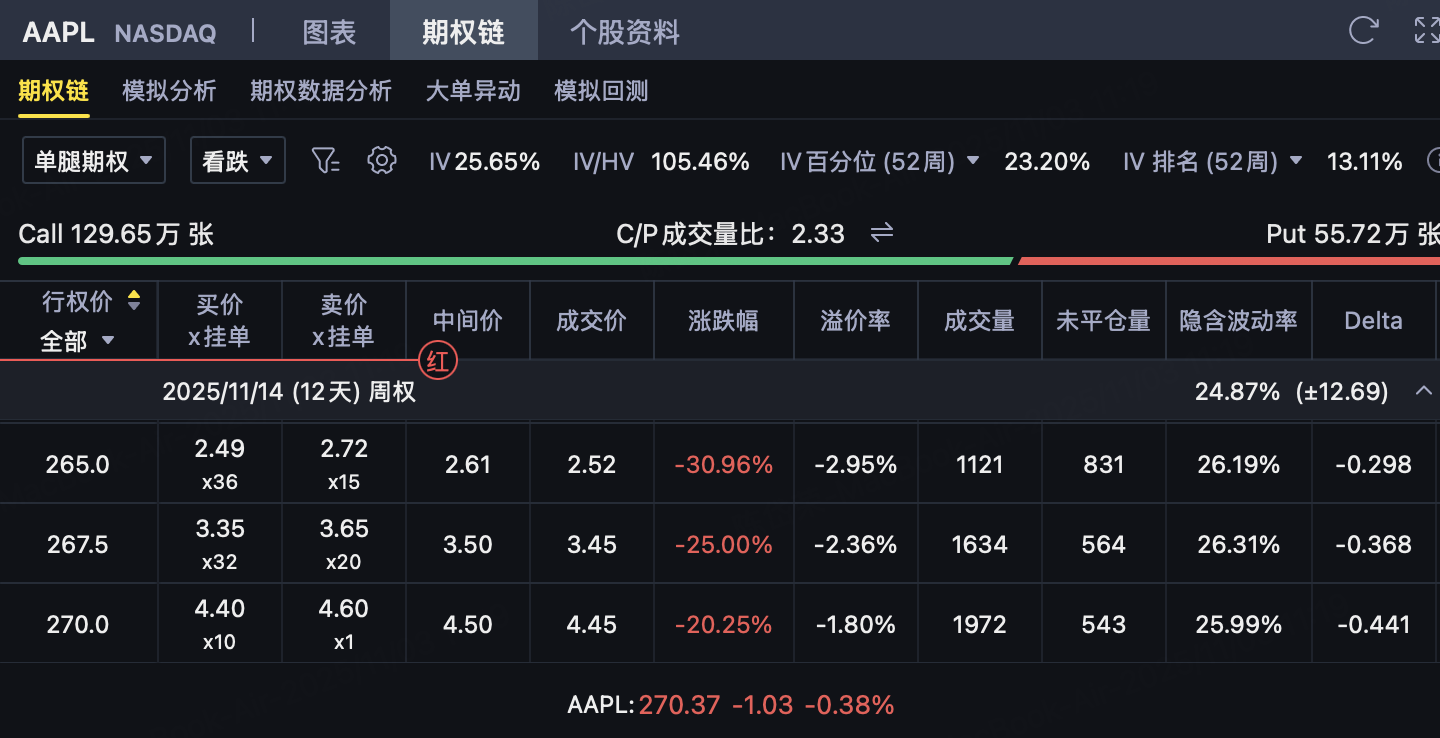
Then,BUYAAPL 265 Put($2.52 to premium)
PROFIT AND LOSS
Initial Net premium Income:Investors sell high strike put options (K ₂ = 272.5) and buy low strike put options (K ₁ = 265), so the net income obtained is:
$4.96 − $2.52 =$2.44/Share(i.e. each option contract receives$244 premium)
Maximum profitWhen Apple's stock price expired ≥$272.5(i.e., both put options lapse), and the investor retains all premium.
Maximum profit =$2.44/share ($244/contract)
Maximum lossWhen the stock price ≤$265When both options are exercised. Loss is strike spread less net income:
Maximum loss = (272.5 − 265) − 2.44 = 7.5 − 2.44 =$5.06/share ($506/contract)
Break-even pointThe breakeven price is:
272.5 − 2.44 =$270.06
That is, as long as Apple's stock price is higher than at expiration$270.06, investors can make a profit.
Risk Analysis
Directional risks (major risks): Investors are betting that Apple's stock price will remain stable or rise moderately in the next one to two weeks. If the stock price falls below$270.06, the strategy begins to lose money; If it falls below$265, the loss reached the maximum value ($506/contract).
Volatility risk (Vega risk): After financial reports and dividends, implied volatility usually falls back (IV Crush). Since investors are net sellers,Decreasing volatility benefits earnings; If a sudden risk event in the market leads to a sharp rise in volatility, the short-term book loss may float.
Time value risk (Theta risk): Time passes in the seller's favor. As long as Apple's stock price remains above $270, the daily time decay of options (θ > 0) will steadily increase strategic returns.
Potential systemic risks: If there is a negative macro situation (such as changes in Fed policy, rising market risk aversion, or a general decline in technology stocks), which causes Apple's stock price to plummet below 265, investors will suffer a maximum loss of $506/contract.
Disclaimer: Investing carries risk. This is not financial advice. The above content should not be regarded as an offer, recommendation, or solicitation on acquiring or disposing of any financial products, any associated discussions, comments, or posts by author or other users should not be considered as such either. It is solely for general information purpose only, which does not consider your own investment objectives, financial situations or needs. TTM assumes no responsibility or warranty for the accuracy and completeness of the information, investors should do their own research and may seek professional advice before investing.
