


Looking at Nvidia's strategic opportunities from Burry's shorting
Investor Michael Burry's fund showed in its latest 13F report filed with the U.S. Securities and Exchange Commission (SEC) that Scion Asset Management, which he manages, bought put options on Nvidia and Palantir on a large scale. Targeting$Nvidia (NVDA) $The put contract of about 1 million shares (notional value of about 187 million US dollars), and about 5 million shares of Palantir (notional value of about 912 million US dollars)-the two combined are about 1.1 billion US dollars, accounting for about 80% of the fund's disclosed holdings.
Burry's move was interpreted by the market as his strong skepticism about the AI boom (especially Nvidia in the field of chip + AI hardware and Palantir in the field of AI software/data analysis).
Nvidia shares fell in premarket or overnight trading after the news flowed out. In addition, technology stocks, especially AI-related stocks, experienced a big pullback/retracement that day, and NVIDIA's stock price has fallen by about 4%-7% from its recent high.
As Nvidia's stock price has risen significantly during the year (more than 80%), its P/E are already at historical highs, causing some institutions to worry about valuation bubbles. Between strong fundamental support and high valuation pressure, the market is clearly divided: bulls believe that the AI cycle has just begun, while bears are wary of the risk of a high pullback.
In this environment of "strong fundamentals but short-term sentiment under pressure", investors may considerBull Put Spread Bull Put SpreadStrategy to obtain stable returns with limited risks.
Bull Put Spread Strategy
1. Strategy structure
Investors sell put options with higher strike prices (K ₂ = 190, premium $1.06),
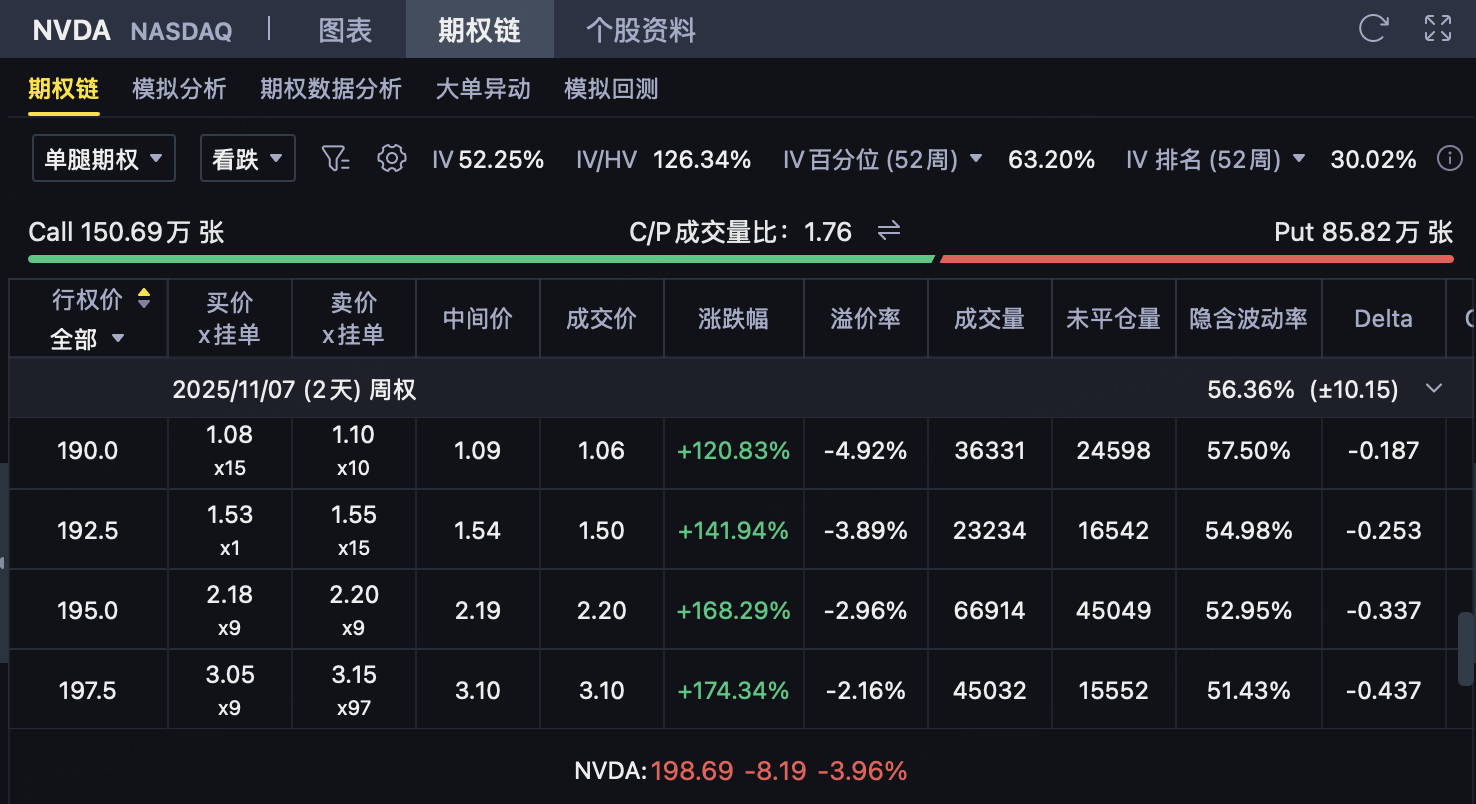
At the same time, buy the put option with the lower strike price (K ₁ = 185, premium $0.59).
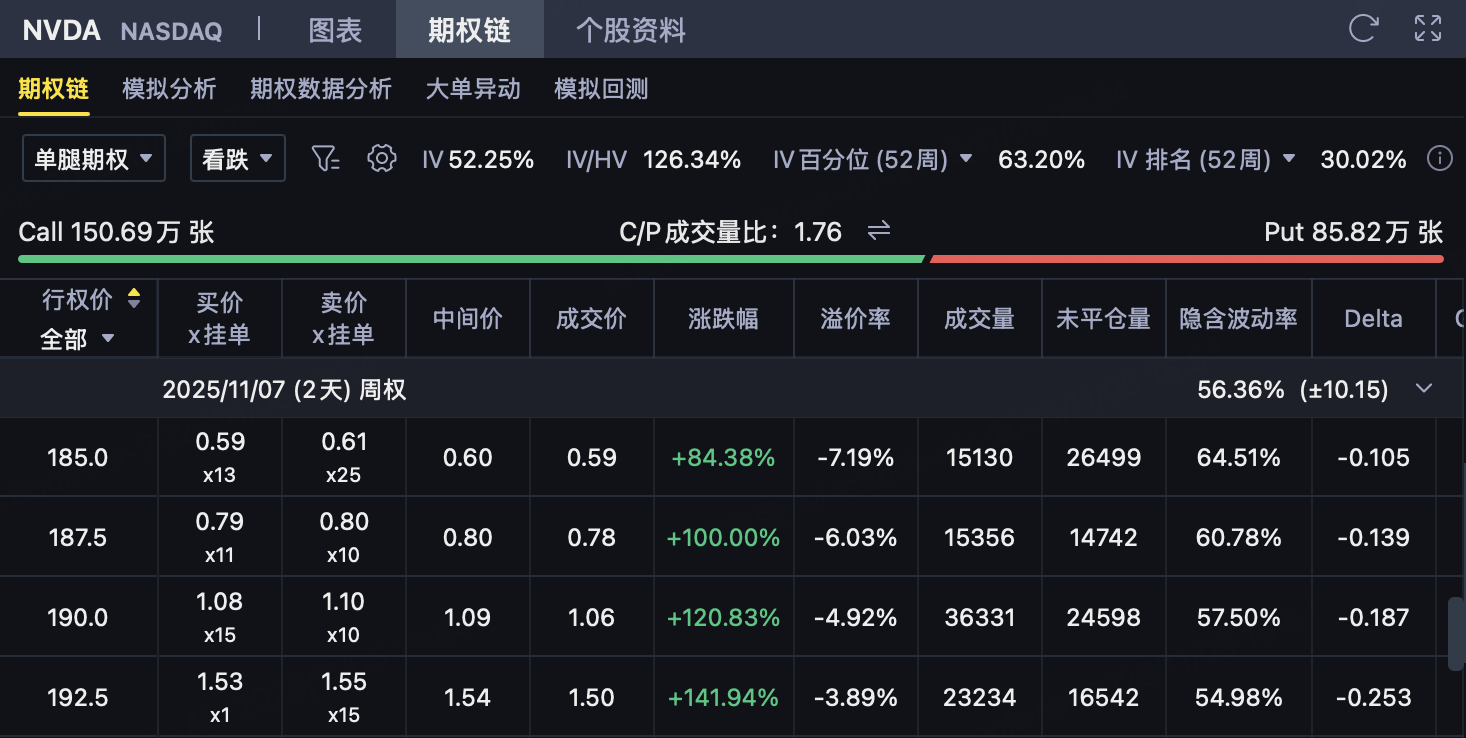
Both options have the same expiration date. Investors gain more premium by selling high-strike options, and then use part of the income to buy low-strike protective put options, thus formingBullish, risk-limitedCombination of.
2. Initial net income
Net premium income = 1.06 − 0.59 =$0.47/Share
Corresponding total revenue = 0.47 × 100 =$47/contract
Investors get this premium when they open a position
This income is strategicMaximum potential profit
3. Maximum profit
Condition: Nvidia stock price ≥ at expiration$190
Result: Both puts lapse, investors retain all premium
Maximum profit = $0.47/share × 100 = $47/contract
4. Maximum loss
Condition: Nvidia stock price ≤ at expiration$185
Result: Both put options were exercised, resulting in a strike spread loss
Loss = (190 − 185) − 0.47 = $4.53/share
Maximum loss = 4.53 × 100 = $453/contract
Investor risk is limited risk
5. Break-even point
Calculation formula: Strike price (sell) − Net premium
Breakeven = 190 − 0.47 = $189.53
When the stock price is above $189.53 → investor profit
When the stock price is below $189.53 → investors lose money
6. Risk and return characteristics
Maximum benefit: $47/contract
Maximum loss: $453/contract
The profit/loss ratio is approximately 1: 9.6(The benefits are less than the risks, but the winning rate is high)
Applicable scenarios: The stock price fluctuates too much, volatility decreases, or rises steadily before expiration
Strategic positioning: Steady and bullish, mainly based on premium income
Engage and Win Options Rewards!
Share your thoughts on options trading or the market in the comments below.
10 lucky participants will each receive a free copy of the Options Handbook!
Already have one, you’ll get a USD 5 Options Voucher instead!
The Options Handbook takes you from the fundamentals to advanced strategies, helping you gradually build your own trading system. You’ll also gain insights from 10 top traders, and learn how to avoid common options trading pitfalls — making your decisions clearer.
💬 Don’t miss out, drop your thoughts and win your reward!
Disclaimer: Investing carries risk. This is not financial advice. The above content should not be regarded as an offer, recommendation, or solicitation on acquiring or disposing of any financial products, any associated discussions, comments, or posts by author or other users should not be considered as such either. It is solely for general information purpose only, which does not consider your own investment objectives, financial situations or needs. TTM assumes no responsibility or warranty for the accuracy and completeness of the information, investors should do their own research and may seek professional advice before investing.
- mark2012·2025-11-06I would love and [Smile]options handbook. can I buy one?LikeReport
- mark2012·2025-11-06please please pleaseLikeReport