


Pre-Broadcom Earnings: Defensive Strategy Choices Amid Increased Market Volatility
$Broadcom (AVGO) $The latest quarterly financial report will be released on December 11, 2025 (after the U.S. stock market closes). The market pays attention to the momentum and profit resilience of AI network and infrastructure software.
The market consensus expects that Broadcom's total revenue this quarter is expected to be US $17.492 billion, a year-on-year increase of 24.14%; Adjusted earnings per share (EPS) are expected to be $1.86, up 34.70% year-over-year; Earnings before interest and taxes (EBIT) are expected to be $11.921 billion, a year-on-year increase of 38.59%. At present, the public consensus expectation does not provide the forecast data of gross profit margin and net profit margin for this quarter, and the update at the company level is subject to the disclosure on the financial report date.
The company's current main business highlight lies in the collaborative pulling of AI-driven Ethernet switching and acceleration related semiconductor solutions and infrastructure software. The existing business with the greatest development prospects is concentrated in the dual engines of semiconductor solutions and infrastructure software: last quarter, semiconductor solution revenue was US $9.166 billion and infrastructure software revenue was US $6.786 billion, both of which constituted the company's core growth framework.
The company's revenue in the last quarter was US $15.952 billion, a year-on-year increase of 22.03%; Gross profit margin was 76.78%; The net profit attributable to the parent company is US $4.14 billion. The year-on-year data is to be compared with the company's disclosure caliber, and the net profit rate is 25.95%; Adjusted earnings per share were $1.69, up 36.29% year-over-year. In the last quarter, driven by the demand for supporting AI-related networks and accelerators, the company's revenue maintained high growth, while the profit quality was stable. In terms of businesses, semiconductor solutions revenue was US $9.166 billion, and infrastructure software revenue was US $6.786 billion. The dual business structure supports scale and cash flow.
U.S. stocks encounter "black swan" fall after interest rate cut
After the market closed on Wednesday Eastern Time, the stock price of U.S. technology giant Oracle Bone Inscriptions plummeted 11.55%.
After the U.S. stock market closed overnight, Oracle Bone Inscriptions reported disappointing earnings. The company's recent large-scale AI orders may take longer to fulfill. Oracle's second-quarter financial report showed that cloud business sales increased by 34% to US $7.98 billion; Revenue from the company's closely watched infrastructure business rose 68% to $4.08 billion. But both numbers were slightly below analysts' expectations. Remaining performance obligations, a measure of orders, jumped to $523 billion in the fiscal second quarter, compared with analysts' average estimate of $519 billion, the company said in a statement Wednesday.
In addition, in its earnings call, Oracle Bone Inscriptions' cash flow issues became the focus of analysts' attention. According to the data released in the financial report, Oracle Bone Inscriptions' free cash flow in the second fiscal quarter was-US $10 billion, and its capital expenditure was as high as US $12 billion, reflecting the high investment in purchasing revenue-generating equipment for data centers.
As soon as this news came out, not only the stock price of Oracle Bone Inscriptions plummeted, but the stock prices of Nvidia and AMD also fell significantly. Nasdaq futures were also significantly dragged down as a result. Analysts believe that if the AI bubble bursts, the market will inevitably be brought into a huge quagmire.
Broadcom Bear Put Spread
Against this background, the market's uncertainty about Broadcom's short-term financial report began to heat up. Although the overall fundamentals remain strong, the recent violent fluctuations in the U.S. stock technology sector due to the "black swan" event have exacerbated the market's concerns about the pace of realization of the AI industry chain. In particular, Oracle's after-hours financial report was significantly lower than expected, causing its stock price to plummet and dragging down AI heavyweights such as Nvidia and AMD to pull back significantly, strengthening investors' concerns that the AI capital expenditure cycle may slow down in stages.
On the eve of the financial report, on the one hand, the market recognized Broadcom's structural long-term value in the fields of AI switching chips, customized acceleration ASICs and infrastructure software; on the other hand, it was also worried that if the short-term fluctuations in the industry further expanded, it might suppress the stock price.
In such an environment, if investors think that Broadcom's stock price may decline or fluctuate before and after the financial report, but the decline is expected to be limited, they can consider adoptingBear Put Spread Bear Put SpreadTo participate in potential declines and improve the risk-return efficiency of the strategy by limiting the loss ceiling.
1. Strategy structure
Investors Build a on Broadcom (AVGO)Bear Put Spread, consisting of two Put options with the same expiration date:
Sell Lower Strike Put: K ₁ = 415, premium Revenue $15.2
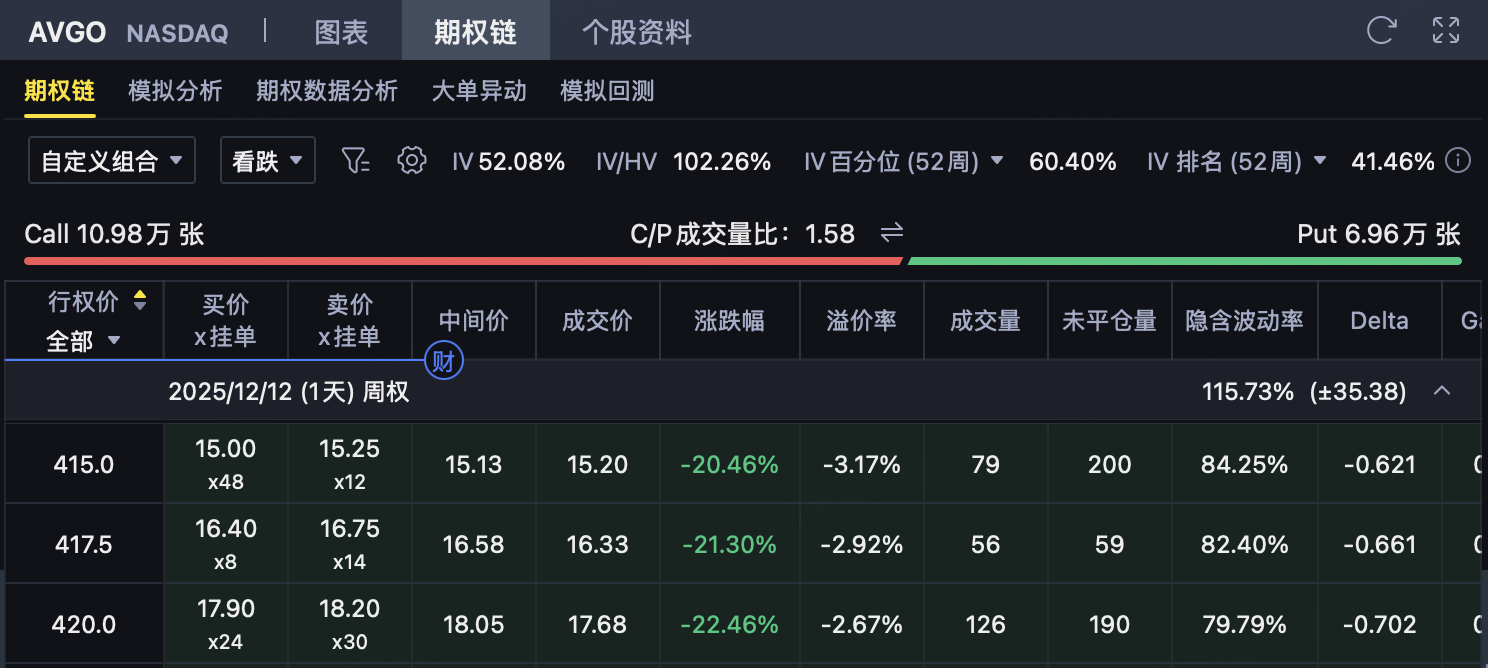
Buy higher strike price Put: K ₂ = 420, premium spend $17.68
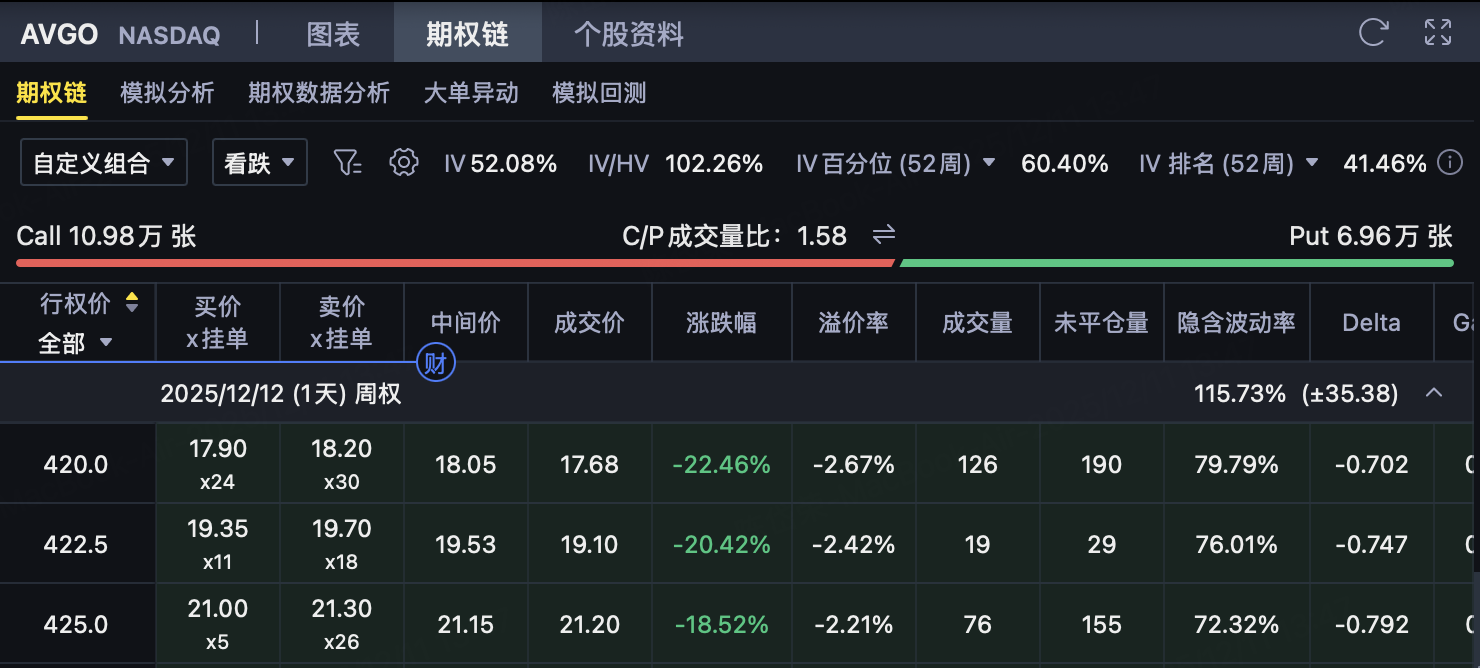
The strategy belongs toDebit type, bearishThe spread combination. Investors Expect Broadcom Stock Price at ExpirationDown but limited decline; Looking to participate in the decline at a lower cost while capping profits.
2. Initial net expenditure
Net premium (per share) = 17.68 − 15.2 = $2.48/share 1 mouth = 100 shares, so: total net expenditure = 2.48 × 100 = $248/contract This is what investors pay when opening a positionMaximum potential loss。
3. Maximum profit
Strike spread
= 420 − 415
= $5/share
Maximum profit (per share)
= 5 − 2.48
= $2.52/share
Total maximum profit
= 2.52 × 100
= $252/contract
Happens at:
When the AVGO expiration price is ≤ $415.
4. Maximum loss
The maximum loss is the net premium paid when opening the position:
Maximum loss
= $248/contract
Happens at:
When the AVGO expiration price is ≥ $420, both Put shares are out-of-the-money and all options become zero value.
5. Break-even point
Breakeven = K ₂ − Net expenses = 420 − 2.48 =$417.52
Maturity judgment rules:
≤ $417.52 → Investor Earnings
= $417.52 → Flat
≥ $417.52 → Investor losses
6. Risk and return characteristics
Maximum gain: $252/contract (limited)
Maximum loss: $248/contract (limited)
Profit-loss ratio: gain: loss = 252: 248 ≈ 1.02: 1
Applicable scenario: Investors expect Broadcom stock price before expirationModerate decline to around 415 or lower, but unwilling to bear all the risks of naked Put; Hoping to exchange limited losses for limited but controlled falling gains.
Disclaimer: Investing carries risk. This is not financial advice. The above content should not be regarded as an offer, recommendation, or solicitation on acquiring or disposing of any financial products, any associated discussions, comments, or posts by author or other users should not be considered as such either. It is solely for general information purpose only, which does not consider your own investment objectives, financial situations or needs. TTM assumes no responsibility or warranty for the accuracy and completeness of the information, investors should do their own research and may seek professional advice before investing.
