


Hedging strategy for PLTR returning to high
Last Friday, the U.S. stock AI sector rebounded as a whole, and the sentiment picked up significantly. As one of the core targets of the highly elastic AI narrative,$Palantir Technologies Inc. (PLTR) $With a gain of more than 4% on the day, the share price is back above 190. This rebound is more reflected in the restoration of risk appetite and the return of funds at the sector level, rather than the new fundamental changes at the company level. In the context of highly crowded AI concepts and generally high valuations, such rebounds are often more likely to become a rise in sentiment in a volatile structure than the starting point of a new round of trend market.
From the perspective of trend structure, PLTR has formed an obvious high and wide fluctuation in the past two months, rather than a strong trend unilateral rise. * * The technical aspect shows that the stock price has repeatedly sawed in the range of 150-205, and the current price is once again close to the upper edge of the shock of 190-198. This area has constituted a pressure zone for many times in history and is accompanied by a rapid pullback/retracement. The Bollinger Bands did not show the continuous opening expansion required by the trend market, and the rebound was mainly repaired along the middle rail rather than bandwidth amplification; At the same time, the momentum indicator is in a state of high passivation, and the trading volume has not been significantly enlarged during the rebound process, indicating that the willingness of new funds to follow up is limited, which is more in line with the technical counter-pumping characteristics in the volatile market.
From a fundamental perspective, Palantir's business growth itself is not weak. The company has benefited from the expansion of demand for AI and data analysis on both the government and commercial sides. Its revenue growth and guidance have exceeded market expectations many times, and its commercialization capabilities are gradually improving. However, the question is not "whether there is growth", but "whether the growth is sufficient to match current prices". Under the latest market pricing, PLTR's valuation is already at an extreme level. Its P/E and price-to-sales ratio are significantly higher than most software and AI peers. The extremely optimistic medium-and long-term growth path has been included in the price in advance. Under this valuation structure, even if the fundamentals continue to improve, as long as short-term growth or sentiment cannot further exceed expectations, the stock price will easily enter a high digestion or even a pullback/retracement stage.
It is precisely under the superposition of this technical structure and valuation background that the logic of short-term short selling is more of a probabilistic choice at the transaction level than a negation of the company's long-term value. The current stock price is located in the upper half of the shock range, and the upward trend requires new catalysis and stronger capital promotion, while the resistance from the downward pullback/retracement to the center of the range is relatively smaller. Buy one that expires in one monthPut, is essentially a game of shock and fall back. The option price of 180 is close to the central axis of the shock range in the past two months. Once the price falls from the high level, the option Delta will be significantly enlarged. At the same time, the one-month period can cover the 2-4-week adjustment rhythm that has occurred many times before, making the time value loss relatively matches the expected pullback/retracement window.
Overall, after the sentiment of the AI sector rebounded and PLTR rose by more than 4% in the short term, the stock price re-entered the high game range. Technical aspects show that the upward momentum is insufficient, and fundamental growth has been fully priced in by high valuations. In this context, participating in the shock fall through short-term Put is a trading choice with clear risk boundaries and relatively reasonable odds structure. If the subsequent heavy volume breaks through and effectively stands at the previous high, this strategy should be abandoned in time; Otherwise, the process of price returning to the shock center will constitute the main source of profit for the Put.
PLTR Buy Put Bearish Strategy
1. Strategy structure
Investors build a * * buy put (Long Put) * * strategy on Palantir Technologies (PLTR) options.
This strategy is a single option position. By paying premium, investors obtain the right to sell PLTR shares at a fixed price before or on the expiration date. The core goal is to amplify profits when the underlying stock price falls back, while limiting the maximum risk to premium paid.
This strategy is suitable for investors to judge that PLTR in the next month or soThe probability of falling is greater than the probability of, or at least it is difficult to maintain the situation at the upper edge of the high oscillation zone.
2. Specific contract elements
Underlying stock Palantir Technologies (PLTR)
Expiration time: 32 days
Option type: Put (Put option)
Strike price: $180
Premium: $4.56/share
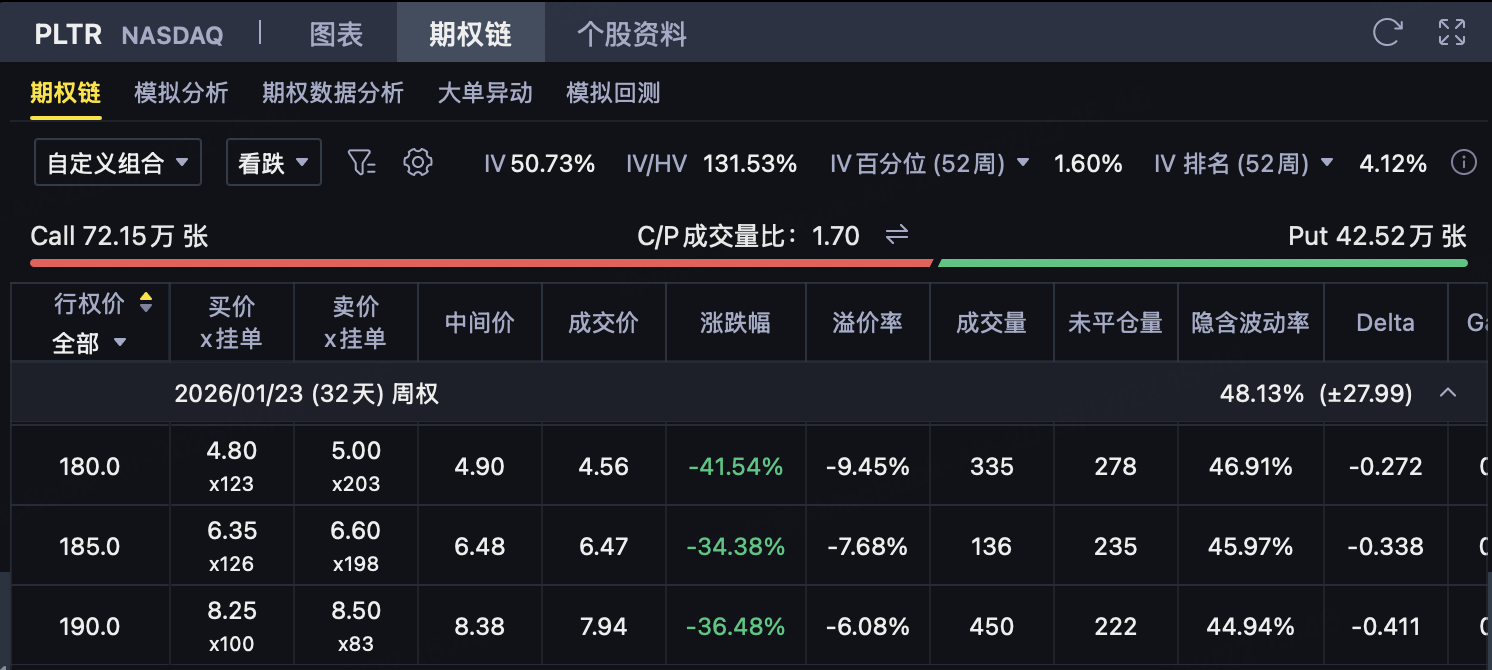
Since 1 option contract corresponds to 100 shares of the underlying stock, the total cost that investors need to pay when opening a position is:
Initial investment (per contract) = 4.56 × 100 =$456
This amount is theMaximum possible loss。
3. Maximum profit
The theoretical maximum profit of the buy Put strategy occurs in the extreme case where the underlying stock price falls to 0.
Maximum profit (per share): = Strike price − premium = 180 − 4.56 =$175.44
Maximum profit (per contract): = 175.44 × 100 =US $17,544
Although this scenario is almost impossible in reality, it illustrates the strategyThe profit margin is theoretically very large, and as the stock price falls, the profit amplifies linearly.
4. Maximum loss
The maximum loss of the Buy Put strategy is clear and limited.
When PLTR Expiration Price≥ $180Time:
Put option fully out of the money
Contract value returned to zero
Maximum loss (per share): = premium paid =$4.56
Maximum loss (per contract): = 4.56 × 100 =$456
No matter how much PLTR rises, the strategy will not lose more than $456.
5. Break-even point
The Buy Put strategy has only one break-even point.
Breakeven Price: = Strike Price − premium = 180 − 4.56 =$175.44
The maturity judgment rules are as follows:
PLTR Expiration Price< $175.44→ Earnings for investors
PLTR Expiration Price= $175.44→ flat
PLTR Expiration Price> $175.44→ Investor losses (losses not exceeding $456)
6. Intuitive understanding of income under different price situations
If the PLTR expiration price falls back to around $170, the intrinsic value of this Put is about $10. After deducting the $4.56 premium, investors can still obtain considerable positive returns.
If the stock price only falls slightly but does not fall below 180, American options may still have periodic liquidation opportunities before expiration due to changes in time value and implied volatility, but if they are held to expiration and the price is higher than the strike price, premium will lose all.
VII. Risk and return characteristics
Maximum gain: theoretically huge (amplified as stock prices fall)
Maximum loss: $456/contract (fixed, predictable)
Profit and loss structure:
Downside earnings are not capped
Fully limited upside risk
Strategy features:
Clear directional strategy
Higher requirements for the decline range and time rhythm
Relatively unfriendly to implied volatility pullback, but highly sensitive to rapid declines
Applicable situation: When investors judge that PLTR will be difficult to effectively break through the high shock area in the next month, and there is a high probability of falling below 180 or even the shock center area, and hope to participate in the downward market on the premise that the risk is completely controllable, Buying 180 Put due in 32 days is a trading strategy with clear logic, simple structure and strong return elasticity.
Disclaimer: Investing carries risk. This is not financial advice. The above content should not be regarded as an offer, recommendation, or solicitation on acquiring or disposing of any financial products, any associated discussions, comments, or posts by author or other users should not be considered as such either. It is solely for general information purpose only, which does not consider your own investment objectives, financial situations or needs. TTM assumes no responsibility or warranty for the accuracy and completeness of the information, investors should do their own research and may seek professional advice before investing.
