


Leading technology stocks are weak under the rotation of US stocks
The recent US stock market has shownObvious style rotation。 Investors can see a wave of small and mid-cap stocks and growth stocksPhased pull-up, more funds flocked to emerging sectors and theme stocks, pushing the small-cap stock index to rebound rapidly. In contrast, large-cap leading stocks, especially tech giants in the Nasdaq 100, have gained significantlySlowing down or even weakening。 These stocks have driven the index to rise sharply in the past few years, but at the current stage, most leading stocks lack momentum to rise, trading volume has shrunk, and the technical aspect shows high volatility and pressure.
On the other hand, from the perspective of interest rate expectations, according to the latest data from the CME "Fed Watch" tool (as of January 7, 2026), the market believes that the Fed willThe probability of keeping interest rates unchanged is 85.1%, the probability of a 25 basis point rate cut is only 14.9%. This expectation shows that the market has reached a high degree of consensus on the stability of the Fed's short-term policy. A relatively stable interest rate environment is generally not conducive to short-term tailwinds for high-valued tech stocks, as investors rely less on stimulus funding, while discount rate pressures remain for growth stocks.
Taken together,Large-cap leading stocks gain weakly + interest rate policy remains stable, making the Nasdaq 100 ETF (QQQ) lack strong upward momentum in the short term, while the small and medium-cap sectors continue to rotate. This landscape provides investorsShorting QQQ or Building a Bear Market Put Spread StrategyOpportunities: It can not only capture the benefits brought by the potential correction of leading stocks in the large cap, but also control risks through the spread strategy.
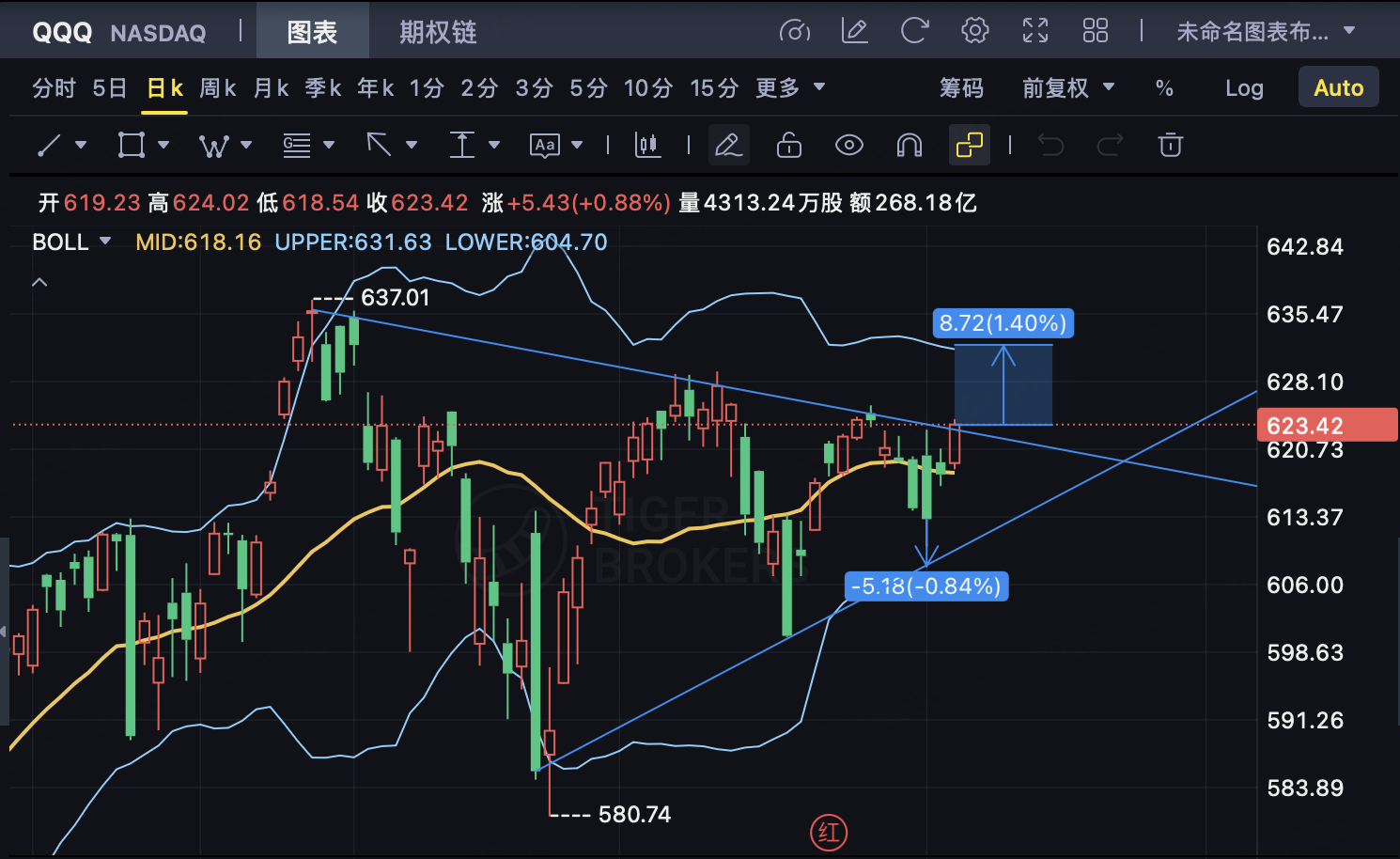
Profit and Loss Analysis of QQQ Bear Market Put Spread Strategy
1. Strategy structure
Investors in$Nasdaq 100ETF (QQQ) $Build aBear Put Spread (Bear Put Spread) strategy.This strategy buys the higher strike price Put and sells the lower strike price Put at the same timeConstitute, belonging toBearish strategy with limited risk and limited return。
(1) Buy a higher strike price Put (main source of income) Investors buy a strike priceK ₂ = 637Put options, pay premium$14.04。 This Put is closer to the current price and most sensitive to QQQ declines, making it a core source of earnings for this strategy. When QQQ falls, the intrinsic value of this Put will increase rapidly.
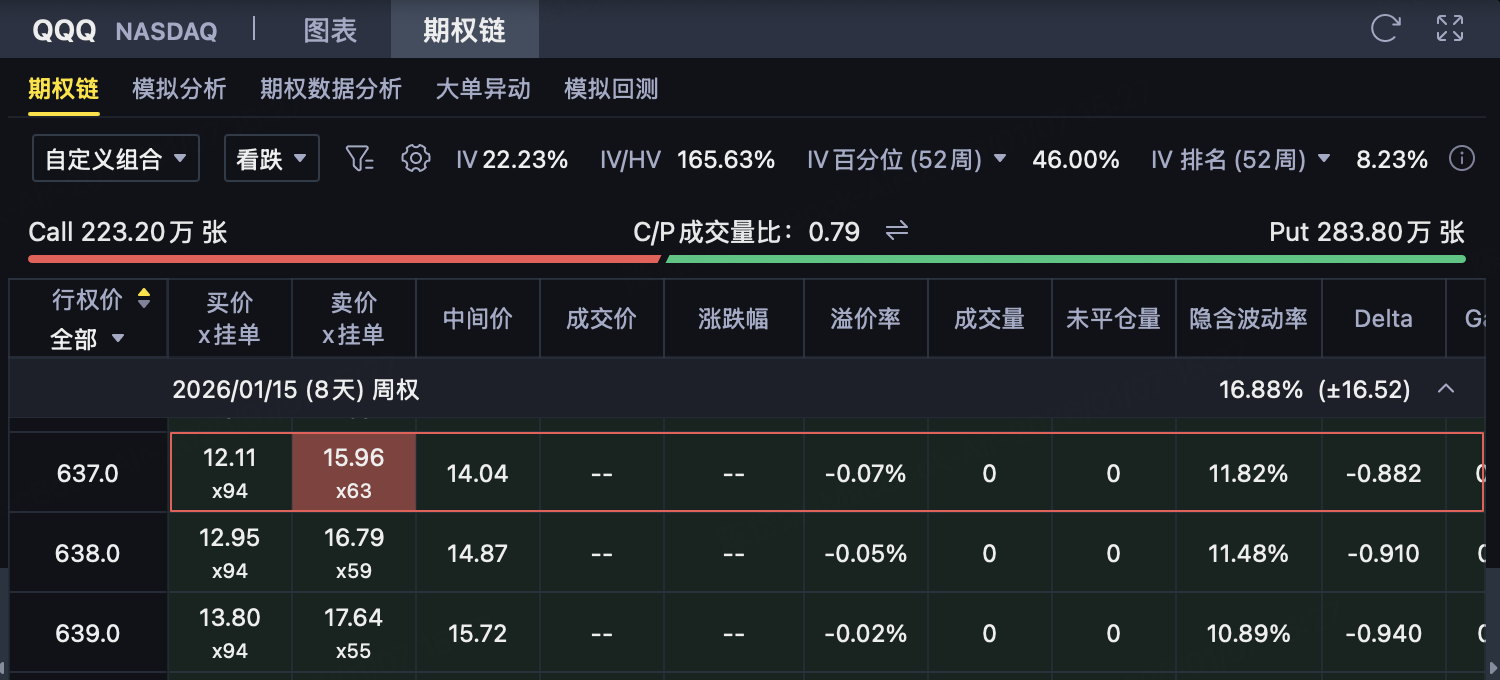
(2) Sell at a lower strike price Put (reduce costs) Investors sell one strike price at the same timeK ₁ = 632Put options, receive premium$10.47。 This Put is used to hedge some of the premium costs, but it also limits the maximum profit margin of the strategy. When QQQ falls below $632, this Put will start to offset some of the profit.
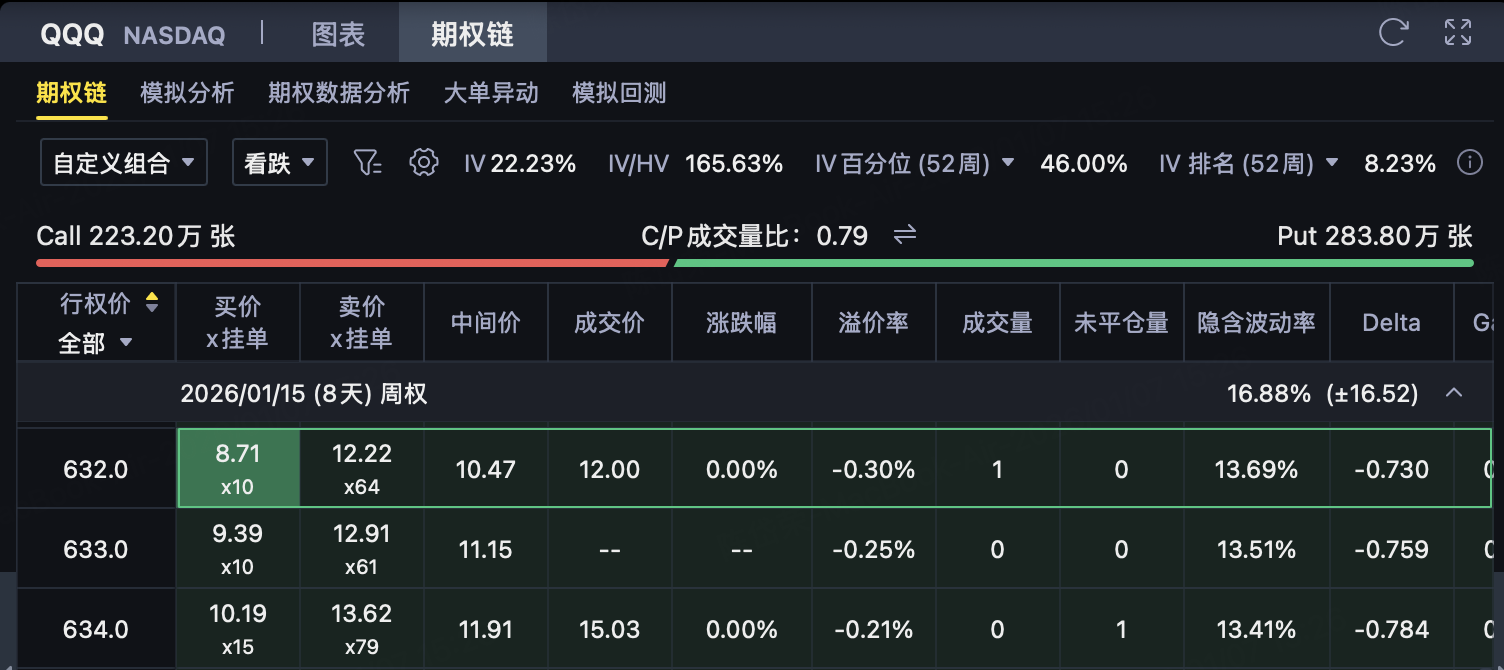
(3) Net expenses on the Put side (per share) Net premium = Buy Put − Sell Put = 14.04 − 10.47 =$3.57/Share
2. Initial net expenditure
Since 1 lot of options = 100 shares:
Net premium (per share): $3.57
Initial net expenditure (per contract): = 3.57 × 100 =$357/contract
This initial net payout is the bear market put spread strategyMaximum potential loss。
3. Maximum profit
The maximum profit occurs when the Put spread is fully expanded, that is, QQQ falls significantly.
Strike spread width:
= 637 − 632
= $5
Maximum profit (per share): = Strike spread − Net premium = 5 − 3.57 =$1.43/Share
Maximum profit (per contract): = 1.43 × 100 =$143/contract
Conditions of occurrence:
QQQ expiration price ≤ $632
4. Maximum loss
The biggest loss occurs when QQQ does not fall as expected.
When the QQQ expiration price is ≥ 637 USD:
Both 637 Put and 632 Put are out of the price
Both options lapse
Investors lose all net premium:
Maximum loss per share: $3.57
Maximum loss per contract: $357
5. Break-even point
There is only one break-even point for bear put spreads:
Breakeven Price = Buy Put Strike Price − Net premium = 637 − 3.57 =$633.43
Maturity judgment rules:
QQQ < $633.43 → Earnings for Investors
QQQ = $633.43 → No Profit, No Loss
QQQ > $633.43 → Investor losses
6. Risk and return characteristics
Maximum gain: $143/contract (limited)
Maximum loss: $357/contract (limited)
Profit-loss ratio: gain: loss ≈ 143: 357 ≈1: 2.5
Strategy features:
Bearish strategy, the core assumption is that QQQ will fall
Reduce premium costs by selling low strike price Put
The maximum risk and maximum benefit can be clarified when opening a position
You don't need a sharp plunge in QQQ, just fall below the breakeven point to make a profit
Applicable scenarios:
When investors judge:
There is pullback or downward pressure on QQQ short term or before expiration
Near $632 below may become a stage low
I hope to participate in the downward market under the premise of controllable risks
Don't want to bear the greater risks brought by naked Put
Disclaimer: Investing carries risk. This is not financial advice. The above content should not be regarded as an offer, recommendation, or solicitation on acquiring or disposing of any financial products, any associated discussions, comments, or posts by author or other users should not be considered as such either. It is solely for general information purpose only, which does not consider your own investment objectives, financial situations or needs. TTM assumes no responsibility or warranty for the accuracy and completeness of the information, investors should do their own research and may seek professional advice before investing.
