


Tariff Notice Sent Tonight! How to hedge risk with volatility?
US President Trump posted on social media: "I am pleased to announce that tariff letters and/or agreements between the United States and other countries around the world will be issued at 12 noon EST on July 7th (early Tuesday morning, Beijing time)."
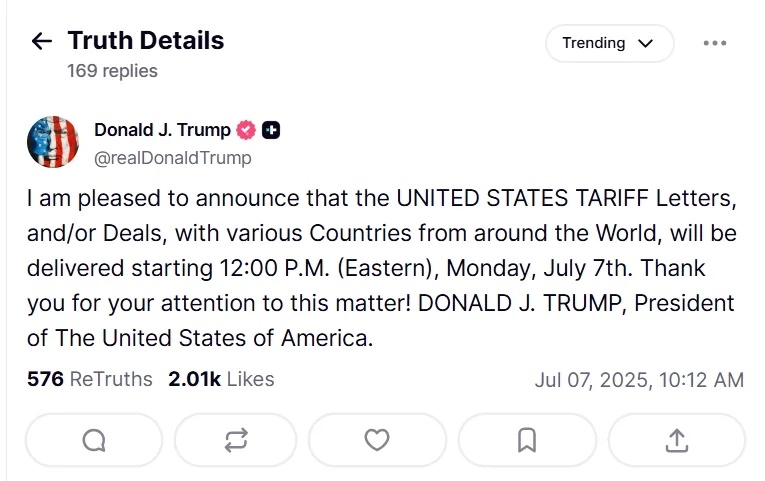
The Trump administration plans to reimpose reciprocal tariffs of 10% to 70% on dozens of countries after the 90-day moratorium ends. With the deadline coming on Wednesday, the United States may re-impose tariffs on dozens of countries.
ButBescent said in an interview with the media that the United States will send a notification letter to its trading partners, asking for an agreement to be reached before August 1st, otherwise it will return to the tariff level on April 2nd. U.S. Secretary of Commerce Lutnick also said that Trump's country tariffs will take effect on August 1st, and the current tax rates and agreements are formulated by the president.
According to the Global Times, India and the United States are striving to finalize an interim trade agreement before the end of the "reciprocal tariff" suspension period on July 9. Although the two sides stepped up negotiations, New Delhi still showed a tough stance and planned to impose retaliatory tariffs on the United States.
According to media reports, India and the United States are expected to make a final decision on the mini-trade agreement within 24 to 48 hours, and the average tariff may be around 10%。 However, Indian officials have made it clear that they have "drawn red lines" in sensitive areas such as agriculture and dairy products, and now "the ball is on the side of the United States".
Bescent: Notice Letter Requires Agreement By August 1
Trump's initial plan to promise 90 trade deals in 90 days was noticeably setbacked. U.S. trade consultant Navarro previously predicted that after suspending the reciprocal tariff program in April and allowing a three-month extension, the government would get 90 agreements within 90 days. In fact, the United States has reached only three agreements so far, and some of them lack key details.
According to CCTV news reports, US President Trump said on the 3rd local time that he would start sending letters to trading partners on the 4th to set unilateral tariff rates.Trump later said that the new tariff rate could be between 10% and 70%, and that the letter would be sent out Monday and payment would be made by Aug. 1.
In an interview, Treasury Secretary Bescent acknowledged that the notification letter may not be an announcement of immediate tariffs on dozens of countries, but another deadline for trading partners.
"President Trump will send a notice letter to some trading partners, saying, 'If you don't move forward, then you will return to the tariff level of April 2nd on August 1st,'" Bescent said. This statement is in line with Trump's previous schedule of issuing a notice letter on Monday and paying fees on August 1st.
U.S. Secretary of Commerce Lutnick also said that Trump's country tariffs will take effect on August 1st, and the current tax rates and agreements are formulated by the president. That means U.S. trading partners will have some breathing room before the July 9 deadline previously set by the president.
White House spokesman Kush Desai said any trade decisions will come directly from Trump himself, and the administration is working to complete the trade deal.
Hedging plunge risk with VIX
Assuming that investors also have a US $1 million position in US stocks, they can consider using UVIX to hedge the tail risk of the market.
UVIX is2x long VIX short-term futures, which usually surges sharply when the market panics (far exceeds the increase of the VIX itself). During plunges such as March 2020 or June 2022, UVIX (or predecessor TVIX/UVXY) hadDaily rise exceeding 50%-100%。 Therefore, buying a UVIX call option is a pair ofTail riskA highly leveraged hedging tool.
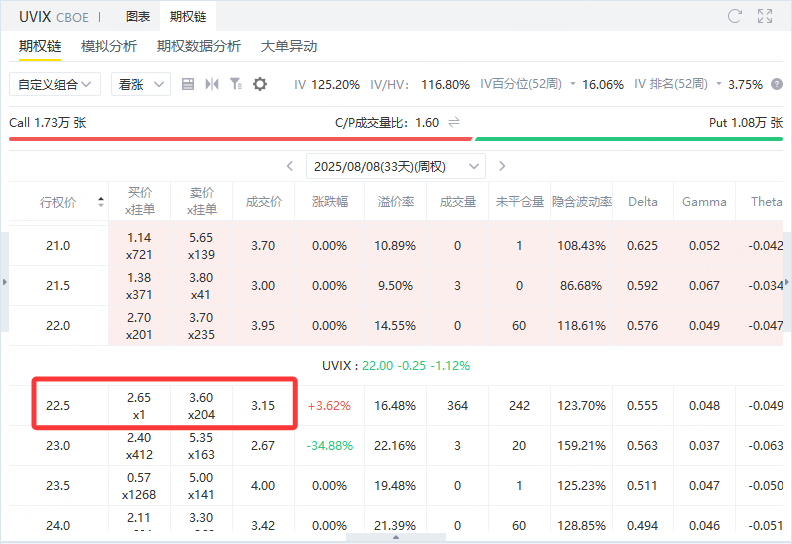
Set to invest 1% to 1.5% of the funds as a hedging position, corresponding to approximately $10,000 to $15,000. Investors can choose to buy 40 call options on UVIX 22.5, each costing $315, for a total investment of approximately $12,600.
Long positions in US stocks:$1,000,000
UVIX Current Price:$22
Option contracts: Call option with an exercise price of 22.5 expiring on August 8
Premium: $3.15 (i.e. $315/sheet)
Expiration time: approximately 1 month
Scenario revenue analysis
If the market plummets and the UVIX price rises from $22 to $40, then the intrinsic value of this 22.5 Call option is $17.5, which is theoretically worth about $1,750 each. The total value of 40 sheets is $70,000, minus the cost of $12,600, and the net benefit is approximately $57,400.
If the market crashes further and UVIX rises to $50, with an option intrinsic value of $27.5 and a value of $2,750 per option, the total gain can reach $110,000 and a net profit of nearly $97,400.
If the market doesn't move or the UVIX falls below 22.5, then these options will all expire to zero and the investor will lose the entire $12,600 invested. This is also the maximum loss range.
The core of this strategy is to use the high volatility of UVIX to quickly amplify profits when the market is extremely panicked, and provide investors with a "catastrophe insurance" for their long position of $1 million. The cost is small and the leverage is high, but it is possible that all of them will be returned to zero when they expire. Only by adopting a small proportion of deployment, regular rolling, and long-term execution can the hedging effect be achieved.
Disclaimer: Investing carries risk. This is not financial advice. The above content should not be regarded as an offer, recommendation, or solicitation on acquiring or disposing of any financial products, any associated discussions, comments, or posts by author or other users should not be considered as such either. It is solely for general information purpose only, which does not consider your own investment objectives, financial situations or needs. TTM assumes no responsibility or warranty for the accuracy and completeness of the information, investors should do their own research and may seek professional advice before investing.
