


Big-Tech Weekly | AAPL: Short Squeeze or Bull's Beginning? Which Companies Win from the $600B AMP?
Big-Tech’s Performance
Macro Headlines This Week: Tariff Escalation? Fed Divisions Emerge; US Stock Structure Diverges
Chain Reaction from Deteriorating Non-Farm Payrolls (NFP)? May-June NFP was cumulatively revised down by 258K (the largest downward revision since May 2020), July job additions were only 73K (versus 110K expected), the unemployment rate rose to 4.2%, while this week's continuing jobless claims reached 1.97 million (highest since November 2021), signaling rapid cooling in the labor market. On one hand, the methodological differences between the NFP and ADP employment reports technically contribute to this gap. On the other hand, Trump seized this opportunity to replace the Bureau of Labor Statistics commissioner appointed during the Biden administration with his own appointee, and further pressure the Powell-led Fed to cut rates.
Fed Reshuffling Moves. Christopher Waller has become the widely presumed successor to Powell, garnering market attention due to his dovish stance favoring rate cuts and policy based on future expectations. Simultaneously, Trump appointed economic advisor Stephen Miran as an interim Federal Reserve Governor until January 2026, increasing Trump's influence within the Fed's policymaking body. This indicates Trump's attempt to steer US monetary policy through personnel appointments. Treasury Secretary Scott Bessent is no longer considered a candidate for Fed Chair.
Highlights and Trends in Tech Earnings Week. According to Factset, approximately 82% of $S&P 500(.SPX)$ companies that have reported earnings this quarter exceeded EPS expectations. Strong Q2 earnings reports from companies like Meta and $Humana(HUM)$ provided support for market sentiment. However, divergence among individual stocks has become increasingly pronounced, with trade tensions and tariff policies posing potential pressure. Notably, $Eli Lilly(LLY)$ s oral weight-loss drug, Oglianron, failed in clinical trials (efficacy lower than expected), causing its stock to plunge 14% in a single day and dragging down the healthcare sector.
Mega-Tech stocks rallied across the board driven by earnings reports this week. As of the August 7th close, performance over the past week was: $Apple(AAPL)$ +6.00%, $Microsoft(MSFT)$ -2.37%, $NVIDIA(NVDA)$ +1.63%, $Amazon.com(AMZN)$ -4.69%, $Alphabet(GOOG)$ +2.41%, $Meta Platforms, Inc.(META)$ -1.5%, $Tesla Motors(TSLA)$ +4.54%。
Big-Tech’s Key Strategy
Apple (AAPL): From Short-Covering Rally to a Structural Bull Case?
AAPL stood out significantly this week. The impetus came from CEO Tim Cook and Donald Trump jointly announcing an additional 100billioninvestmentcommitmentintoUSmanufacturing(underaprogramcalled"AmericanManufacturingProgram"−AMP),inexchangeforpotentialtariffexemptions.Addedtotheexisting500 billion commitment, the total pledged investment amounts to approximately $600 billion. The AMP program focuses on bringing more upstream critical components (glass, wafers, assembly/testing, magnets, VCSELs, etc.) to the US, while also establishing domestic server production lines for its AI data centers and "Apple Intelligence" services.
Key Program Details:
Initial AMP Partners Listed: Corning, Coherent, GlobalWafers America (GWA), Applied Materials, Texas Instruments (TI), Samsung, GlobalFoundries (GF), Amkor, Broadcom, etc. (covering glass, wafers, packaging, magnetic materials, VCSEL lasers, equipment manufacturing).
Key Figures: Supports >450,000 supplier/partner jobs; Plans direct hiring of ~20,000 people over the next four years (4-year period specified, focused on R&D, silicon engineering, software, AI); Claims >19 billion chips will be produced in the US by 2025 (emphasizing US fabs and related packaging/testing/material ecosystem).
Project Highlights: Expand Corning glass production in Kentucky (claiming US-made cover glass for iPhone/Apple Watch); Pilot production for Apple Intelligence servers in Houston; Strengthen collaborations on tools/materials/assembly/testing with GWA, Amkor, TI, Applied Materials.
Apple's Intentions:
Magnifying Numbers for Political Publicity: Emphasizing 450,000 supply chain jobs, presence across 50 states, and local impact, this uses typical rhetoric to "secure state government and public support". It aims to gain the upper hand in public opinion ("Apple is saving the economy") and achieve visibility/potential exemption space at the White House level (or at least reduce the likelihood of targeted tariffs). Apple's press release deliberately highlights "export proportions" and "full-link suppliers" to showcase scale and legitimacy.
Emphasizing Supply Chain "Control" Over Full Chain Relocation: Apple focuses on key materials, wafers, packaging, specialized components, and servers (upstream & midstream), not relocating final assembly back to the US (media/analysis also note Apple made no commitment to fully build iPhones in the US). This aligns better with Apple's gradual strategy to "de-risk the supply chain geopolitically": first relocate core, harder-to-replace segments constrained by national security or export controls (e.g., rare-earth magnets, certain packaging/testing, silicon wafers) to the US.
Industrial Support for AI & "Apple Intelligence" Strategy: Server factories, domestic packaging/testing, and wafer supply chains are linked to Apple's AI/private cloud compute strategy, representing future-facing infrastructure investments (security, compliance, latency, control). At the corporate level, it also forces Apple to deploy its massive cash reserves towards investment (beyond just buybacks), though such investment inherently carries risk.
Feasibility Analysis:
Sense of Scale vs. Actual Cash Outflow: 600billion÷4years= 150 billion/year average. While Apple has ample capital, deploying investments of this size as CapEx in the US requires coordination among suppliers, state governments, equipment makers, and capital markets. Much of this involves blended commitments of "procurement + incentives + partnerships," creating uncertainty about near-term realization rates.
Timeline & Technology Migration Difficulty: Migrating advanced semiconductor manufacturing, advanced packaging, and specialized materials takes years (plant construction, certification, yield ramps), making near-term replacement of global mature capacity impossible. Thus, near-term risk mitigation for the iPhone supply chain is limited.
Political/Legal Risks Coexist: While such grand commitments may secure immediate political goodwill, they risk scrutiny over "trading investment for exemptions" and regulatory probes (antitrust, subsidy compliance). Delayed execution could lead to negative blowback.
Recommend Monitoring Four Signals:
Details of Corresponding CAPEX in 10-K/8-K Filings: Discerning how much is booked as real CapEX vs. long-term purchase/partnership commitments.
Supplier CapEx Announcements & State-Level Incentive Agreements: Track CapEx changes and hiring announcements from Corning, GWA, Amkor, TI, Applied Materials.
Federal/State Policies & Tariff Enforcement Details: Exemption rules, tax incentives, or subsidy schemes would directly impact realization speed.
Market Pace of Commercialization for Apple Intelligence Servers/Services: (Houston factory mass production, client/internal cloud adoption pace), determining strategic ROI.
Beneficiaries:
Fast-Tracking, High Probability Projects:
Corning ($2.5B glass line) $Corning(GLW)$ , $COHERENT(COHR)$ (multi-year VCSEL contract), $Amkor Technology(AMKR)$ (packaging plant expansion) – Clear amounts/facility locations/government documents, visible near-term output.
Mid-term Realization, Government-Dependent Projects:
GlobalWafers America, $Applied Materials(AMAT)$ , $Texas Instruments(TXN)$ , $GLOBALFOUNDRIES Inc.(GFS)$ – Wafer/equipment/mature process expansion; Long build cycles; State/federal incentives crucial.
Projects with Vague Details or Primarily Purchase Contract-based:
$Broadcom(AVGO)$ , etc. – Mostly long-term purchase agreements; Lack CAPEX/facility info; Realization pace harder to gauge.
We view this as a meticulously crafted "Political-Supply Chain-Product Strategy" trifecta PR campaign. It can deliver near-term political and PR gains (during the Trump era) and embed the "AI + silicon chain" thesis into investor sentiment. However, the "$600 billion" figure includes highly debatable accounting and bundled items. True long-term value hinges on subsequent capital flows and project execution.
Big Tech Options Strategy
This Week We Focus: AMD Has Reported, Now Just Waiting on NVDA?
Following $Advanced Micro Devices(AMD)$ earnings release, the market's optimistic mood has paused but not extinguished. Previous expectations centered on AMD gaining market share in traditional computing. However, overly high expectations have limited further upside. Investors seek stronger evidence of broad customer enthusiasm for AMD's long-term roadmap, particularly the MI400 series, which currently remains insufficient.
A major suspense factor is sales of the MI308 product line in China, currently excluded from guidance (suggesting possible catch-up gains later if included), reflecting uncertainties in the licensing approval process. AMD's communication expressed conservatism, showing less optimism than expected regarding the multi-billion dollar annual Chinese opportunity.
Market acceptance and performance of the MI400 series will be key future indicators for assessing AMD's investment value.
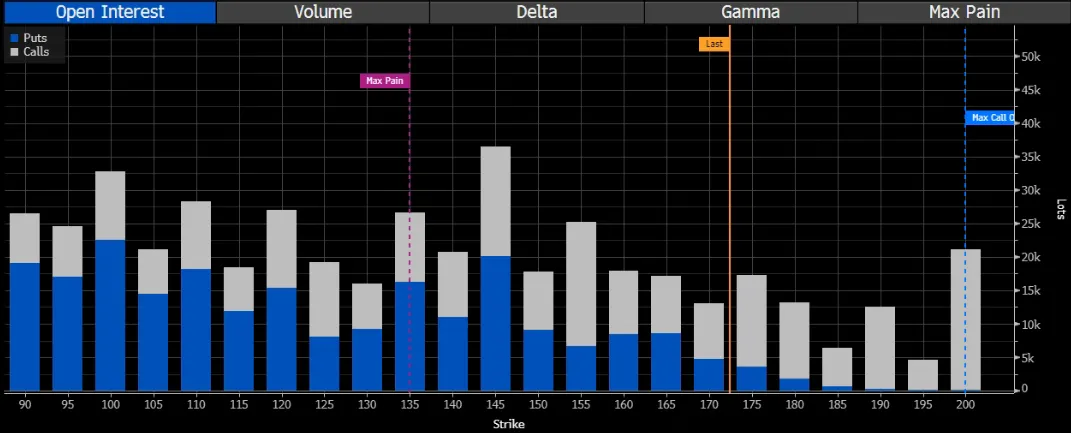
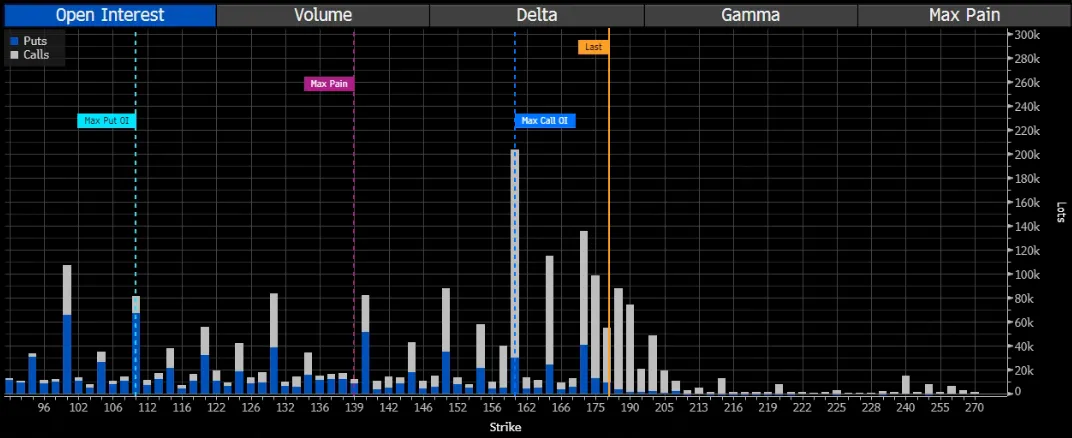
From the options market: Call volume at current price points isn't particularly high. September monthly options show significant call open interest capped heavily around the 200barrier–acrucialtradingdayfollowingNVDA′searnings(August21stimplied).Conversely,NVDAstillshowssubstantialcallopeninterestatcurrentpricesanddowntoaround150.
Big-tech Portfolio
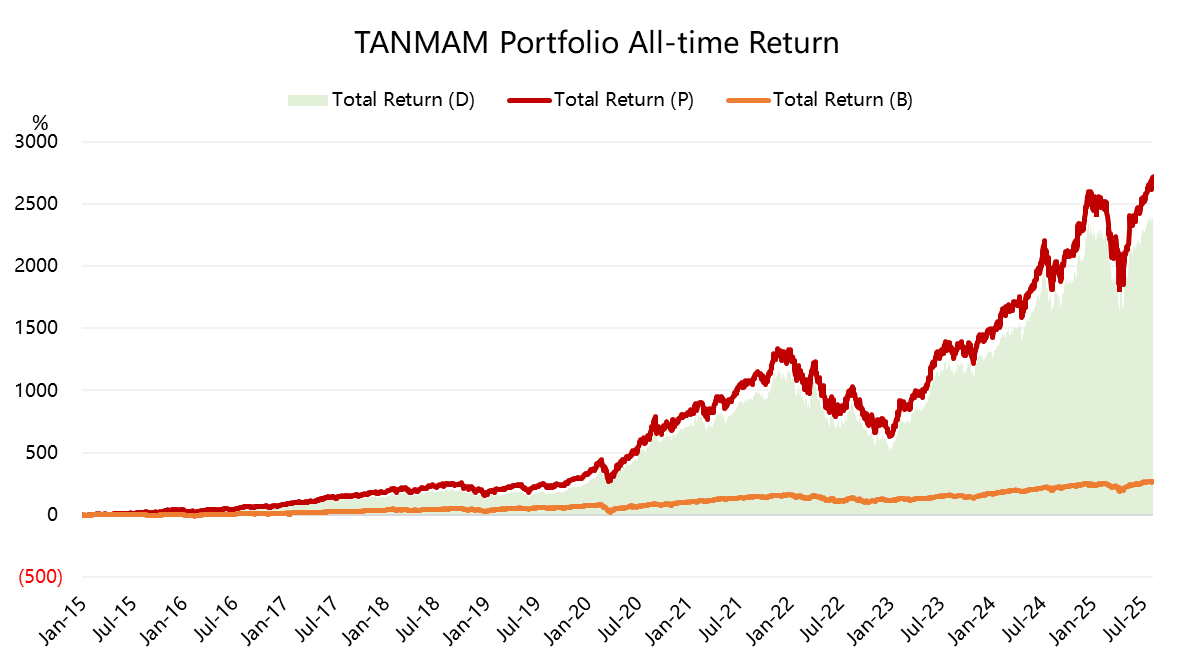
The "Magnificent Seven" stocks (forming an equally-weighted, quarterly rebalanced portfolio termed "TANMAMG") have dramatically outperformed the S&P 500 since back-tested from 2015. Total return reached 2,720.91%, compared to $SPDR S&P 500 ETF Trust(SPY)$ 's 268.84%, resulting in an alpha (excess return) of 2,452.07%, setting new records.
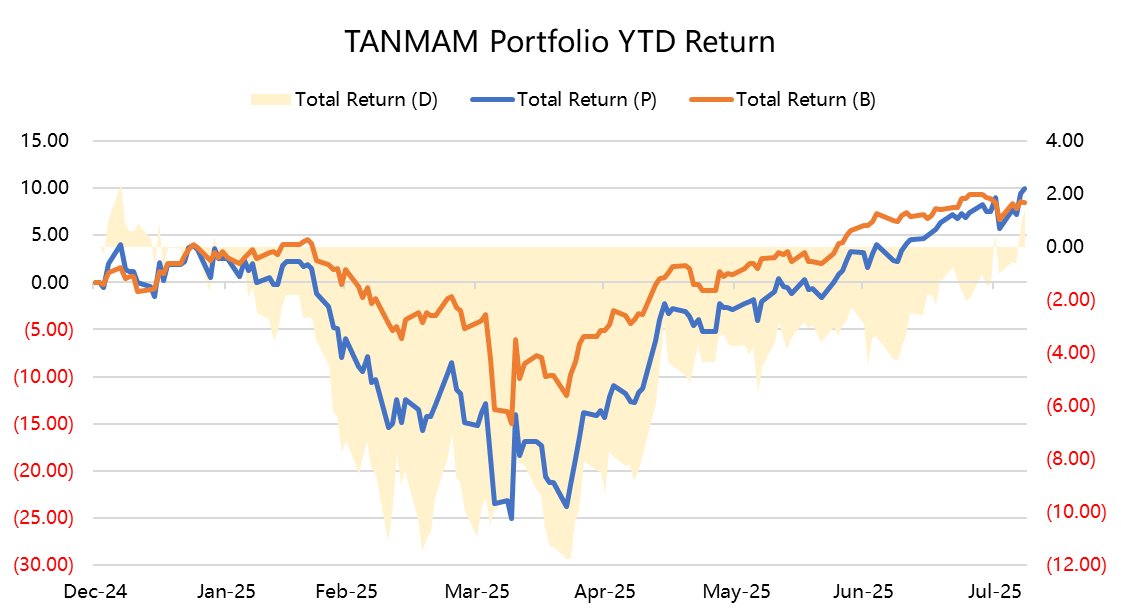
Year-to-date, the Mega-Tech portfolio has also delivered a solid positive return of 9.95%, outperforming SPY's 8.52%.
$Invesco QQQ(QQQ)$ $NASDAQ(.IXIC)$ $ProShares UltraPro QQQ(TQQQ)$ $ProShares UltraPro Short QQQ(SQQQ)$
Disclaimer: Investing carries risk. This is not financial advice. The above content should not be regarded as an offer, recommendation, or solicitation on acquiring or disposing of any financial products, any associated discussions, comments, or posts by author or other users should not be considered as such either. It is solely for general information purpose only, which does not consider your own investment objectives, financial situations or needs. TTM assumes no responsibility or warranty for the accuracy and completeness of the information, investors should do their own research and may seek professional advice before investing.
- Valerie Archibald·2025-08-10will get a nice little pullback to 219 before going higher. aapl really going up for no reason. will eventually retrace back to 200LikeReport
- Enid Bertha·2025-08-10I think Apple is heading back to retest the 260 level for sure by NOV/DEC strong months.LikeReport
- cheeryk·2025-08-08Interesting indeed1Report