


Tech Weekly Reviews: AI Divergence? Macro Momentum Widens The Gap!
The past week has been very exciting, with a flurry of earnings reports and actual volatility far exceeding expectations (35% of TMT stocks that have reported earnings this earnings season have seen volatility of more than 10%), and the software sector is particularly turbulent.
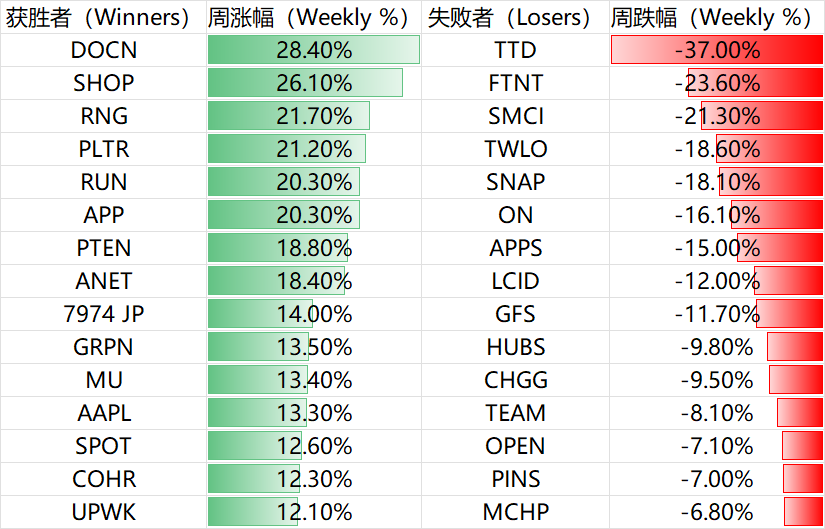
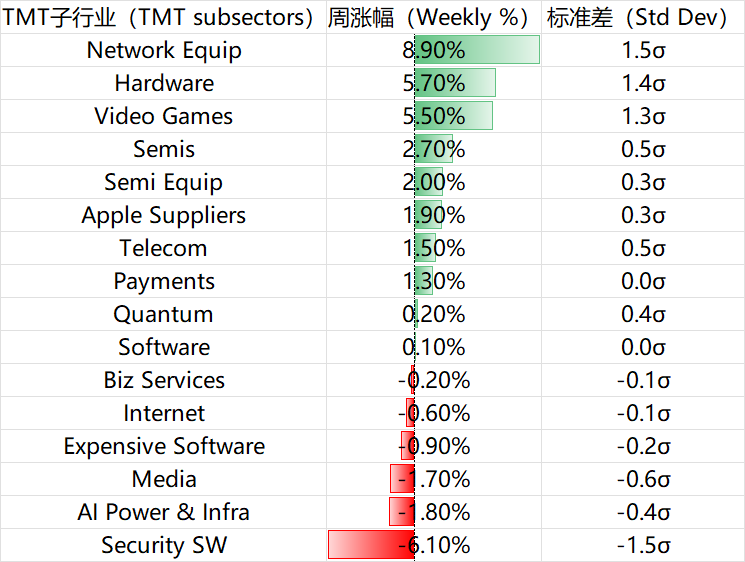
Last week was relatively quiet on the macro front, while this week is relatively busy.
July CPI data will be released on Tuesday, and July PPI data will be released on Thursday, both of which will set the tone/narrative for Powell's speech at Jackson Hole on August 21 (will the Fed cut interest rates faster?).
The three major macroeconomic issues facing investors today:
To what extent will tariffs continue to drive up commodity prices in the coming months?
Will most of the inflation related to tariffs be offset by deflation/price declines in housing and non-housing services?
Is the July employment report a fluke, or is the job market in a clear downturn?
Following the release of weak unemployment data, there has been increasing discussion in the market about AI replacing jobs. Never before has technological change forced companies to act so quickly or invest so aggressively as artificial intelligence has.
Since AI can change the competitive landscape almost overnight—by optimizing decisions, reducing costs, and opening up new sources of revenue—companies have no choice but to view rapid application as a rule for survival rather than a long-term R&D project. AI deployment is evolving into a typical winner-takes-all situation.
If unemployment caused by artificial intelligence triggers backlash at the reputational, cultural, or policy levels, its second- and third-order effects may become negative: high-profile AI layoffs could lead to public relations and morale issues (see DUOL's public relations crisis earlier this year). More seriously: a significant rise in unemployment rates will begin to impact corporate revenue (we believe short-term cyclical factors will overshadow long-term structural trends, and let’s not forget that companies like META are fundamentally cyclical advertising businesses).
Companies that are potentially affected by AI in the long term/structurally and are worth paying attention to:
IT Services and Consulting: ACN, CTSH, IT, EPAM, DXC
Staffing and recruitment: MAN, RHI
Creative Software and Media: $Adobe(ADBE)$ , SSTK
Web development: WIX
Advertising and Marketing: OMC, WPP, IPG
Travel and reservations: $Expedia(EXPE)$ , $Booking Holdings(BKNG)$
Education Technology: CHGG, COUR
Freelance platforms: UPWK, FVRR
Accounting and Tax Services: $Intuit(INTU)$ , HRB
Legal and professional information services: LZ, TRI, RELX
Language Learning: $Duolingo, Inc.(DUOL)$
Business Process Outsourcing (BPO) and Call Centers: GEN, FIVN, CNXC
Human Resources and Compensation Services: ADP, PAYX
$NASDAQ(.IXIC)$ $Invesco QQQ(QQQ)$ $Apple(AAPL)$ $NVIDIA(NVDA)$ $Meta Platforms, Inc.(META)$ $Microsoft(MSFT)$ $Tesla Motors(TSLA)$ $Amazon.com(AMZN)$ $ProShares UltraPro QQQ(TQQQ)$ $ProShares UltraPro Short QQQ(SQQQ)$ $Alphabet(GOOGL)$
Disclaimer: Investing carries risk. This is not financial advice. The above content should not be regarded as an offer, recommendation, or solicitation on acquiring or disposing of any financial products, any associated discussions, comments, or posts by author or other users should not be considered as such either. It is solely for general information purpose only, which does not consider your own investment objectives, financial situations or needs. TTM assumes no responsibility or warranty for the accuracy and completeness of the information, investors should do their own research and may seek professional advice before investing.
