


Yen Fell To Weakest Level This Year,The Depreciation trend May Not End In The Near Future.
Despite the tepid performance of the US Dollar Index in the past few weeks, this still cannot stop the yen's continued decline.
In the 11 months from 2023 to the present, the yen closed up in only 2 months, This shows the determination and motivation of the market to sell yen. On the one hand, the lack of real safe-haven demand in the market makes the yen go unattended. On the other hand, more crucially, the expected central bank turn (ultra-loose to normal) has not appeared.
Ueda Kazuo's latest speech in November made the trend of the yen even more worrying. He stated that it is necessary to cut interest rates cautiously, and relaxing ultra-loose monetary policy is a severe challenge. Earlier, the Bank of Japan challenged YCC policy again, and raising the yield of 10-year Japanese bonds to more than 1% was also regarded as a clear choice to abandon foreign exchange protection bonds. After the long-term inertia of relying on fiscal stimulus, it is far more difficult to get rid of this dependence than imagined.
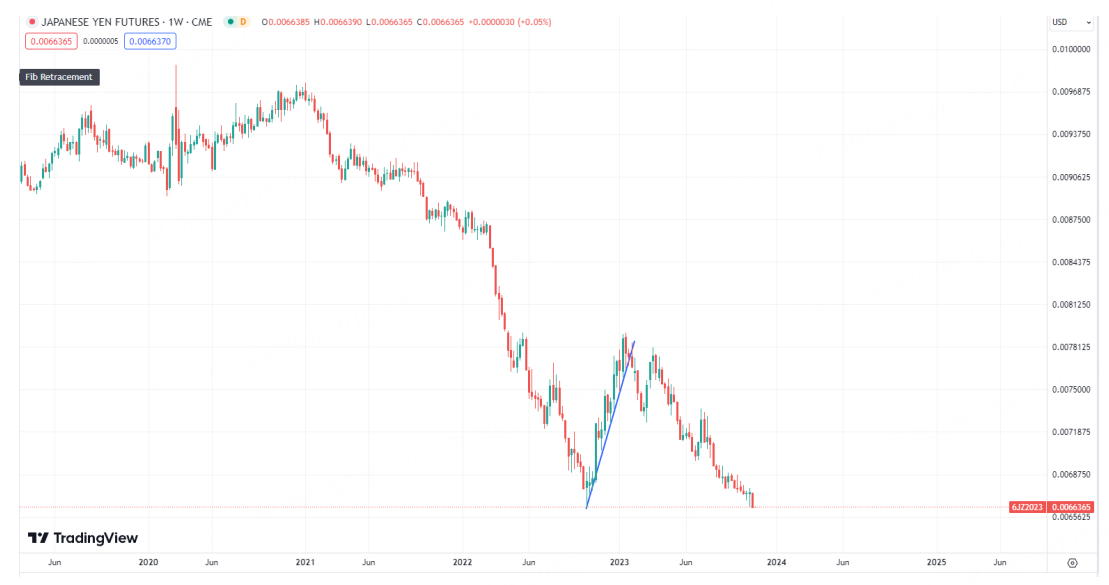
Under such fundamentals, we think it is unlikely to change the trend of the yen through central bank intervention or "intimidation", so the overall depreciation of the yen will not change.
On the other hand, it is interesting that the recent two or three actual interventions of BOJ appeared in a strange state: the trend was obviously weak and the news was relatively calm. If history can repeat itself, it may bring some short-term operation opportunities. Taking advantage of the opportunity of yen rebound brought by intervention, we can relatively find selling yen on rallies. In the case of diminishing effect, the possibility of reverse movement on intervention failure within days or weeks is not ruled out.
At the dollar level, we predicted last week that there will be room for downward correction, which will slow down the depreciation of the yen, but it is difficult to directly turn the yen from weak to strong. Even though the yen is the second largest component of the US Dollar Index, the disadvantage of spread/spread and the expectation of monetary policy difference are still too obvious. If the yen wants to turn over, the only chance is that there will be a real turmoil in the financial market, which will trigger the return of capital to Japan.
In addition, it should be noted that the current value of Nikkei Index, which was used as a reference index for some time before, is not obvious. After peaking in June, the kinetic energy of Japanese stocks' continuous upward attack has weakened. Although the upward trend has not been reversed, there is not much comparative value in the trajectory of the two in recent weeks.
$NQ100 Index Main Connection 2312 (NQmain) $$Dow Jones Main Connection 2312 (YMmain) $$SP500 Index Main Connection 2312 (ESmain) $$Gold Main Connection 2312 (GCmain) $$WTI Crude Oil Main Connection 2312 (CLmain) $
Disclaimer: Investing carries risk. This is not financial advice. The above content should not be regarded as an offer, recommendation, or solicitation on acquiring or disposing of any financial products, any associated discussions, comments, or posts by author or other users should not be considered as such either. It is solely for general information purpose only, which does not consider your own investment objectives, financial situations or needs. TTM assumes no responsibility or warranty for the accuracy and completeness of the information, investors should do their own research and may seek professional advice before investing.
