


Continuing Duan Yongping’s Covered Call Strategy: Absolutely Brilliant
Let’s continue discussing Duan Yongping’s covered call strategy. This strategy is absolutely brilliant. There were a lot of points in yesterday’s article that weren’t fully explained.
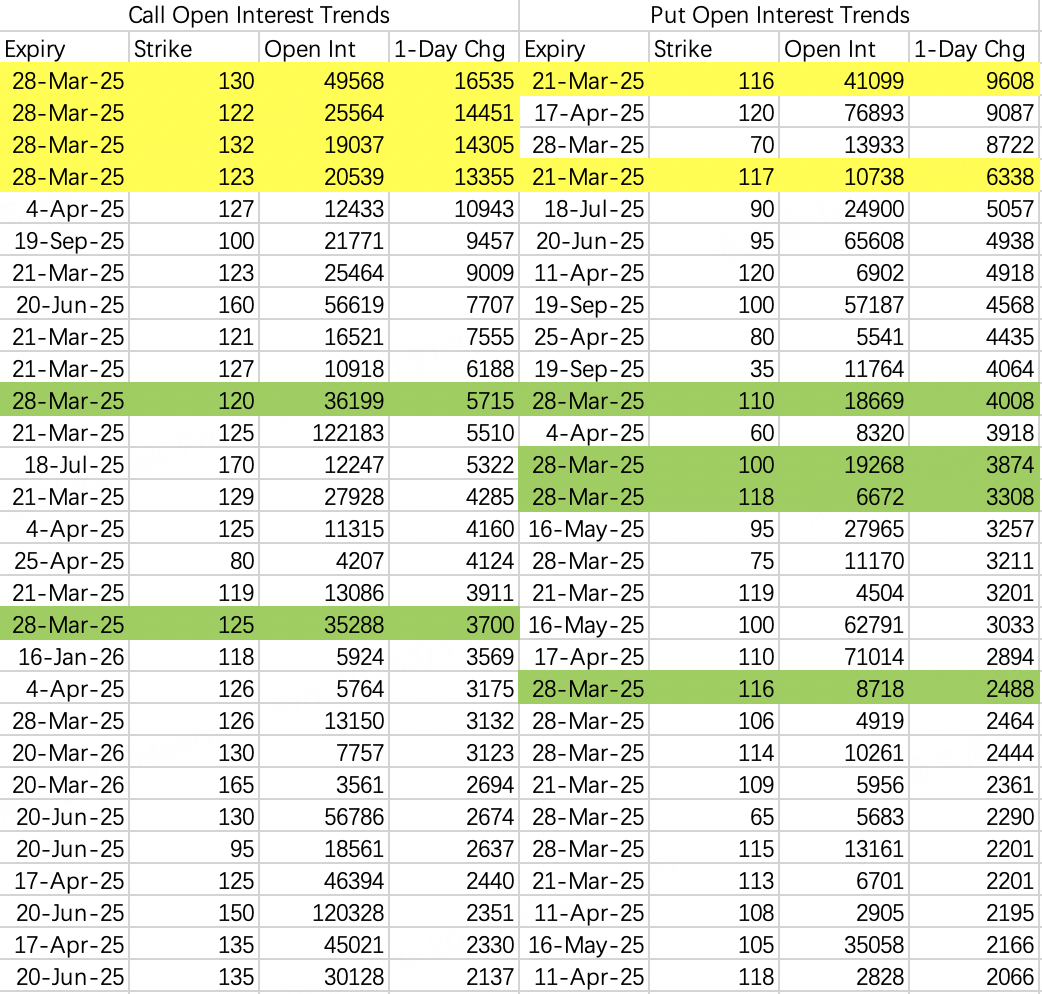
Market Expectations for Next Week
Next week’s market expectations are similar to this week. Reciprocal tariffs will take effect on April 2, followed by the start of earnings season. This means the market is likely to continue fluctuating next week, just as it has this week.
However, unlike the past two weeks, bearish forces will have limited influence, and the volatility will be more straightforward. It won’t be worse than last week.
Institutions are selling calls at $122 and $123 while hedging with long calls at $130 and $132. Next week’s strategy and strike price choices remain consistent with this week: selling calls at $130 and selling puts at $110 or $105.
Duan Yongping’s Strategy Is Unbeatable
In yesterday’s article, we discussed copying Duan’s strategy. It’s better to replicate the covered call strategy with $NVDA 20260320 120.0 CALL$ than to sell a put option.
Although both strategies carry the same risk, Duan chose the covered call instead of the more familiar sell put strategy because the maximum potential profit of the covered call ($2,750 per contract) is significantly higher than the maximum profit of selling puts ($900 per contract).
Covered call yield: 23%
Sell put yield: 7%
The most important difference is that selling puts avoids holding the stock, whereas the covered call involves owning shares, which provides a higher return compared to selling puts.
Given that both strategies have equivalent risk, using the covered call strategy with $NVDA 20260320 120.0 CALL$ is clearly a better choice.
There’s also an implicit signal here: choosing the covered call instead of selling puts suggests that Duan Yongping is more bullish on NVIDIA.
Selling puts is a more conservative strategy because it doesn’t benefit from stock price appreciation. In contrast, holding the stock allows you to capture upside gains, while the covered call strategy reduces costs in a bear market and caps profits in a bull market at a reasonable target price.
For NVIDIA, Duan Yongping’s covered call strategy, which locks in a 23% return, is unbeatable. In a bearish scenario, the cost basis of holding the stock drops to $92.5 after subtracting the option premium. In a bullish scenario, the stock will be exercised at $120, but including the premium, the effective sale price is $144.
For me personally, simply recognizing that Duan is favoring holding NVIDIA stock is already a massive bullish signal.
Common Questions
Duan Yongping’s trade has some nuances, and there’s been a lot of debate around the expiration date and strike price. For example:
Why choose an expiration date one year out?
Selling $120 calls—does this mean he only expects the stock to go up to $120?
Why use a covered call strategy at a relatively low stock price?
Why not choose the sell put strategy instead?
1. Why Choose an Expiration Date One Year Out?
This likely ties to Duan’s expectations. Comparing NVIDIA’s 171% growth last year with this year’s expected 23% return may seem conservative. But what if his expectations for this year are indeed modest?
Currently, the market doesn’t seem to have high hopes for hardware shipments. Even the GTC conference had no significant impact on NVIDIA’s stock price. Unless AI applications suddenly take off and drive hardware demand to a new level, it may be challenging to achieve significant growth this year.
Additionally, NVIDIA was recently targeted by malicious short sellers. Bearish forces are likely to stir up trouble during periods of market volatility, so being cautious isn’t a bad approach.
2. Does the $120 Call Mean He Only Expects the Stock to Reach $120?
This is a common question. Let’s break it down:
If Duan holds the stock at $116.5 and sells the $120 call, how much does he earn from the stock price difference?
$120 - $116.5 = $3.5How much does he earn from the option premium?
$24What’s the total profit from both stock price appreciation and the option premium?
$24 + $3.5 = $27.5
Effectively, holding the stock at $116.5 is equivalent to selling it at:
$116.5 + $24 + $3.5 = $144
Or, more simply:
$120 (strike price) + $24 (premium) = $144
In other words, as long as the stock price rises above $120 by expiration, Duan effectively sells the shares at $144.
3. Why Use a Covered Call Strategy at a Relatively Low Stock Price?
Covered calls are often associated with high stock prices, so some people are puzzled by Duan’s decision to implement this strategy at $116.5.
Why not wait for higher stock prices to sell calls? After all, call premiums are higher when the stock price rises. Selling calls at lower stock prices might seem less profitable.
However, as call premiums increase, the stock price is also rising. For example:
If you buy shares today at $119.5 and sell $NVDA 20260320 120.0 CALL$ , the premium might be $25.
This would result in an effective sale price of $145, which is only $1 higher than the $144 target price mentioned earlier.
As the delta increases and the option becomes more in-the-money, the combined strike price and premium do not change significantly. In other words, whether you sell the $120 call today or two days later, the difference is minimal.
The core question here is why not choose a higher strike price, such as selling the $150 call, instead of the near-the-money $120 call.
Why didn’t Duan choose the $150 strike price? That’s a good question—just like I’d want to ask the trader who shorted Tesla in February why they chose the $250 strike price for $TSLA 20251219 250.0 PUT$ .
The answer lies in information asymmetry—and whether you’re willing to acknowledge it.
4. Why Not Sell Puts?
This was discussed earlier—it’s less attractive. While selling puts at a higher strike price could increase the premium, it would also raise the cost of taking delivery if the stock is assigned. It comes down to personal preference and weighing the trade-offs.
With equivalent yields, most would prefer the strategy that results in a lower cost basis.
Final Thoughts
Duan Yongping’s choice of the covered call strategy with $NVDA 20260320 120.0 CALL$ is a masterclass in balancing risk and reward. Whether the market moves up or down, this strategy delivers solid returns:
Bearish scenario: The cost basis drops to $92.5, making holding the stock more manageable.
Bullish scenario: The stock is exercised at $120, but the effective sale price, including the premium, is $144.
For retail investors, it’s a good idea to learn from such a strategy. Whether you sell puts or calls, the key is to stick within a well-defined range and avoid being overly greedy. In a volatile market like this year, staying disciplined can still lead to excellent returns.
Disclaimer: Investing carries risk. This is not financial advice. The above content should not be regarded as an offer, recommendation, or solicitation on acquiring or disposing of any financial products, any associated discussions, comments, or posts by author or other users should not be considered as such either. It is solely for general information purpose only, which does not consider your own investment objectives, financial situations or needs. TTM assumes no responsibility or warranty for the accuracy and completeness of the information, investors should do their own research and may seek professional advice before investing.
