


SaaS Doomsday, From DUOL To Kuaishou, AI Redirects Organic Traffics!
By mid-2025, the narrative in the tech industry is crystal clear: AI is no longer just a buzzword, but a game-changer that is reshaping the entire industry.
We are witnessing a brutal "SaaS apocalypse" — companies deemed structurally vulnerable in the AI-centric world are struggling to survive, a trend reflected in the secondary market performance of these firms. The core logic is that: The rapid progress of AI is driving the market to focus more on the "valuation (P)" rather than the "earnings (E)" in the price-to-earnings ratio, especially for companies that rely on traditional growth levers such as SEO traffic.
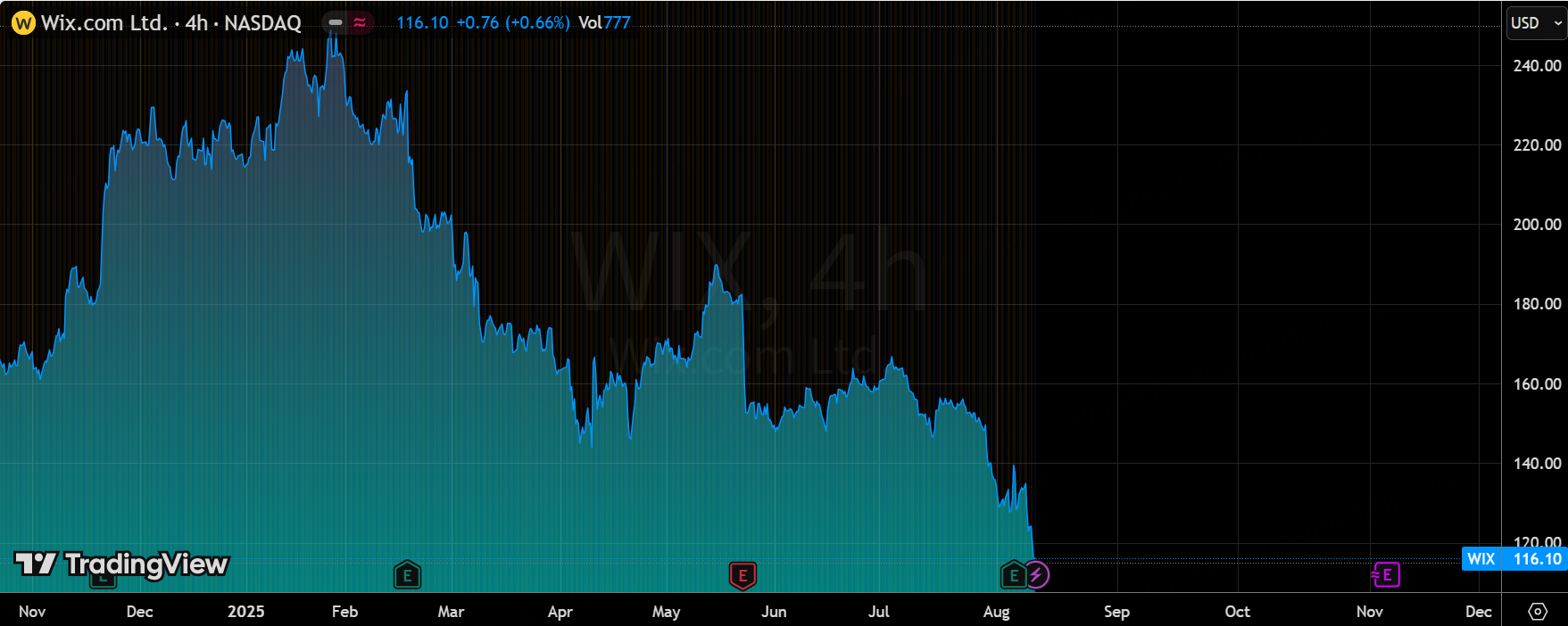
Based on recent stock price performance, $Wix.com(WIX)$ $Duolingo, Inc.(DUOL)$ $Monday.com Ltd.(MNDY)$ $Squarespace Inc.(SQSP)$ $Asana, Inc.(ASAN)$ $Yelp(YELP)$ $HubSpot(HUBS)$, and other companies are facing pressure due to the AI search revolution and the rise of chatbots like ChatGPT and Gemini.
Some clues about Q2 performance: slowing growth and erosion of indicators
Data never lies. In Q2 2025, several companies saw a significant decline in key indicators due to the impact of AI.
Duolingo (DUOL): The stock price plummeted by 8% in a single day, and the growth rate of daily active users (DAU) dropped from 30% year-over-year in Q1 to the mid-single digits in Q2. This aligns with the conclusion in the TMT report that "ChatGPT-5's demonstration of instant language learning tools undermines Duolingo's core value." Despite orders exceeding expectations in the previous quarter, revenue growth slowed from 50% to 45% (according to the 10-Q filing).
Monday.com (MNDY): Management admitted that "Google's algorithm changes have led to weakness in the lower-tier market," triggering a 30% plunge in the stock price after the earnings report. If organic click-through rates decline by 30% as predicted by 2027 (currently 40% of new customers come from SEO), its net annual recurring revenue (ARR) growth rate will drop from over 20% to over 10%. Actual data already shows a downturn: Q1 revenue was $216 million (up 34% year-over-year), but Q2 guidance suggests slowing growth, with customer acquisition cost payback periods extending from 12 months to 15 months.
WIX.com: Q2 order value increased by 15% year-over-year to $435 million, but AI summaries consumed clicks, causing organic traffic to decline by 10-15%.
Squarespace (SQSP): User acquisition costs rose 20% year-over-year, and revenue growth slowed from 25% to 19%.
Asana (ASAN): Billings revenue growth slows sharply to 10%; HubSpot (HUBS) reports a 5% decline in inbound leads (attributed to AI chatbots diverting traffic from the top of the funnel).
Yelp has been particularly hard hit: historically, 50% of its traffic has come from Google, and its public filings warn that "AI summaries could have a substantial negative impact." Advertising revenue in Q2 grew by only 6% to $337 million, with local services seeing zero growth due to reduced search recommendations.
This can be corroborated by macro data: the proportion of search traffic accounted for by chatbots will surge from nearly zero in 2024 to 2.96% in 2025, and 66% of consumers believe that AI will replace traditional search within five years.
Platforms such as Bing and AI tools are capturing 5.2% of organic traffic, eroding $Alphabet(GOOG)$ 's 94.8% dominance, but Google itself has the Gemini ecosystem to facilitate the transition. For these companies, performance is not just declining—it is structurally damaged because AI is redirecting user behavior.
Essentially, it is a business model shock: from SEO dependence to AI replacement, evolving towards AEO.
These companies once relied on SEO as a low-cost customer acquisition engine, but AI-generated summaries and chatbots are disrupting this model, and the business logic is undergoing a fundamental restructuring.
Traffic hijacking: Chatbots such as Gemini directly answer queries, reducing user clicks on blue links by 49% (February 2025 consumer research). WIX explicitly states in its 10-K filing: "If algorithm changes result in insufficient exposure of website links, the business will be severely impacted."
Survival threat: Duolingo's GPT-5 challenges its gamified learning model with its ability to generate flashcards and games through simple commands. Monday.com/Asana: AI agents can coordinate tasks across platforms, rendering dedicated workflow interfaces obsolete (as demonstrated by the OpenAI prototype). HubSpot/Yelp: The "high search ranking traffic" model relied upon by inbound marketing is being fragmented by AI summaries; the review ecosystem is being bypassed due to chatbots aggregating data.
Semrush shows that AI-driven SEO can increase organic traffic by 45% for adopters, but for laggards, it means a 20-30% loss in traffic (as users shift to conversational search).
How can we break the deadlock? The answer lies in "Answer Engine Optimization (AEO)". This requires a complete overhaul of the traffic funnel model to create an AI-inclusive ecosystem.
AEO, short for Answer Engine Optimization, is an emerging digital marketing and content optimization strategy aimed at enhancing the visibility and citation rate of content within AI-driven "answer engines." These answer engines include AI tools such as ChatGPT, Google AI Overviews, Perplexity, and Bing Copilot, which do not return lists of links like traditional search engines but instead generate summary answers or respond directly to user queries. The core objective of AEO is to ensure that brands or content are "understood, trusted, and referenced" by these AI systems, thereby indirectly driving traffic, brand exposure, and conversions.
High valuation trap
The valuation levels of these companies are not low. For companies with a P/E ratio of 100, a collapse in valuation (P) would be fatal: DUOL has a forward P/E ratio as high as 100. If growth is halved due to AI, the P/E ratio could compress to 50-60 times; MNDY's enterprise value/sales multiple has dropped from 20 times before AI-related concerns to 12 times, reflecting a 30% risk to ARR; WIX/SQSP: While they appear undervalued (5 times/4-6 times sales), McKinsey notes that AI-driven improvements in marketing productivity (valued at $463 billion annually) will primarily benefit AI-native companies, not traditional players.
Since May 2025, the "AI risk basket" containing WIX, Shutterstock, and Adobe has fallen 22%, underperforming the S&P 500 Index. Yelp has fallen 15% year-to-date, and Asan has fallen 20%.
In the AI world, "P" dominates, and these companies' premiums are evaporating as investors bet on disruption.
Investor sentiment is mixed, but leaning bearish. In a SeoClarity survey, 52% of SEO professionals saw AI improve page performance, but 40% reported revenue losses of 6-10% for non-adopters. Kevin Indig's Growth Memo analyzed 14 studies showing AI referrals grow with high engagement, but publishers fear zero-click searches.
Adapt or perish in the AI era
By 2025, AI-driven SEO disruption and the proliferation of chatbots will not merely be trends—they will be a survival inflection point for SaaS companies. Companies like WIX, DUOL, and MNDY must move beyond SEO dependency and embrace AEO and AI-native functionality, or risk becoming irrelevant. Bullish observers are betting on adaptation (e.g., DUOL's AI integration), while bearish observers foresee the "elimination" of service-intensive companies.
The data paints a vivid picture: slowing growth, pattern fractures, multiple compression, market sell-offs, and tension. However, for those who take action, opportunities abound—diversified traffic, optimized entities, and deep AI integration.
Disclaimer: Investing carries risk. This is not financial advice. The above content should not be regarded as an offer, recommendation, or solicitation on acquiring or disposing of any financial products, any associated discussions, comments, or posts by author or other users should not be considered as such either. It is solely for general information purpose only, which does not consider your own investment objectives, financial situations or needs. TTM assumes no responsibility or warranty for the accuracy and completeness of the information, investors should do their own research and may seek professional advice before investing.
- pangngk·08-12Incredible insights on the SaaS landscape! [Wow]LikeReport