


It's Time to Buy the Dip in Apple
$AAPL$
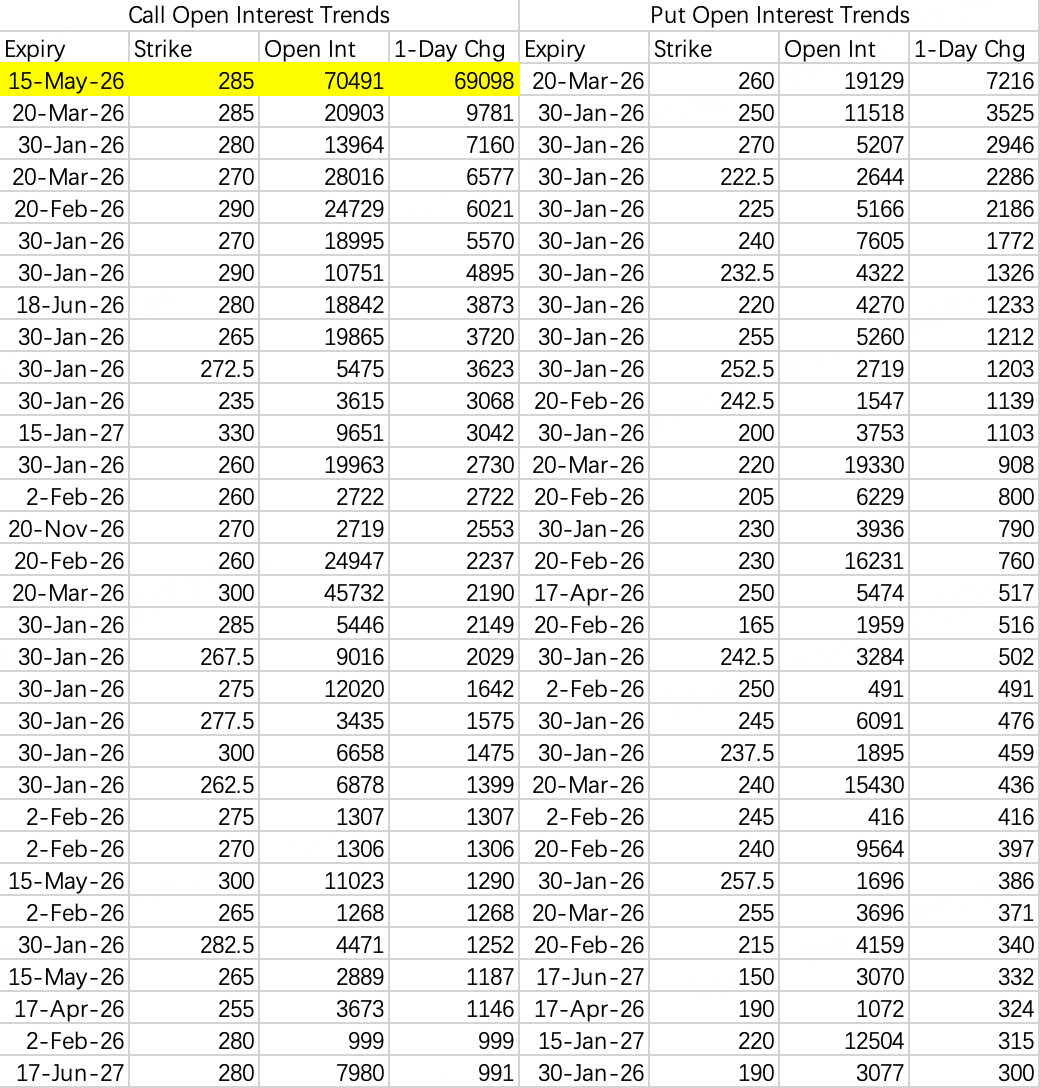
Apple has seen a large bullish call order. The May 15th expiry 285 call $AAPL 20260515 285.0 CALL$ had 69,000 contracts opened, with a total notional value of approximately $34+ million.
Although I believe Apple's performance this year may still be weighed down by high memory prices, this doesn't prevent the market and large investors from perceiving a potential bottom. With earnings this week, selling the 250 put is an option: $AAPL 20260130 250.0 PUT$ .
$FXI$
Regarding the large bearish China ETF orders, I discovered someone shared my analysis in a group, causing some panic.
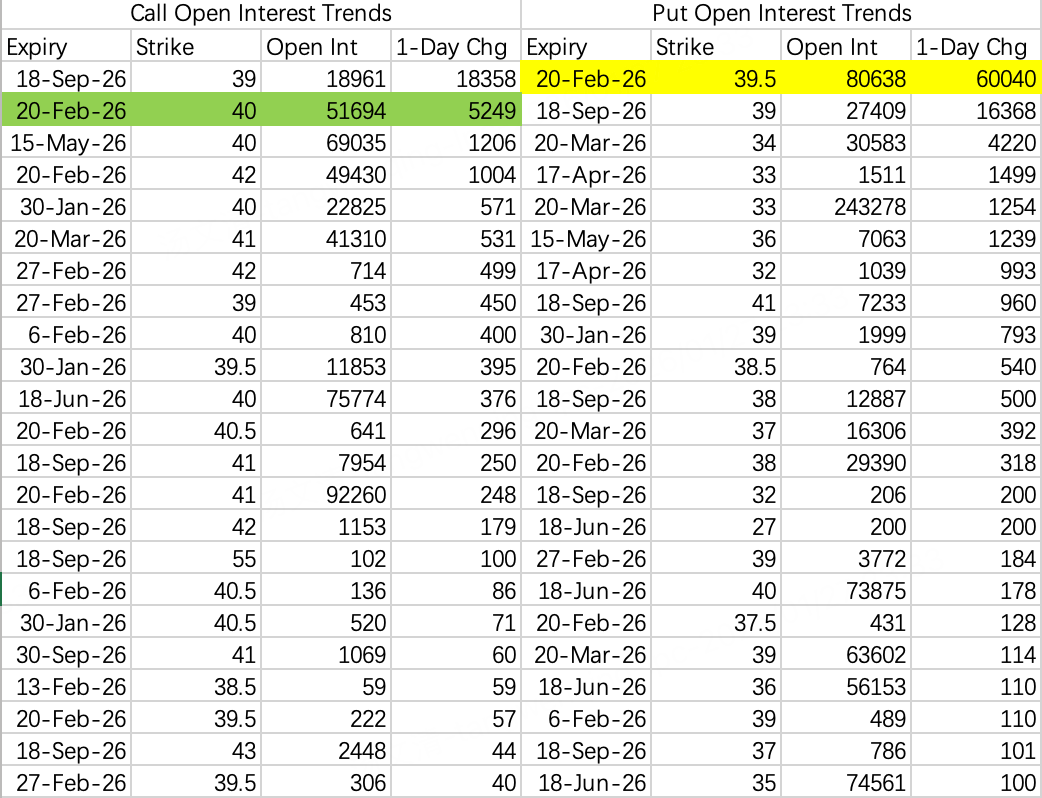
However, a massive, deep out-of-the-money bearish order like $FXI 20260320 32.0 PUT$ is something I'm seeing for the first time as well. The trader's intention remains to be seen.
Intuitively, one might think buying puts means betting on a crash. But for extremely out-of-the-money puts, the price doesn't necessarily need to drop to 32 or 33; a surge in implied volatility can also increase their value.
For such large orders, several scenarios could theoretically be profitable: a crash, a decline, or a rally followed by a drop. If the price rises 5% and then suddenly drops 3%, these puts could potentially break even.
In other words, they could be profitable if there is a single sharp, volatility-spiking crash in Chinese stocks before March.
Whether this justifies completely liquidating A-share or Hong Kong holdings requires careful thought. You must consider whether you could psychologically handle it if Chinese stocks subsequently rally.
Of course, the above analysis is merely speculation; only time will tell.
However, on Monday, another large bearish order emerged: $FXI 20260220 39.5 PUT$ , with 60,000 contracts opened.
It can only be said that there are indeed many bearish voices on Chinese stocks recently, and the confirmed bearish timeframe is before the Lunar New Year.
It's important to re-emphasize that large orders must be considered alongside other information. Large orders failing is not uncommon; a solid rationale for opening a position doesn't guarantee its success, as market conditions are fluid and complex.
For example, the recent Google bearish orders mentioned earlier $GOOGL 20260220 330.0 PUT$ $GOOGL 20260227 330.0 PUT$ might fail. However, the possibility of a coordinated US-China market decline before the Lunar New Year cannot be ruled out.
A more successful example of a large order might be $CRWV 20260320 100.0 CALL$ , where the price smoothly reached the strike after a month of consolidation. However, this leans more towards insider information and differs from bearish macro bets.
$INTC$
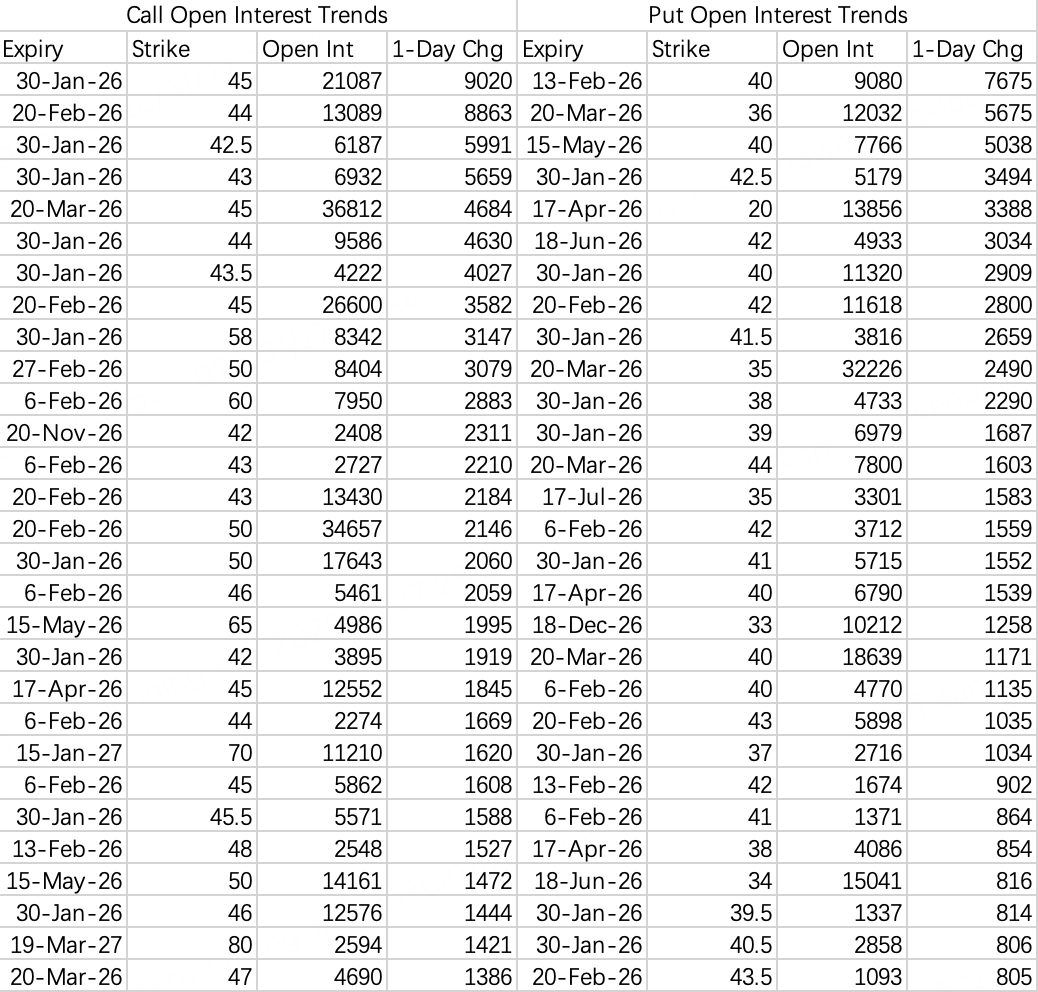
Intel dropped sharply post-earnings, returning to a level suitable for selling puts. The most appropriate strike is 40. If you find the premium too low and don't mind assignment, choosing a slightly higher strike is also fine. The price is expected to consolidate and adjust between 40 and 50.
$TSLA$
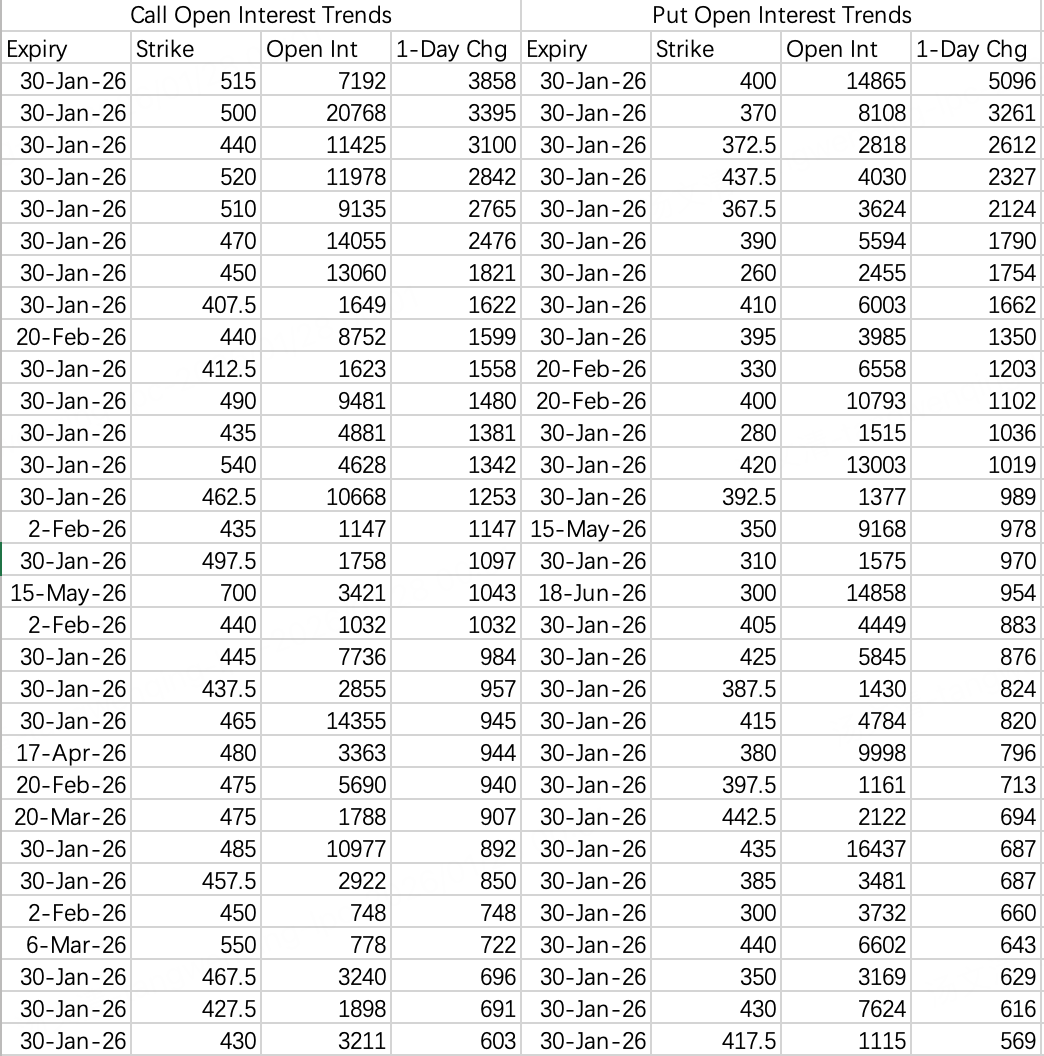
Tesla's earnings outlook is not optimistic. Robotic applications seem distant, and the automotive business is expected to miss market expectations. Post-earnings, the stock could pull back to 400.
One can mimic institutions by implementing a bullish call spread: sell the 465 call $TSLA 20260130 465.0 CALL$ and buy the 485 call $TSLA 20260130 485.0 CALL$ .
Disclaimer: Investing carries risk. This is not financial advice. The above content should not be regarded as an offer, recommendation, or solicitation on acquiring or disposing of any financial products, any associated discussions, comments, or posts by author or other users should not be considered as such either. It is solely for general information purpose only, which does not consider your own investment objectives, financial situations or needs. TTM assumes no responsibility or warranty for the accuracy and completeness of the information, investors should do their own research and may seek professional advice before investing.
Great article, would you like to share it?