Although there have been changes in Japan’s political landscape, the announcement by the ruling party leader Shigeru Ishiba to remain in office has boosted confidence in Japanese stocks. Following a significant rise last week, the Nikkei is now just one step away from its historical peak. As an important gauge of market sentiment, the increase in the Nikkei and the potential for new highs suggest that risk appetite may continue. However, it is important to note that the yen has remained relatively stable. Even as the US dollar retraces, the USD/JPY pair has only seen a modest increase. Until the movements of these inherently counterbalancing assets align, the effectiveness of this rally remains uncertain.
Regarding the Nikkei itself, large-scale breakthroughs typically undergo multiple retests. Once a valid breakout occurs, it usually opens the door for further gains. The coming weeks will be crucial in determining whether the index can firmly surpass the previous highs after repeated tests. Fundamentally, Japan’s situation is complex. On one hand, the Bank of Japan faces inflation-driven pressure to raise interest rates—a pressure complicated by ongoing trade tariff negotiations with the US and their uncertain outcomes. On the other hand, while the Japanese political scene has stabilized in the short term, the long-term emergence of populist and nationalist right-wing forces appears inevitable.
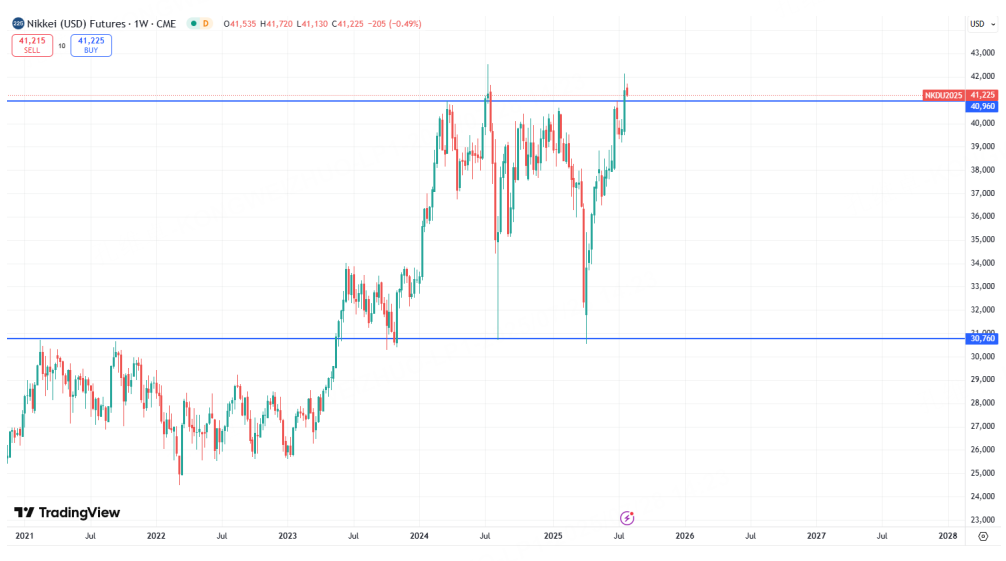
If the Nikkei successfully breaks through and sustains new highs, from a global equities perspective, further gains are highly probable. Although this exuberance could be seen as a risky bubble—potentially a "time bomb" laid by former US President Trump—it might persist for some time regardless. The ideal scenario, however, remains a weakening yen, given the historical correlation between the two.
In recent weeks, the yen’s performance has been largely unremarkable, reflecting a lack of unified market preference. Should the Nikkei rise while the yen either holds steady or strengthens, this divergence would cast doubt on the legitimacy of the Nikkei’s gains. Using USD/JPY as the benchmark, the exchange rate needs to climb above 151.85 to support the strength in the stock market. A sudden drop below 140 would indicate a stronger yen and undermine the foundation of the Nikkei’s rally.
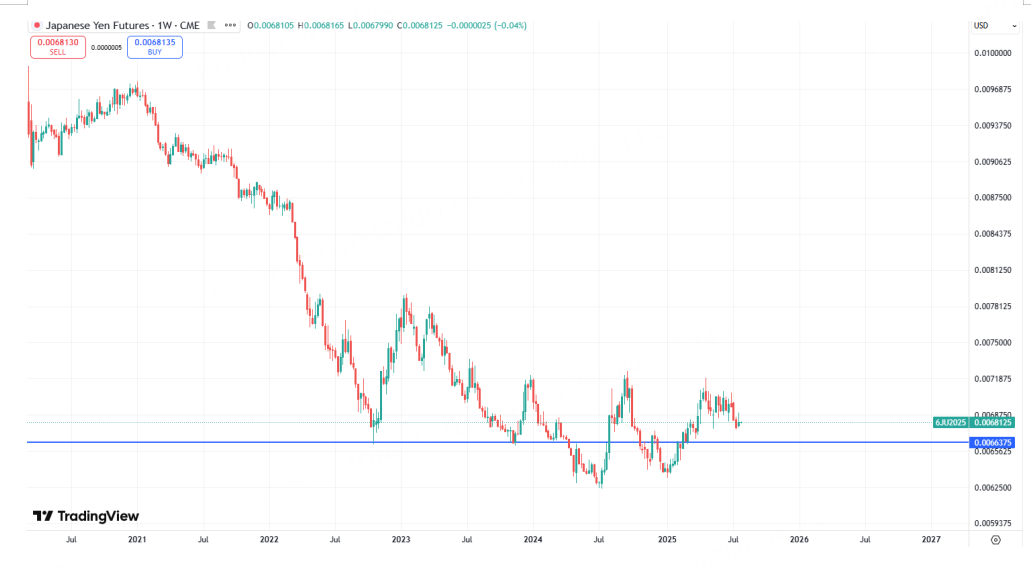
Given these practical observations, it may be worthwhile to consider a hedging strategy between the yen and Japanese equities to capitalize on their eventual convergence. More importantly, however, is monitoring the Nikkei’s upward momentum as a guide to shifts in risk appetite. As a major source of arbitrage capital, developments in Japan frequently provide leading signals.
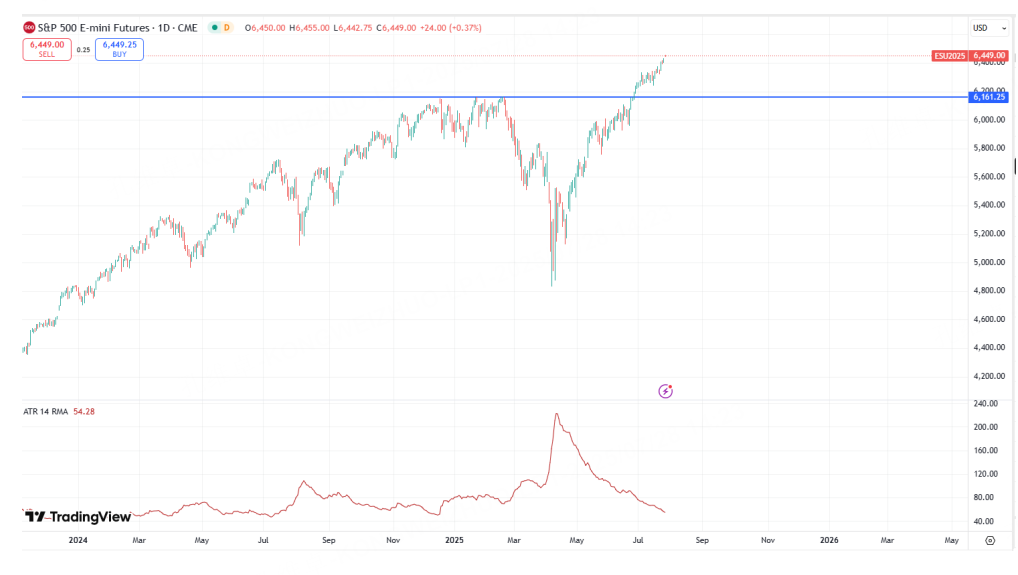
Additionally, the ATR (Average True Range) indicator, which we previously discussed, is showing changes in US stock indices. The daily volatility reading for the S&P has now declined to around 54 amid the slow bull market. Historically, this indicator residing in the 40–50 range often signals a bottoming reversal. An increase in volatility typically brings corrections and pullbacks to the index itself. However, unless there is a major shift in news or fundamentals, such pullbacks may present good buying opportunities, especially for quick dips where the initial retracement often offers a bounce-back chance.
$E-mini Nasdaq 100 - main 2509(NQmain)$ $E-mini S&P 500 - main 2509(ESmain)$ $CME Nikkei 225 - main 2509(NIYmain)$ $Japanese Yen - main 2509(JPYmain)$ $WTI Crude Oil - main 2509(CLmain)$ $Gold - main 2512(GCmain)$
Comments