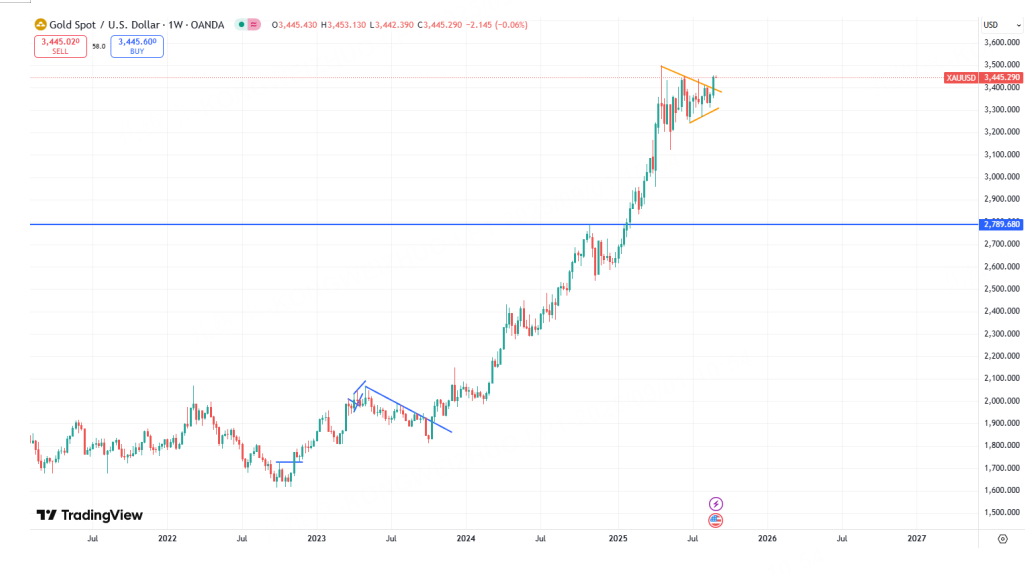
Several weeks ago, we discussed how gold was on the verge of breaking out of a triangle pattern. Due to constraints of time and space, this breakout is now imminent. Although the fundamental backdrop at that time seemed unfavorable for gold, the market’s actual choice takes precedence. As spot gold has followed futures gold upward to break out, a new round of rally appears poised to begin. Given that triangle breakouts often involve many false breakouts, conservative investors might find it more suitable to seek arbitrage opportunities based on the current spot-futures price spread.
Looking at the weekly charts of both futures and spot gold, while there are some differences (futures recently reached a new high due to contract rollover, whereas spot was lagging), the overall pattern and trend are very similar. Currently, the synchronization of their breakouts is quite consistent. Generally, buying on a breakout to follow the trend is the primary choice, offering the theoretically largest profit potential. However, considering the risk of a bull trap and the roughly 2% price spread between spot and futures, arbitrage or hedging might also be viable options.
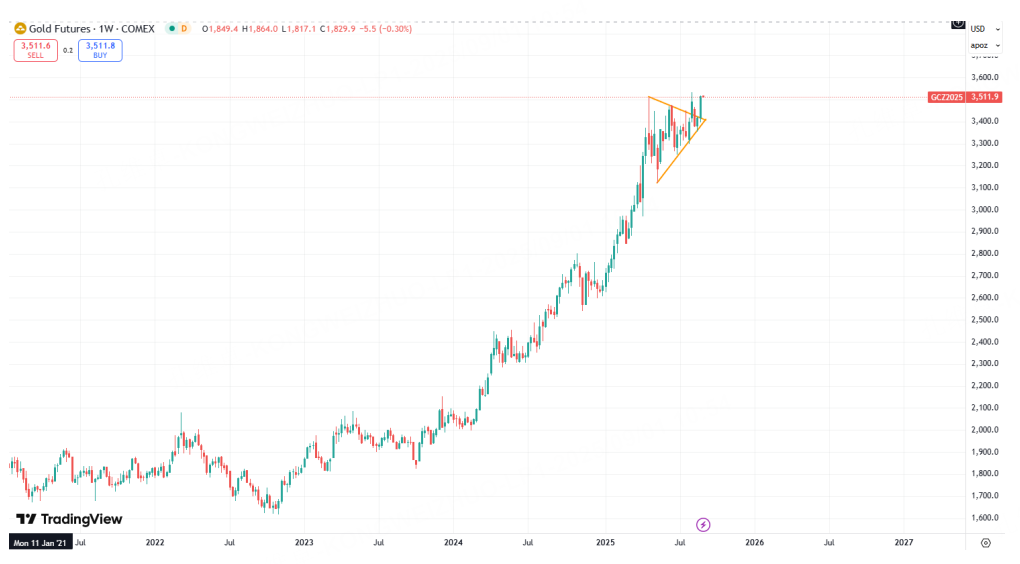
Specifically, combining a long position in spot gold with a short position in futures can reduce trading risk but limits profit potential. Historically, when factoring in the time element, a 3% price spread represents an excellent opportunity for price convergence trades. Although the current spread is not yet at a “risk-free” level, establishing a base position is reasonable. If the price spread continues to widen, it is advisable to keep some capital reserved for adding to positions. This approach ensures that regardless of whether prices continue rising or if the breakout reverses downward, the spread will tend to converge back to a typical range of about 0.3% to 1%, either through spot catching up or futures correcting downwards. For those seeking higher profits, chasing the breakout on the upside is naturally the better choice, but if a reversal breakout occurs, stop losses and switching to short positions will be necessary. Handling this psychologically can be challenging for traders.
Besides gold, silver has also matched an upward trend recently. Although its price still lags behind the historical high, silver has evidently shed its underperformance of the past several years. However, this catch-up rally arguably marks the final phase of the precious metals’ overall uptrend. In other words, compared with gold, silver currently serves more as a reference point—similar to the role Ethereum plays for the broader cryptocurrency or risk asset market.
Like gold, as long as the trend remains unchanged, the current breakout should be treated as a bullish market. If the gold-to-silver ratio fails to break below its previous low, it would indicate that gold and silver remain relatively balanced with each other. In the medium to long term, the ratio at around 86 is relatively high, but if silver continues to rally and pushes the ratio down below 70, one should decisively go long gold and short silver.
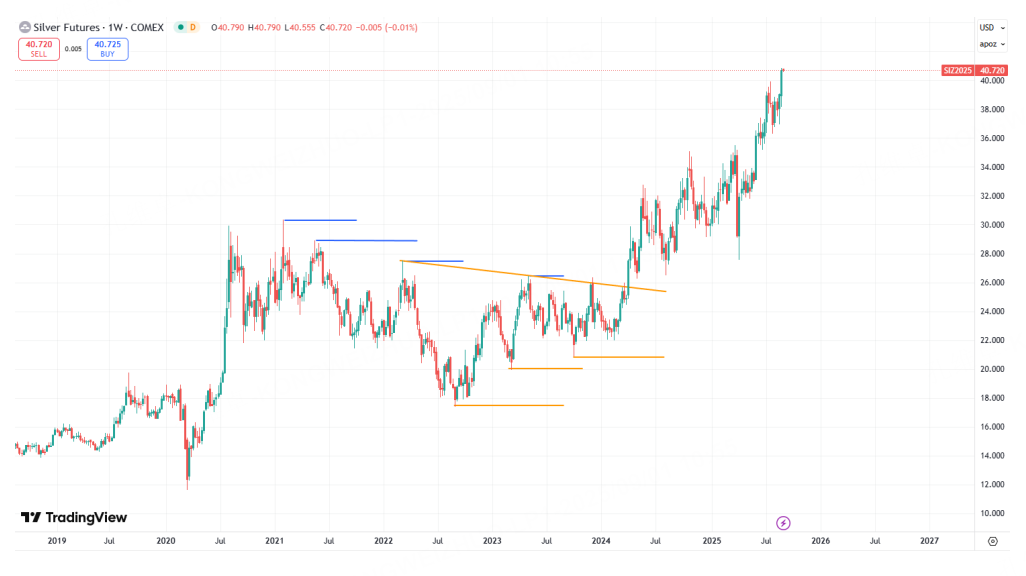
In summary, both gold and silver show a bullish bias as prices break upwards. However, from a practical trading perspective, adopting a “small but certain” mindset favors arbitrage strategies over trend chasing.
$E-mini Nasdaq 100 - main 2509(NQmain)$ $E-mini S&P 500 - main 2509(ESmain)$ $E-mini Dow Jones - main 2509(YMmain)$ $Gold - main 2512(GCmain)$ $WTI Crude Oil - main 2510(CLmain)$
Comments