In September, as the U.S. summer travel season ended, a decline in U.S. gasoline consumption drove down international crude oil prices. The NYMEX WTI October crude contract fell below $65 per barrel, a significant drop from the June 23 peak of $74.25 per barrel. Similarly, the ICE Brent November crude contract also declined, falling close to the $65 per barrel level.
From the current supply and demand perspective, there is a strong possibility of substantial inventory build-up in the international crude oil market, which would increase market surplus pressure. This is mainly because both OPEC+ and non-OPEC oil-producing countries are increasing output, while demand shows signs of slowing, particularly in the United States, where stagflation characteristics are prominent. This weakens U.S. crude oil demand despite the offsetting positive growth in China’s recovery. However, geopolitical crises and production costs for oil-producing countries determine the marginal increase in future oil output. This implies that the surplus amount of oil may be less than expected, and the stagflation environment provides some support to oil through investment demand.
Crude Oil Production Increase is Certain
In 2025, global crude oil is entering a production increase cycle, with both OPEC+ and non-OPEC countries ramping up output. Over the past five months, OPEC+ has accelerated the restoration of previously curtailed production capacity. If OPEC+ maintains a monthly increase of about 137,000 barrels per day, it will fully reverse the 1.66 million barrels per day of production cuts within a year.
On September 7, OPEC+ “in principle agreed” to increase production again in October, marking a strategic shift toward pursuing market share rather than defending prices. According to officials from member countries, the alliance led by Saudi Arabia and Russia is set to approve an approximate daily increase of 137,000 barrels at a Sunday video conference, initiating the next round of lifting production cuts.
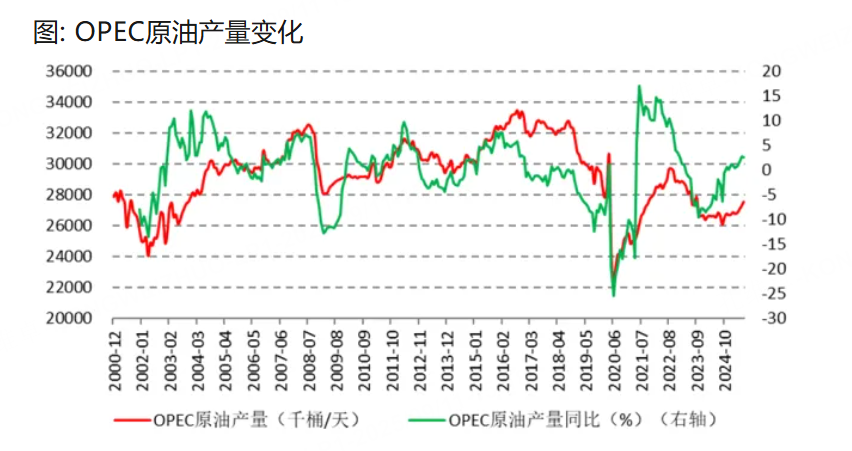
Significant Uncertainty in Actual Production Increments
Based on historical production data, although OPEC+ aims to gain market share through production increases, the actual increment depends heavily on remaining idle capacity, geopolitical factors, and production costs, creating significant uncertainty about the marginal global oil output increase.
The intensity of production increases also varies. Data from April to August 2025 show that OPEC+ countries collectively increased production by about 1.16 million barrels per day, with a production increase execution rate of around 61%. Saudi Arabia’s oil output rose by 650,000 barrels per day, with an execution rate of 84%. Kuwait, which had previously complied well with cuts, has basically completed its planned increases. Countries like the United Arab Emirates, Iraq, and Kazakhstan remain in an overproduction state, with actual increases falling short of planned amounts. Russia, by contrast, remains cautious about output release, with an execution rate near 53%.
Geopolitical crises also affect production in oil-producing countries. OPEC’s monthly report shows Venezuela’s oil output dropped by 4,000 barrels per day to 914,000 barrels in July compared to the prior month. The U.S. secondary sanctions on Venezuela’s oil and gas sector have caused Venezuela’s output to have declined for four consecutive months from April through July.
According to the U.S. Energy Information Administration (EIA) monthly report, in June, due to a rebound in oil prices, U.S. crude oil daily production hit a record 13.58 million barrels, exceeding earlier weekly preliminary estimates by about 150,000 barrels per day.
Demand Weakness is Highly Likely
Global crude oil demand shows a clear weakening trend in 2025, with the year-over-year growth rate slowing from 1.1% in Q1 to 0.7% in Q2. As demand weakens, global oil inventories continue to build. In June, inventories rose for the fifth consecutive month, adding 28.1 million barrels month-over-month and reaching 7.836 billion barrels, a 46-month high. In Q2 2025, global oil stocks increased by an average of 1.5 million barrels per day, including a 900,000-barrel-per-day rise in U.S. liquid hydrocarbons stocks. Offshore floating storage of crude oil also increased notably. In June, OECD industrial oil stocks decreased by 28.8 million barrels to 2.758 billion barrels, down 88 million barrels year-over-year.
In summary, global crude oil market output growth is certain, but the marginal increase is subject to significant uncertainty due to idle capacity, geopolitical risks, and production costs, which affects the surplus oil amount. Demand weakness is also highly probable, even though emerging market demand such as China’s is recovering. The risk of demand weakening from U.S. stagflation cannot be overlooked. Therefore, in light of the risk of a phase decline in oil prices after the U.S. summer travel peak, investors may consider using appropriate crude oil futures tools for risk management.
$NQ100指数主连 2509(NQmain)$ $道琼斯指数主连 2509(YMmain)$ $SP500指数主连 2509(ESmain)$ $WTI原油主连 2510(CLmain)$ $黄金主连 2512(GCmain)$
Comments