After a near-vertical rally, gold and silver were finally “punished” last Friday, with both plunging sharply in a single day. Silver, measured from its peak, even suffered a drawdown close to being cut in half. After such a violent round-trip, do ordinary investors still have a viable trading opportunity?
From a volatility standpoint, the current environment is no longer suitable for the vast majority of retail and traditional precious-metals traders. Moves that used to take a full year can now happen in a single day or within a week. This kind of irrational volatility also means the old stop-loss logic and methods stop working. Whether you try to buy the dip or fade a rebound, there’s a high probability you’ll get stopped out. And if someone dares to skip a stop-loss to avoid getting wicked out, the market will “teach” them with another one-way trend. So even though the tape looks full of opportunity, the risk is enormous—watch more, trade less is the best choice.
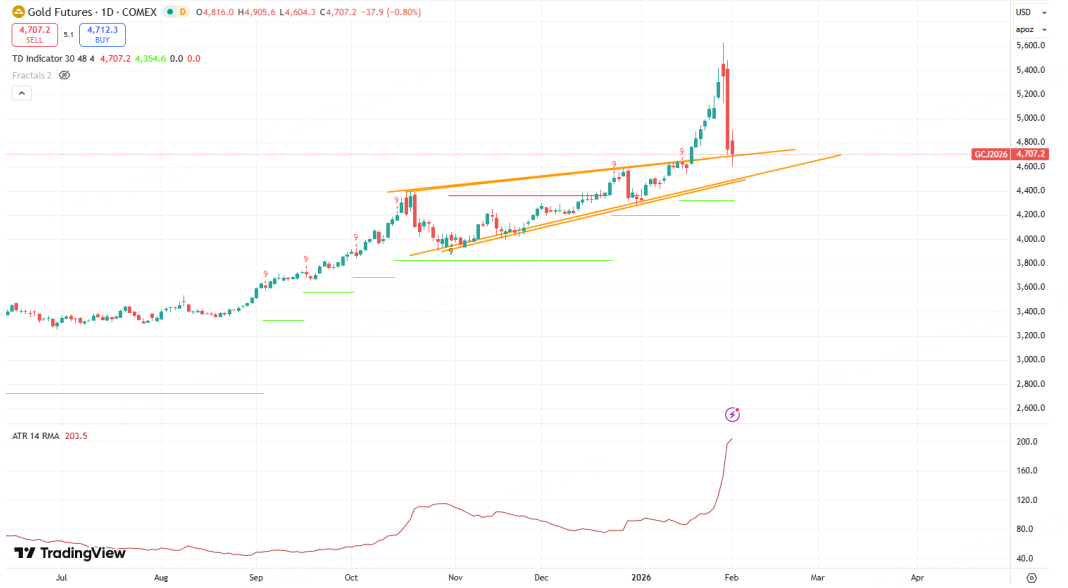
So when can we look for trades again? In our view, a key prerequisite is for the market to broadly return to a reasonable intraday volatility range. Using gold as a reference, the 14-day ATR is now above $200, while near the prior historical high—even though volatility was still elevated—the ATR was only around $120. A more reasonable range would be roughly $60–$80.
In other words, we need to see the market itself slow down before we can consider trading again. To put it another way, it’s like a bouncy ball dropped from the 10th floor: you have to wait until it has bounced enough times—“let the bullet fly for a while”—before it becomes something regular participants can realistically play.
$Silver - main 2603(SImain)$ $E-mini Silver - main 2603(QImain)$ $Silver - Mar 2026(SI2603)$ $iShares Silver Trust(SLV)$
After the Volatility: Has the Market Really Topped?
After a volatility shock, the next unavoidable question is: has the market put in a true major top? Are we facing a position that could be trapped for 10 years or more, or is this a so-called healthy bull market driven by deleveraging? The answer may not be clear. On one hand, from the perspective of real demand and supply dynamics, current prices are clearly unreasonable. On the other hand, if you incorporate how the market is pricing global macro conditions and geopolitics, the power of sentiment cannot be ignored.
Fortunately, trading often doesn’t require us to overthink things. As long as the trend has not signaled a reversal, we can continue to look for trades in the direction of the prevailing trend. For gold, even though it dropped more than $1,000 in just a few days, the prior weekly swing point at 4,284 has not been broken, and below that there is still the prior platform low at 3,900. Based on this, once volatility starts to fall, price action slows, and the market moves into a range, going long remains the higher-priority choice.
If this downswing pauses on Monday and returns to a consolidation phase, then 4,600–5,200 is likely to become a zone of sustained two-way rotation between bulls and bears. In that phase, looking to participate from relatively lower levels can keep risk controllable while still offering a reasonable profit cushion.
From a longer-term perspective, I personally think that if you look at gold from an investment-value angle, it may need to pull back to around 3,500 before it becomes a new platform suitable for regular fixed-amount investing. Of course, that level most likely won’t be reached quickly or easily; it may only become available after the next wave of mania ends.
$Gold - main 2604(GCmain)$ $E-Micro Gold - main 2604(MGCmain)$ $1-Ounce Gold - main 2604(1OZmain)$ $E-mini Gold - main 2604(QOmain)$ $E-Micro Gold - Feb 2026(MGC2602)$ $VanEck Gold Miners ETF(GDX)$
Comments