


Is a Recovery Rally Coming for the US Dollar? Opportunities in Non-Dollar Currencies
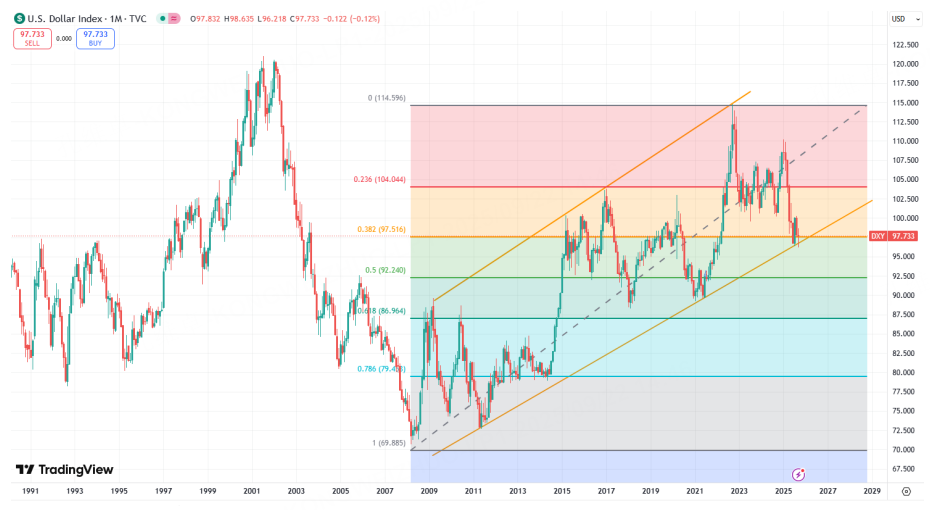
Last week’s Federal Reserve interest rate decision went as expected, with no surprises, following the usual course. This resulted in some assets experiencing opposite swings after initial reactions to the news. The US dollar index briefly hit a recent low but then stabilized and rebounded at a key long-term trendline. If this rebound can hold through the rest of the month, the dollar is likely to see a phase of upward repair rally, though the overall large range is unlikely to be broken.
The nominal interest rate cut is theoretically bearish for the dollar, but its actual impact has been limited. On one hand, most other central banks are also in the process of easing, so there is no real interest rate gap expectation. On the other, the market had already priced in the Fed’s actions well in advance. More importantly, the dollar index is currently sitting at a very critical level near 97. From a monthly perspective, with 7 trading days left, the chart still shows a bearish doji, but last week’s weekly candle formed a clear lower shadow with a small gain. Historically, after similar weekly patterns, the dollar tends to rebound for a number of weeks (around four). Given improvements in both the news and technical outlook, it seems the dollar should have little difficulty maintaining its core support in the near term.
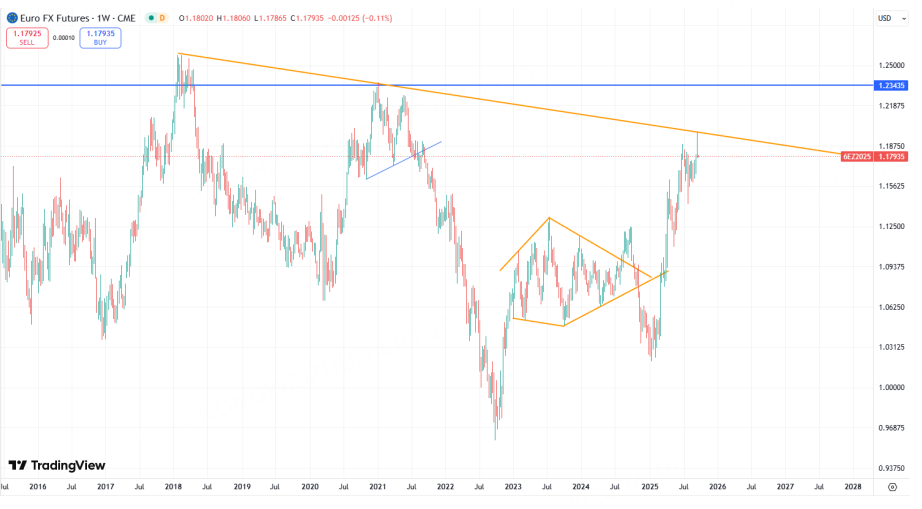
The dollar’s rebound naturally caused various degrees of pullbacks and corrections in non-dollar currencies. Aside from the euro, attention should also be paid to movements in the Chinese yuan exchange rate. The EUR/USD pair fell near a long-term resistance, mirroring the dollar index’s movement. It is worth noting that the previous cycle did not show such a strong correlation, making the sync and reference value this time clearly more significant. In other words, if the dollar weakens in the future and the euro breaks through its resistance line, this could open the door for further euro gains and a sharp dollar decline. However, this scenario likely requires major catalysts, such as shifts in US-China relations or changes in the Trump administration.
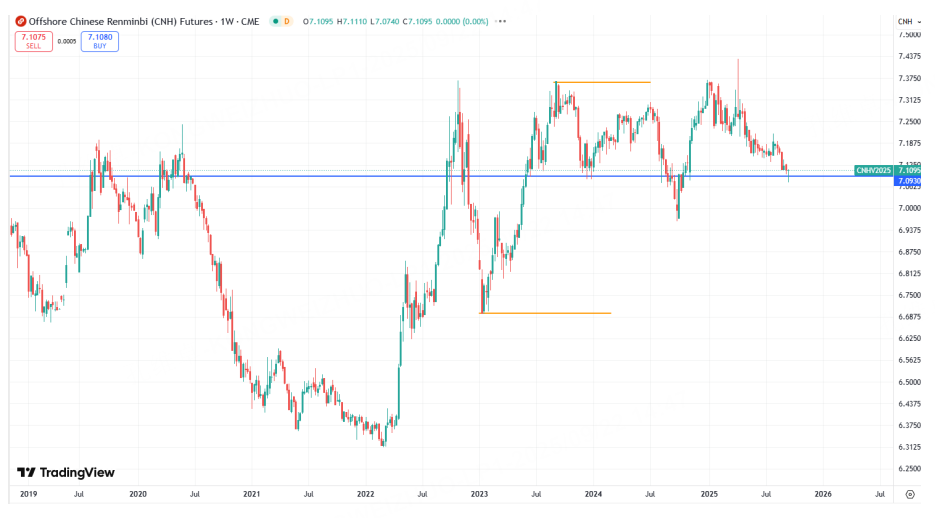
Regarding the yuan, the exchange rate has repeatedly fluctuated around the psychologically important level of 7 previously. With overall low volatility in the forex market and an even more constrained yuan backdrop, only critical news or fundamental changes can drive breakthroughs. Therefore, it is more probable that currently USD/CNY will experience minor rebounds or sideways trading. But if it truly falls below the level of 7 again, this would likely signal a risk of proactive dollar depreciation. At that point, following the trend by shorting the dollar would be the only viable choice.
In the short-term trading view, throughout the remaining days of this month, the dollar index can be bought near or below 97, setting a new low as the stop loss and targeting a modest rebound towards 100. If the market rejects further declines and rallies consecutively, the area above 100 may provide opportunities to short (subject to real-time conditions). Without fresh news driving the forex market, range trading with high selling and low buying remains the main strategy.
$NQ100指数主连 2512(NQmain)$ $SP500指数主连 2512(ESmain)$ $道琼斯指数主连 2512(YMmain)$ $黄金主连 2512(GCmain)$ $WTI原油主连 2511(CLmain)$
Disclaimer: Investing carries risk. This is not financial advice. The above content should not be regarded as an offer, recommendation, or solicitation on acquiring or disposing of any financial products, any associated discussions, comments, or posts by author or other users should not be considered as such either. It is solely for general information purpose only, which does not consider your own investment objectives, financial situations or needs. TTM assumes no responsibility or warranty for the accuracy and completeness of the information, investors should do their own research and may seek professional advice before investing.
- JudyFrederick·2025-09-24Interesting analysisLikeReport