


February Volatility Is Back: Is It Time to Buy the Dip in U.S. Stocks and Silver?
U.S. equity indices have recurring time windows each year that deserve extra attention—February, May, August, and October—and the first week of February that just passed seems to have “worked” again in influencing U.S. equity indices.
Think back to last year: U.S. equity indices formed a cyclical top during February, and then, on news that Trump would impose tariffs globally, they fell about 20% in a short period.
That move also produced a near-10% single-day drop—an historical record in recent years.
Even though the pace of tariff implementation later slowed and U.S. equity indices went on to make new highs, these kinds of sharp, fast pullbacks still caused many investors unnecessary panic and losses.

This year, at the same time window, U.S. equity indices have again experienced a similar adjustment—does that mean they will repeat last year’s path?
In the short term, the decline in U.S. equity indices is mainly because the market is still not clear about the stance of the new Fed chair—whether they will be a hawk focused on balance-sheet reduction or a dove inclined toward money printing. Because the market lacks clarity, the overly optimistic expectations priced in earlier have been revised. Since there is no concrete, substantive negative catalyst, the expectation is that the index will remain range-bound.
What’s next for U.S. equity indices?
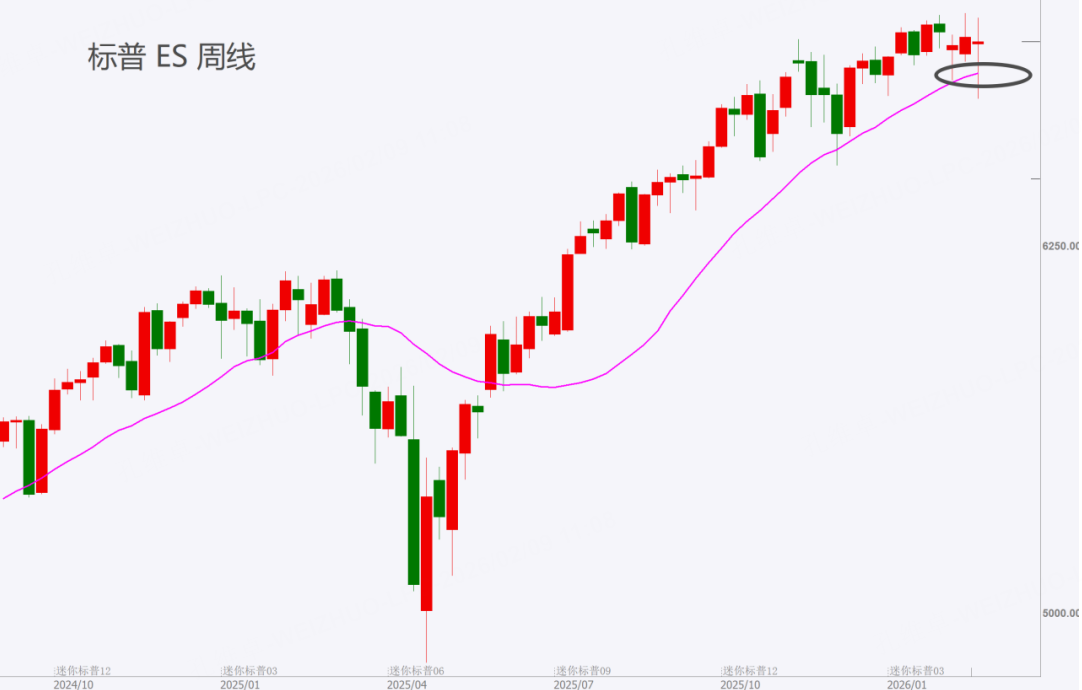
Technically, the S&P is still above its 20-week moving average, which means U.S. equity indices remain in an uptrend.If next week’s Nonfarm Payrolls and CPI data do not significantly exceed market expectations, U.S. equity indices are unlikely to see large swings.Given that the midterm elections are still some time away, even if U.S. equity indices do pull back, Trump has enough time to guide them back above the trend line.
Therefore, the fundamental backdrop for U.S. equity indices this year looks a bit better than it did at the same time last year.Based on historical statistics, the two to three quarters ahead of the midterm elections are the most negative period for U.S. equity indices.So, the current approach is still to use the 20-week moving average as the key reference; if it is broken, buy a small amount of put options as protection.Because U.S. equity indices have stayed choppy, the VIX has not risen, which suggests U.S. equity index options are relatively cheap right now.
That makes it more cost-effective to buy puts after a break below the moving average.
At the same time, because the market is in the February “sensitive window” for U.S. equity indices, owning options means you don’t have to fear a sudden, sharp reversal, which makes risk control easier.
$纳斯达克(.IXIC)$ $纳指100ETF(QQQ)$ $NQ100指数主连 2603(NQmain)$ $微型NQ100指数主连 2603(MNQmain)$ $标普500(.SPX)$ $标普500ETF(SPY)$ $SP500指数主连 2603(ESmain)$ $道琼斯指数主连 2603(YMmain)$ $微型道琼斯指数主连 2603(MYMmain)$ $道琼斯(.DJI)$
Have gold and silver stopped falling and bottomed?
Silver’s decline has been breathtakingly fast.While this has been relatively rare over the past decade, it is normal volatility for this type of speculative instrument.In moves like this, market sentiment can influence investors’ decisions more than fundamentals do: prices can rise quickly, and they can fall just as fast.From its high to last week’s low, silver has already retraced 47%.
Even though that number is large, historically silver capitulation can reach declines as deep as 75%, so it is still uncertain to declare a bottom at this point.Technically, despite the steep drop, the silver price is still above the 10-week moving average.So the key is whether silver can stabilize next week and stop falling; if it does, the moving average remains valid and you can continue to track it using the 10-week moving average.Short-term traders can also take a small position to buy a rebound, but the rebound is estimated to be about 50% of the prior decline (i.e., around a silver price of 89).Be sure to keep the position small to control mark-to-market volatility.
$白银主连 2603(SImain)$ $迷你白银主连 2603(QImain)$ $白银2603(SI2603)$ $2倍做多白银ETF-ProShares(AGQ)$ $白银ETF-iShares(SLV)$ $黄金主连 2604(GCmain)$ $微黄金主连 2604(MGCmain)$ $1盎司黄金主连 2604(1OZmain)$
Disclaimer: Investing carries risk. This is not financial advice. The above content should not be regarded as an offer, recommendation, or solicitation on acquiring or disposing of any financial products, any associated discussions, comments, or posts by author or other users should not be considered as such either. It is solely for general information purpose only, which does not consider your own investment objectives, financial situations or needs. TTM assumes no responsibility or warranty for the accuracy and completeness of the information, investors should do their own research and may seek professional advice before investing.
